
Are Businesses Paying for AI Productivity — Or Just AI Usage?
Nelspruit June09, 2026
Artificial intelligence is rapidly becoming part of everyday business operations.
Employees are using ChatGPT, Microsoft Copilot, and other AI productivity tools to draft emails, summarise meetings, analyse information, prepare reports, and support decision-making.
As AI adoption accelerates, organisations are spending more on AI subscriptions and licences than ever before.
However, a growing number of business leaders are beginning to ask a more important question:
Are we paying for genuine productivity improvements, or simply paying for AI usage?
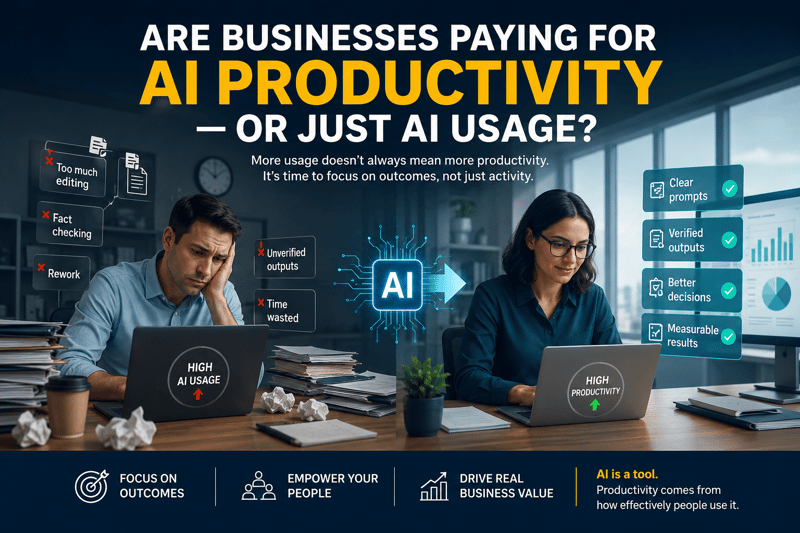
Many organisations can measure how often employees use AI.
Far fewer can measure whether AI is delivering meaningful business value.
“AI generates language — not truth. It can assist employees, but it cannot replace verification, judgement, and accountability,” says Arnold Muscat, Director of College Africa Group.
An employee may use AI dozens of times a day, but if the output still requires extensive correction, verification, rewriting, or rework, the expected productivity gains may never fully materialise.
AI Productivity Training Becomes a Business Priority
This is one of the reasons why AI Productivity Training is becoming a growing business priority.
While AI can generate content, summarise information, and provide suggestions within seconds, it does not automatically understand a company's goals, customers, compliance requirements, or operational realities.
Employees still need to know how to ask the right questions, verify responses, identify errors, and apply business judgement.
In many workplaces, the challenge is no longer gaining access to AI tools but ensuring employees know how to use them effectively.
Research, reports, proposals, spreadsheets, presentations, customer communications, and operational decisions all require human oversight.
AI can assist with the process, but accountability remains with the employee and the organisation.
Governance, Compliance and Human Oversight
This is particularly important in South Africa, where organisations must also consider POPIA, data protection, governance, and compliance requirements.
Employees need clear guidance on what information can be shared with AI platforms and how AI-generated outputs should be reviewed before being used in business operations.
As a result, many organisations are shifting their focus away from simply providing AI tools and towards building practical AI skills within their workforce.
“The organisations achieving the greatest return on AI investment are not necessarily those using the most AI. They are the organisations helping employees use AI effectively, safely, and with clear business objectives,” adds Muscat.
From Technology Adoption to Business Outcomes
The conversation around AI is gradually changing from technology adoption to business outcomes.
The question is no longer whether organisations should use AI.
The question is whether they are using it well enough to justify the investment.
“The goal should not be to use more AI. The goal should be to achieve better business outcomes. AI is a tool. Productivity comes from how effectively people use it,” says Muscat.
Businesses that want to improve AI adoption, productivity, governance, and employee AI skills should focus not only on technology but also on practical workplace training.
For more information visit https://collegeafricagroup.com/ai-in-the-workplace-training/ or contact College Africa Group on +27 (0) 83 778 4903.
About College Africa Group
College Africa Group (CAG) is a South African corporate training provider specialising in Microsoft Excel, Microsoft Project, AI Productivity Training, ChatGPT for Business, Microsoft Copilot Training, and workplace skills development.
Established in 2003, CAG delivers practical, business-focused training solutions to organisations throughout South Africa, helping employees improve productivity, decision-making, reporting, and workplace performance.
Release information
Issued on behalf of
College Africa Group
Media contact
College Africa Group
Arnold Muscat