
Are Your Employees Using Microsoft 365—or Just Using Office?
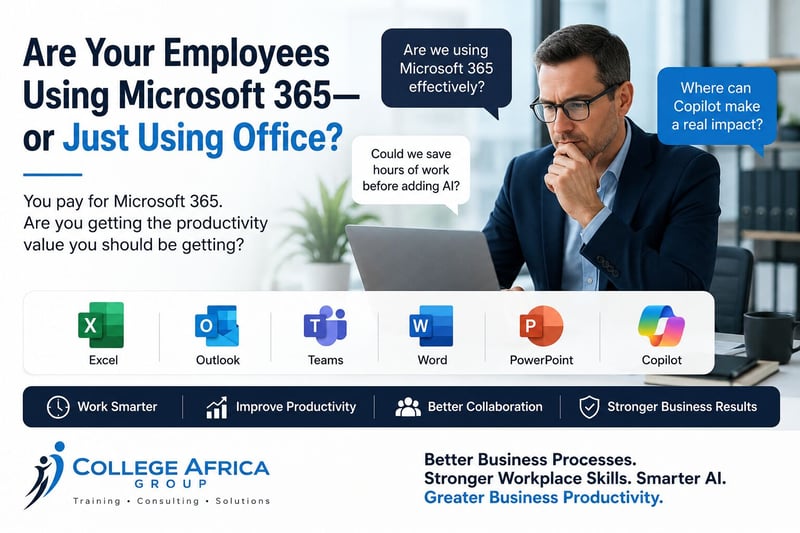
Your business pays for Microsoft 365.
But are your employees really using Microsoft 365—or are they still working exactly as they did when Microsoft Office was simply Word, Excel, Outlook and PowerPoint?
It is a question worth asking.
In many organisations, employees open Outlook in the morning, work in Excel throughout the day, prepare documents in Word and occasionally build a PowerPoint presentation.
They are using Microsoft 365 every day.
But that does not necessarily mean the business is getting the productivity value it is paying for.
The Software May Have Changed. Has the Way People Work?
Consider a typical finance department.
Someone receives information by email. They copy it into Excel. Another employee updates the spreadsheet. The spreadsheet is emailed to a manager.
Corrections come back by email, another version is created, and eventually somebody prepares the management report.
Microsoft 365 may be sitting underneath the entire process, but the process itself could be 10 or 15 years old.
That is the distinction executives need to recognise.
Having modern technology does not automatically create a modern workplace.
Before buying more software or adding more AI, businesses should understand how their employees are actually working.
Ask where:
- Information is being duplicated.
- People are manually copying data.
- Reports are taking hours or days to prepare.
- Employee time is disappearing into email.
- People are repeatedly searching for documents or the latest version of a file.
These are business-process questions before they are technology questions.
Excel Is a Good Place to Look
Microsoft Excel remains one of the most important business tools in South African organisations.
It is also an excellent example of the gap between having software and knowing how to use it effectively.
An employee may have used Excel for 15 years but still spend hours manually performing work that could be completed far more efficiently.
Modern Excel provides powerful tools for organising, analysing, validating and presenting business information.
Advanced Microsoft Excel skills can help:
- Reduce repetitive manual work.
- Improve reporting.
- Analyse information more efficiently.
- Reduce avoidable errors.
- Make better use of existing business data.
The same principle applies to Outlook.
Employees can spend a significant part of every working day reading, searching, filing, writing and responding to email.
Better use of Outlook can therefore have a direct impact on productivity.
These improvements may sound less exciting than artificial intelligence.
But they matter.
There is little value in adding AI to a workflow that employees have never learned to perform efficiently in the first place.
Microsoft 365 Is More Than a Collection of Applications
Microsoft 365 has increasingly become an integrated workplace environment.
Excel, Outlook, Word, PowerPoint and Teams do not have to operate as isolated applications.
Used effectively, Microsoft 365 can help employees:
- Share information more efficiently.
- Collaborate without constantly emailing documents.
- Manage documents centrally.
- Improve communication through Teams.
- Reduce unnecessary duplication.
- Connect everyday work across Microsoft 365.
But businesses only receive that value when employees understand the tools and when those tools are incorporated into sensible business processes.
This is why workplace skills remain important even as artificial intelligence becomes more capable.
Better technology does not eliminate the need for better skills. In many cases, it increases it.
Then Comes Microsoft Copilot
Microsoft Copilot adds another layer to the Microsoft 365 environment.
It can assist employees with:
- Drafting and summarising Outlook emails.
- Preparing and reviewing Word documents.
- Supporting Excel analysis.
- Creating PowerPoint presentations.
- Summarising Teams meetings and discussions.
- Finding and organising information across Microsoft 365.
That creates significant opportunities.
It also creates a management challenge.
If an employee already spends too much time following an inefficient process, giving that employee AI may simply help them perform the inefficient process faster.
The better starting point is to understand the work.
An AI Workflow Discovery or business-process review can identify:
- Where employees are losing productive time.
- Which tasks are unnecessarily repetitive.
- Where Microsoft 365 is being underused.
- Which processes should be improved before introducing AI.
- Where Microsoft Copilot or ChatGPT could create measurable value.
Only then does the question become which technology is appropriate.
Measure the Productivity, Not the Technology
Executives do not need employees to use more Microsoft features simply because those features exist.
They need better business outcomes.
For example, can:
- A monthly report that currently takes two days be completed in two hours?
- Managers receive useful information earlier?
- Employees reduce unnecessary email?
- Duplicated work be removed?
- Excel reporting become faster and more accurate?
- Teams collaborate without continually creating multiple versions of the same document?
- Microsoft Copilot reduce repetitive administrative work while employees remain responsible for checking the result?
Those are far more useful measures of Microsoft 365 adoption than counting how many applications employees have opened.
AI outputs must also be validated.
Copilot and ChatGPT can assist employees, but professional judgement and accountability remain human responsibilities.
AI produces language. People remain responsible for decisions.
Perhaps the Question Has Changed
For years, businesses asked whether employees knew Microsoft Office.
That question is becoming outdated.
The better question is whether employees have the workplace skills to use Microsoft 365, Advanced Microsoft Excel, Outlook, Teams and emerging tools such as Microsoft Copilot as part of an efficient business process.
Improving that environment might involve:
- Reviewing existing business processes.
- Identifying inefficient workflows.
- Strengthening Advanced Microsoft Excel and Microsoft 365 skills.
- Improving the way Outlook and Teams are used.
- Identifying appropriate Microsoft Copilot and ChatGPT opportunities.
- Introducing sensible AI governance and human validation.
- Measuring whether the changes actually improve business productivity.
College Africa Group approaches technology from that perspective.
Start with the business objective and understand how the work is currently being done. Improve the process where necessary. Strengthen the workplace skills employees already need.
Then determine where Microsoft 365, Microsoft Copilot, ChatGPT and other AI tools can deliver measurable value.
Because the objective is not to get employees to use more technology.
The objective is to get better results from the technology the business already has.
Better Business Processes. Stronger Workplace Skills. Smarter AI. Greater Business Productivity.
Get More Value from Microsoft 365
If your organisation is already paying for Microsoft 365, the question is simple: are you getting the productivity value you should be getting from it?
College Africa Group can help you identify opportunities to:
- Improve existing business processes and workflows.
- Strengthen Microsoft Excel, Outlook and Microsoft 365 skills.
- Identify where Microsoft Copilot and ChatGPT can save productive time.
- Reduce repetitive and unnecessary work.
- Introduce AI with appropriate human validation and governance.
- Measure the resulting improvement in business productivity.
Contact College Africa Group to discuss how your employees are currently working—and where Microsoft 365, stronger workplace skills and AI could deliver greater business value.
Better Business Processes. Stronger Workplace Skills. Smarter AI. Greater Business Productivity.