
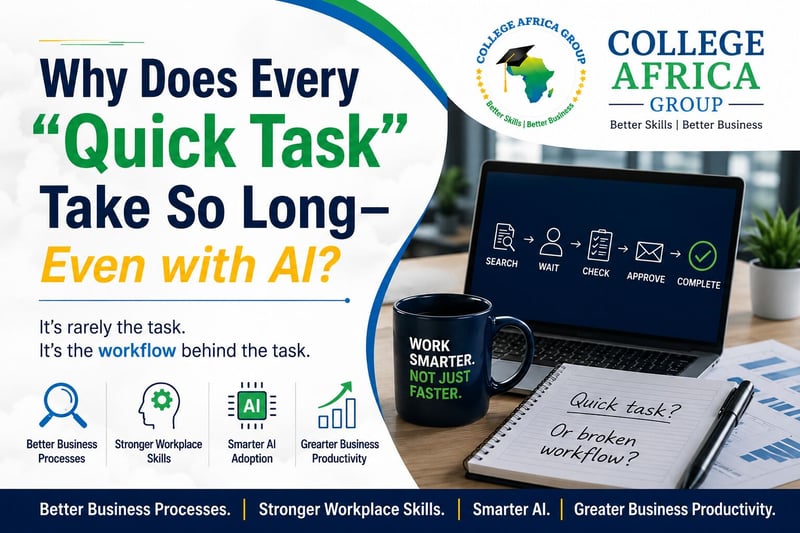
Why Does Every "Quick Task" Take So Long—Even with AI?
Johannesburg, August 04, 2026
Every organisation has them.
The email that should take five minutes.
The report that only needs "a quick update."
The customer proposal that "just needs a few small changes."
The spreadsheet that "only needs one number changed."
Yet somehow these simple tasks consume half an hour—or sometimes an entire morning.
The frustrating reality is that even with AI, many employees still spend large parts of their day chasing information.
Searching emails, locating the latest version of a document, checking figures, asking colleagues for clarification and validating AI-generated content before they can complete what should have been a simple piece of work.
The task was never the problem.
The workflow was.
The Hidden Cost of "Quick Tasks"
Most organisations don't lose productivity through major system failures.
They lose it through thousands of small interruptions every day.
Employees constantly switch between Outlook, Teams, Excel, Word, shared drives, business systems and AI tools.
Every interruption breaks concentration and adds time that rarely appears on a timesheet but significantly impacts business performance.
A five-minute task often becomes a thirty-minute process because employees must first find information, verify it, obtain approvals, correct errors and ensure nothing has been missed.
These hidden delays quietly reduce productivity across the organisation.
Muscat Says – Arnold Muscat, Managing Director, College Africa Group
"I've learnt that productivity problems rarely begin with technology—they begin with the way work flows through a business.
AI is a powerful enabler, but the biggest gains come from improving business processes first and then equipping people with the right workplace skills.
AI Doesn't Automatically Fix Broken Processes
Many organisations believe that introducing AI will immediately eliminate these delays.
It won't.
Artificial intelligence can generate emails, summarise meetings, analyse data and draft reports remarkably quickly.
However, AI cannot fix unclear business processes.
If employees don't know where information is stored, who owns the process, which document is the latest version or what approval is required.
AI simply produces work faster within the same inefficient workflow.
Technology accelerates the process.
It does not redesign it.
The Better Question Executives Should Be Asking
Rather than asking:
"Which AI tool should we buy next?"
Leaders should ask:
Why does this task require so many steps?
Where does work stop waiting for people?
Which activities add no real business value?
Which repetitive tasks could be simplified?
Do employees have the workplace skills to use AI effectively?
These questions often reveal far greater productivity opportunities than purchasing another piece of software.
Start with Workflow Discovery
Before implementing AI at scale, organisations should understand how work actually moves through the business.
This is where AI Workflow Discovery becomes valuable.
By mapping everyday business activities, organisations can identify:
Repetitive manual work.
Duplicate data entry.
Reporting bottlenecks.
Approval delays.
Poor information flow.
Opportunities where AI can create measurable business value.
Only once the workflow is understood does technology deliver its greatest return.
Strong Workplace Skills Still Matter
AI is becoming part of everyday business life, but it cannot replace strong workplace capability.
Employees still need practical skills in:
Advanced Microsoft Excel
Microsoft Outlook
Microsoft Teams
Microsoft Word
Microsoft PowerPoint
Microsoft 365
When these core workplace skills are combined with ChatGPT and Microsoft Copilot, employees become significantly more productive because they understand both the business process and the technology supporting it.
AI Requires Human Judgement
One of the biggest misconceptions surrounding AI is that it removes the need for human involvement.
In reality, AI increases the importance of professional judgement.
AI can draft a report.
It cannot determine whether the conclusions are correct.
AI can generate a spreadsheet formula.
It cannot understand the commercial implications of incorrect data.
AI can summarise a meeting.
It cannot decide which action is strategically important.
As organisations adopt AI more widely, human validation, governance and accountability become even more critical.
After all:
AI produces language. People remain responsible for decisions.
Better Questions Lead to Better Productivity
The next time someone says a task will "only take five minutes," ask a different question.
How many systems, approvals and manual steps are hiding behind that five-minute request?
The answer often explains why teams remain busy despite investing in modern technology.
Real productivity improvements rarely begin with software.
They begin by understanding the way work actually happens.
About College Africa Group
College Africa Group helps organisations improve productivity through:
AI Consulting Services
AI Workflow Discovery
Advanced Microsoft Excel Training
Microsoft Copilot Training
ChatGPT for Business Training
Microsoft 365 workplace skills
Responsible AI adoption and governance
Rather than simply introducing new technology, we help organisations improve business processes, strengthen workplace capability and identify where AI can deliver measurable business value.
Call to Action
If your organisation is still wondering why simple tasks consume so much time, now is the right moment to look beyond software.
Book an AI Workflow Discovery session with College Africa Group, speak to one of our AI Consultants, or explore our Advanced Microsoft Excel, ChatGPT for Business, and Microsoft Copilot Training programmes to help your teams work smarter—not simply faster.
Better Business Processes. Stronger Workplace Skills. Smarter AI. Greater Business Productivity.
Release information
Issued on behalf of
COLLEGE AFRICA GROUP
Media contact
COLLEGE AFRICA GROUP
A MUSCAT