
Is AI Really Your Biggest Productivity Opportunity?
Sandton, July, 16, 2026
Every week, organisations invest in new AI tools hoping to unlock dramatic productivity gains.
Yet many discover that the promised improvements never materialise.
The reason is surprisingly simple: AI productivity depends on the quality of the underlying business processes.
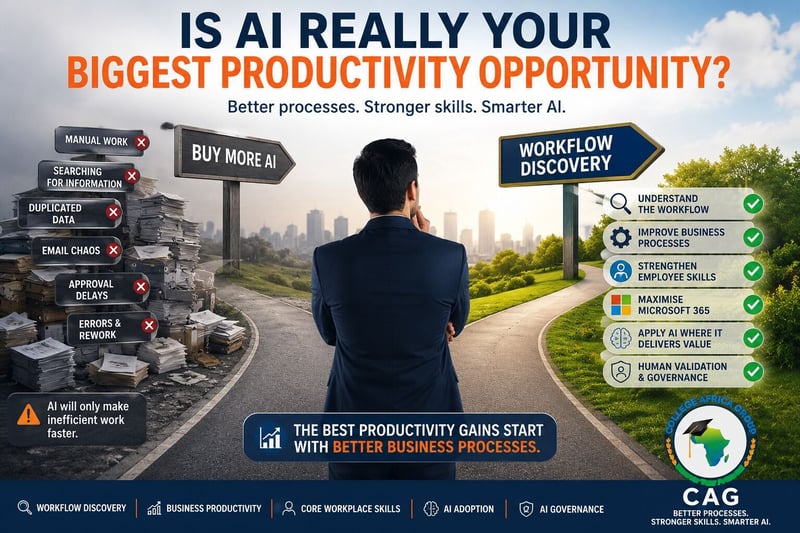
If employees spend hours searching for information, waiting for approvals, correcting errors or duplicating work. AI simply helps them perform inefficient work faster.
Many organisations have become so focused on selecting AI software that they have overlooked a more important question.
How does work actually move through the business?
Why Workflow Discovery Matters
This is where workflow discovery becomes critical.
Rather than asking which AI platform to purchase, business leaders should first understand how information flows from the initial customer request through to the final outcome.
Only then can they identify the delays, bottlenecks and manual activities that consume valuable employee time.
In many organisations, these hidden inefficiencies remain invisible because employees have gradually accepted them as "the way we work."
Hidden Productivity Losses
The result is often surprising.
Employees spend hours every week:
Searching for documents.
Re-entering information into multiple systems.
Waiting for approvals.
Copying data between applications.
Producing reports manually.
Following up on emails.
Correcting avoidable errors.
These activities rarely appear in management reports, yet they quietly reduce productivity across the organisation.
AI cannot eliminate problems that have never been identified.
That is why leading organisations are increasingly beginning with workflow discovery before investing heavily in artificial intelligence.
Asking Better Questions
Once the workflow is understood, businesses can ask much better questions.
Should this task be automated?
Can Microsoft 365 already solve this problem?
Would better Excel skills remove the bottleneck?
Can Microsoft Teams or Microsoft Loop improve collaboration?
Where would Microsoft Copilot or ChatGPT genuinely add value?
These questions lead to practical business improvements rather than technology-driven projects.
The biggest productivity gains frequently come from improving the process before introducing AI.
Improving Processes Before AI
For example, a finance department may spend several hours every month manually combining reports from different systems.
Before introducing AI, the organisation could redesign the reporting process using Microsoft Excel, Power Query and structured data.
AI can then assist with summarising trends, drafting management commentary and identifying anomalies instead of trying to compensate for poor reporting practices.
The same principle applies throughout the organisation.
Sales teams may lose time preparing quotations.
HR departments may manually process repetitive documents.
Operations teams may rely on email chains instead of structured workflows.
Project managers may spend hours consolidating status updates.
In each case, understanding the workflow usually delivers greater returns than immediately deploying another AI application.
A Practical Approach to AI Adoption
Successful AI adoption therefore follows a logical sequence:
Understand the workflow.
Improve the business process.
Strengthen employee skills.
Maximise Microsoft 365.
Introduce AI where it delivers measurable value.
Maintain human oversight and validation.
This approach reduces implementation risk while significantly increasing the return on AI investment.
Artificial intelligence is undoubtedly transforming the workplace.
However, organisations that achieve the greatest success recognise that AI is not the starting point.
Better business processes remain the true foundation of long-term productivity.
Businesses that invest time in understanding how work flows through the organisation are far more likely to achieve sustainable improvements than those that begin with technology alone.
As AI continues to evolve, executives should remember one important principle:
The greatest productivity opportunity may not be AI itself.
It may be discovering how work can be done better before AI is introduced.
Quote
"Many organisations believe AI will solve their productivity challenges. In reality, the greatest gains usually come from understanding how work flows through the business before introducing AI. Technology should improve good processes, not compensate for poor ones."
Arnold Muscat, Director, College Africa Group
About College Africa Group
College Africa Group helps organisations identify hidden productivity opportunities through AI Workflow Discovery, business process reviews and practical Microsoft 365 and AI consulting.
Before investing in more AI software, discover where your organisation is really losing time.
Visit https://www.collegeafricagroup.com or contact College Africa Group to arrange an AI Workflow Discovery session.
Google Business Profile Post
Is AI Really Your Biggest Productivity Opportunity?
Many organisations invest in AI expecting immediate productivity gains, but the biggest improvements often come from understanding and improving business processes first.
Our AI Workflow Discovery service helps organisations identify hidden inefficiencies before recommending AI, Microsoft 365 or automation solutions.
Contact College Africa Group to learn more.
Release information
Issued on behalf of
College Africa Group
Media contact
College Africa Group
A Muscat