
AI in Excel Is Growing Rapidly — But Human Validation Still Matters
Cape Town, June 11, 2026
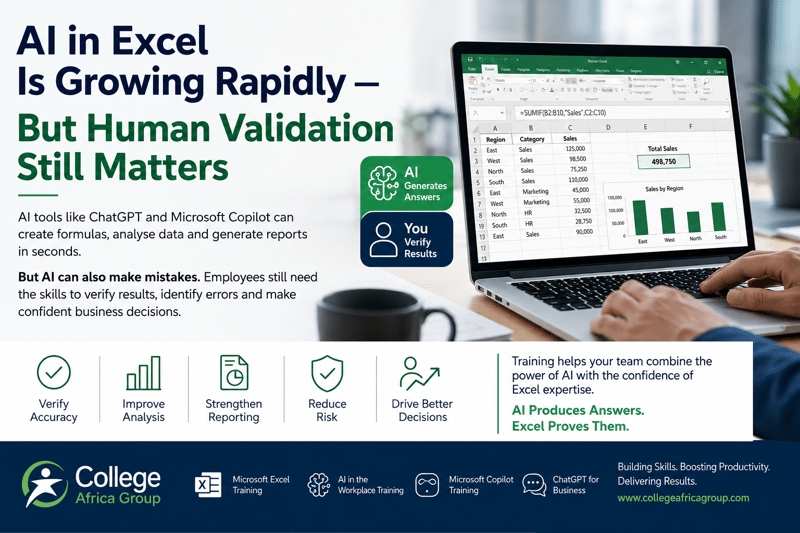
Artificial intelligence is changing how employees use Microsoft Excel. Tools such as ChatGPT and Microsoft Copilot can now generate formulas, explain functions, analyse data, identify trends and assist with report preparation in seconds.
As AI adoption accelerates, many organisations are discovering that while AI can improve productivity, it cannot replace human judgement.
According to Arnold Muscat, Director of College Africa Group, businesses should view AI as a productivity tool rather than a replacement for Excel skills.
"AI can generate formulas, analyse data and suggest solutions remarkably quickly. The challenge is knowing whether those outputs are correct. AI can assist with Excel, but employees still need the skills to validate results, identify errors and make informed business decisions."
Growing Interest in AI and Excel
Search interest in topics such as AI in Excel, ChatGPT Excel and Copilot Excel continues to grow as more employees look for ways to combine artificial intelligence with spreadsheet analysis and reporting.
While AI can significantly reduce the time required to create formulas and analyse information. It can also generate incorrect assumptions, inappropriate formulas and misleading conclusions if outputs are accepted without verification.
This creates a new challenge for organisations.
The Risks of Unverified AI Outputs
In many workplaces, employees are already using AI to generate spreadsheet formulas, analyse sales data, prepare management reports and identify trends.
While these tools can save considerable time, incorrect formulas, flawed assumptions or misinterpreted data can lead to reporting errors, poor decisions and costly rework.
Finance teams may rely on AI-generated calculations that have not been properly validated.
Managers may make decisions based on inaccurate summaries.
Administrative staff may produce reports containing errors that are difficult to identify without a solid understanding of Excel and data analysis.
The Importance of Training
Effective training helps employees understand both the opportunities and limitations of AI in Excel.
By combining AI tools with strong spreadsheet skills, employees are better equipped to verify outputs, identify potential errors and use AI-generated information responsibly.
Organisations that invest in both AI adoption and employee training are more likely to achieve meaningful productivity gains while reducing the risks associated with inaccurate or unverified information.
Areas Where Validation Remains Essential
Examples where validation remains essential include:
- Formula accuracy
- Data analysis
- Financial reporting
- Dashboard development
- Trend analysis
- Management reporting
- Business forecasting
Excel Skills Remain Critical
Muscat believes that Advanced Excel skills remain highly relevant despite rapid advances in AI technology.
"The most valuable Excel skill in the AI era may no longer be creating formulas. It may be validating whether AI-generated formulas, analysis and reports are correct. AI produces answers. Excel professionals still need to prove them."
As organisations continue investing in artificial intelligence, the combination of AI tools and strong Excel skills is likely to become a significant competitive advantage.
Employees who can effectively combine AI productivity with human judgement, validation and analytical thinking are expected to deliver the greatest value.
The message for business leaders is simple. AI can accelerate spreadsheet work. Human expertise remains responsible for the outcome.
About College Africa Group
College Africa Group (CAG) provides Microsoft Excel training, AI in the Workplace training, Microsoft Copilot training, ChatGPT for Business programmes and workplace productivity solutions throughout Southern Africa.
For more information about Microsoft Excel Training, AI in the Workplace Training and Microsoft Copilot Training, visit https://www.collegeafricagroup.com or contact Arnold Muscat on +27 (0) 83 778 4903.
Release information
Issued on behalf of
College Africa Group
Media contact
Cllege Africa Group
Arnold Muscat