
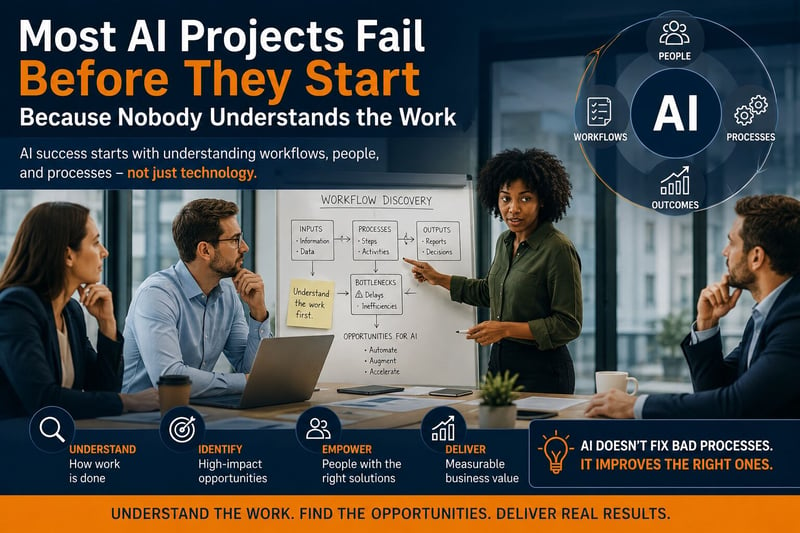
Most AI Projects Fail Before They Start Because Nobody Understands the Work
Sandton, June 27, 2026
Organisations across South Africa are investing heavily in artificial intelligence technologies such as ChatGPT, Microsoft Copilot and other AI-powered tools. Yet despite growing investment, many AI initiatives fail to deliver the productivity improvements, efficiency gains and business outcomes that leaders expect.
The reason is often not the technology itself. It is because organisations attempt to implement AI before they fully understand how work is actually performed.
Many AI projects begin with software selection, licence purchases and training programmes. What is often missing is a clear understanding of employee workflows, business processes and the daily activities that consume time and resources.
According to Arnold Muscat, Director of College Africa Group, this is one of the biggest reasons AI initiatives struggle to achieve meaningful results.
"The biggest mistake organisations make is starting with the AI tool instead of the work itself. When you understand how employees spend their time, where bottlenecks exist and which tasks are repetitive, the opportunities for AI become much clearer."
Arnold Muscat, Director, College Africa Group
Technology Cannot Fix a Process Nobody Understands
Many organisations assume that AI will automatically improve productivity once employees have access to the latest tools. However, AI can only improve a process if the process itself is understood.
If organisations do not know how information moves through the business, where delays occur, which tasks are repeated, or how decisions are made, it becomes difficult to identify where AI can create value.
As a result, employees often receive generic AI training but struggle to apply what they have learned to their actual jobs.
The outcome is predictable.
Licences are purchased.
Training is completed.
Interest is high.
But adoption remains low and measurable business benefits fail to materialise.
Every Role Has Different AI Opportunities
One of the most common mistakes in AI adoption is treating all employees the same.
Different roles perform different types of work and therefore require different AI solutions.
A SHEQ manager may spend significant time reviewing compliance documentation, preparing audit reports and maintaining safety records.
An executive assistant may spend much of the day coordinating meetings, managing communications and preparing executive reports.
A project controls specialist may focus on analysing project data, preparing schedules and generating performance reports.
Although all three employees may use the same AI platform, the workflows, challenges and opportunities are entirely different.
Understanding these differences is critical to successful AI adoption.
The Greatest Opportunities Are Often Hidden
Many organisations focus on obvious use cases such as generating emails or creating content. While these activities can provide value, the largest productivity gains are often found elsewhere.
Common opportunities include:
Document review and comparison
Information retrieval and research
Report preparation
Meeting administration
Action tracking
Compliance documentation
Data consolidation
Email management
Knowledge management
First-draft document creation
These opportunities are rarely identified through software demonstrations alone. They are discovered by observing how work is actually performed.
Workflow Discovery Before AI Deployment
Leading organisations are increasingly adopting a discovery-first approach to AI implementation.
Rather than immediately rolling out technology, they begin by understanding:
What employees do each day
Which tasks consume the most time
Where bottlenecks occur
Which activities are repetitive
What information employees require
Which outputs must be produced
Where human judgement remains essential
This process helps organisations identify realistic AI opportunities and avoid investing time and money in solutions that fail to address real business challenges.
AI Adoption Requires Business Understanding
AI initiatives are often viewed as technology projects. In reality, they are business improvement projects.
Successful adoption requires an understanding of people, processes, governance, risk management and organisational objectives.
Technology is only one part of the equation.
Without workflow analysis and business process understanding, organisations risk implementing AI without a clear purpose or measurable outcome.
Human Judgement Still Matters
While AI can assist with drafting, summarising, analysing and organising information, it cannot replace accountability.
Employees remain responsible for validating outputs, exercising professional judgement and ensuring that decisions align with business objectives, policies and regulatory requirements.
The organisations achieving the greatest success with AI are not removing people from processes. They are helping people work more effectively.
Understanding the Work Before Choosing the Tool
As AI adoption continues to accelerate, organisations that achieve meaningful results are increasingly focusing on workflow discovery before technology deployment.
Instead of asking:
"Which AI tool should we buy?"
They are asking:
"How is work performed today, and where can AI create the greatest business value?"
That shift in thinking often makes the difference between an AI initiative that delivers measurable productivity improvements and one that becomes another underutilised technology investment.
About College Africa Group
College Africa Group provides AI strategy consulting, AI readiness assessments, workflow discovery services, Microsoft Copilot training and ChatGPT training to organisations across South Africa.
The organisation helps businesses identify practical opportunities for AI adoption, improve productivity and develop governance frameworks that support responsible AI use.
For more information, visit: https://collegeafricagroup.com/ai-strategy-consultant-south-africa/