
AI in the Workplace Is Accelerating — But Most South African Businesses Still Lack Structured Training
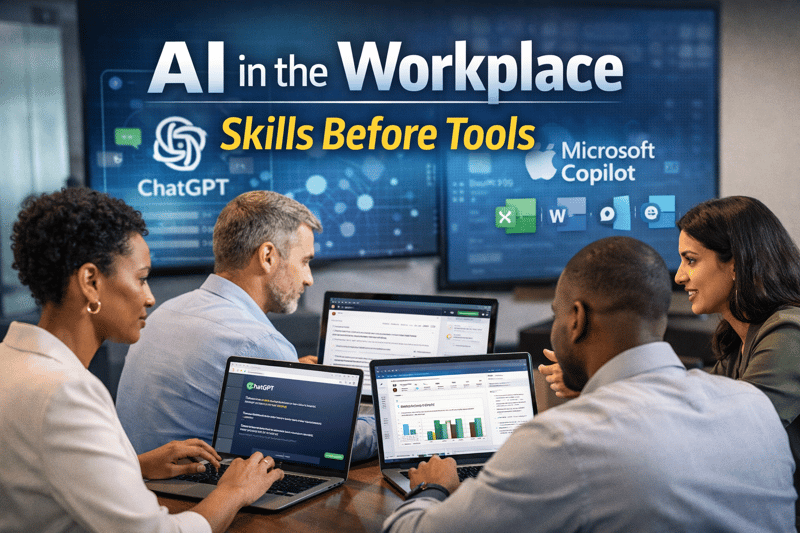
Durban, April 17, 2026 As artificial intelligence adoption accelerates across South African organisations, a growing gap is emerging between access to AI tools and the ability to use them effectively in the workplace.
According to College Africa Group (CAG), many businesses are already using tools such as ChatGPT and Microsoft Copilot, but without structured training, governance, or a clear understanding of risk.
“AI produces language — not truth. That is the most important concept businesses need to understand before integrating AI into decision-making processes,” says Arnold Muscat, Director at CAG.
The Risk Confident Outputs Unverified Results
While AI tools can generate reports, emails, policies, and analysis in seconds, they often present outputs with high confidence — regardless of accuracy.
This creates several business risks:
Incorrect financial or operational decisions
Misleading HR or legal documentation
Reputational damage from inaccurate communication
Over-reliance on AI without verification processes
Many organisations assume that AI tools “know” the answer. In reality, they generate responses based on patterns — not verified facts.
The Reality AI Adoption Is Outpacing Skills Development
Across sectors including finance, HR, and administration, AI usage is growing rapidly. However, structured training is not keeping pace.
Common workplace patterns include:
Employees experimenting with AI without guidance
Inconsistent prompting and poor-quality outputs
Lack of governance or usage policies
No alignment between departments on AI usage
This results in fragmented adoption rather than measurable productivity gains.
Where Businesses Are Getting It Right
Organisations that are successfully integrating AI into the workplace are taking a structured approach:
Establishing a foundation understanding of AI tools
Training teams on prompting techniques and output verification
Defining clear governance and acceptable-use policies
Aligning AI usage with business objectives and workflows
Rather than focusing on the tool itself, these organisations focus on how AI is used in a business context.
ChatGPT Vs Copilot Tool Choice Vs Business Understanding
There is increasing debate around whether businesses should adopt ChatGPT or Microsoft Copilot. However, this is often the wrong starting point.
ChatGPT is a flexible, standalone AI tool used across multiple functions
Microsoft Copilot operates within Microsoft 365 applications such as Excel, Word, Outlook, and Teams
The core skills required to use both effectively remain the same:
Clear instruction (prompting)
Critical thinking and verification
Understanding limitations and risk
“The software matters less than the skill. Businesses that focus only on the tool often miss the bigger picture,” Muscat adds.
AI Will Not Replace Jobs But It Will Change Them
A key concern among employees is whether AI will replace roles. Current evidence suggests a different outcome.
AI is not replacing jobs — it is reshaping how work is performed. Employees who understand how to use AI effectively are becoming more productive, while those without these skills risk falling behind.
This shift is particularly relevant in:
Finance and reporting
HR and policy development
Administrative and operational roles
The Way Forward Structured AI Training
To bridge the gap between AI adoption and effective use, businesses are increasingly investing in structured training programmes.
CAG’s approach focuses on:
AI in the Workplace (Core Foundation)
Practical use of AI tools in business scenarios
Risk awareness and governance
Role-based application across departments
This ensures that organisations move beyond experimentation toward controlled, value-driven AI adoption.
About College Africa Group
College Africa Group (CAG) is a South African corporate training provider established in 2003. The organisation specialises in Microsoft Office, Excel, and AI training for corporate teams, with a focus on practical, workplace-ready skills.
Media Contact
College Africa Group
📞 +27 (0) 83 778 4903
📧 This email address is being protected from spambots. You need JavaScript enabled to view it.
🌐 https://www.collegeafricagroup.com
Release information
Issued on behalf of
College Africa Group
Media contact
College Africa Group
Arnold Muscat