
Plastics SA AGM highlights industry resilience and priorities for growth
South Africa’s plastics industry continues to invest, innovate and advance circularity despite difficult economic conditions. This was the message from Plastics SA’s recent Annual General Meeting, which reviewed the 2025/2026 year and highlighted priorities for strengthening local manufacturing, improving waste management and developing skills.
“The past year has reinforced both the resilience of South Africa’s plastics industry and the scale of the transition taking place around us. As a significant employer, manufacturer and contributor to the economy, our industry has an important role in growth, localisation, investment and job creation,” said Anton Hanekom, Executive Director of Plastics SA.
Supporting a competitive local industry
Globally, the sector faces growing regulatory pressure, public scrutiny and demands to accelerate the transition towards circularity. In South Africa, these challenges are compounded by weak economic growth, rising operational costs, increasing imports and infrastructure constraints that continue to place local manufacturers under pressure.
Volatile polymer and energy prices and supply constraints further underline the need for a resilient local manufacturing base supported by appropriate policy, skills, investment and reliable infrastructure.
Advancing recycling and circularity
Despite these challenges, Hanekom reported that there is much to celebrate. During 2025, South Africa mechanically recycled 485 000 tonnes of plastics, achieving an overall plastics output recycling rate of 30.1%. Domestic recyclate consumption has grown by 62% over the past decade, reflecting an industry that continues to invest and innovate in the face of difficult conditions.
These achievements reflect the commitment of recyclers, manufacturers, Producer Responsibility Organisations, waste pickers and others across the value chain. However, inadequate municipal collection, limited separation-at-source, contamination and inefficient sorting mean that valuable recyclable materials continue to be lost to landfill.
Explained Hanekom: “Simply put, recyclers cannot recycle material they do not receive. Strengthening collection infrastructure, supporting recyclers and stimulating demand for recycled content must remain national priorities.”
Science and skills to guide future progress
Plastics protect food, support healthcare, enable safe water and sanitation, improve agricultural productivity and provide durable solutions for construction and transport. At the same time, the industry recognises the urgent need to prevent plastic waste from entering the environment and to use resources more efficiently.
“Our role is to advocate for the best material for the job, based on its performance and total environmental impact across its life cycle,” Hanekom said.
Mechanical recycling remains the preferred route wherever technically and economically viable, although industry is also investigating complementary solutions for low-value and difficult-to-collect items.
“These innovations must be independently verified, appropriate to the intended application and compatible with existing waste and recycling systems,” Hanekom stressed, adding that options include advanced recycling, renewable material inputs and specialist additives or masterbatch technologies designed to support controlled biodegradation under defined conditions.
Developing skills remains equally important as experienced employees retire and manufacturing becomes more technical, digital and sustainability-focused. Plastics SA will continue advancing training, research, responsible production and cross-sector collaboration while advocating for balanced, workable policies.
Recognising longstanding board service
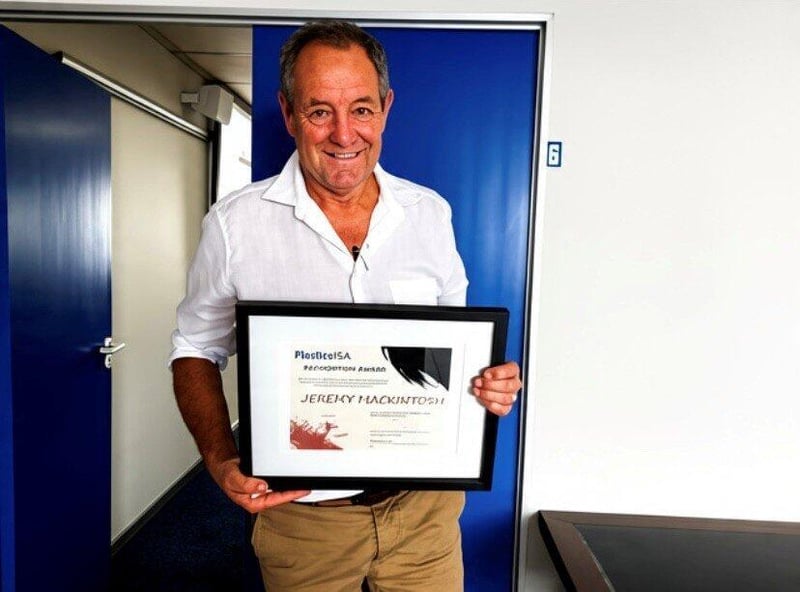
The AGM also marked the departure of Jeremy Mackintosh of Polyoak Packaging, who stepped down after six years as chairman. Having served on the Plastics SA board in various capacities since 2007, Mackintosh was recognised and thanked for his longstanding commitment to the organisation and the industry it represents.
Paying tribute to Mackintosh, Hanekom said: “Jeremy has faithfully served Plastics SA with commitment and a deep understanding of our industry. His six years of service on the board as chairman, and before that as deputy chair, board member and two more staggered terms as Chairman, represent an exceptional contribution. We sincerely thank him for his leadership, guidance and dedication.”
Gerome Marrion of Sasol also stepped down from the board, with Bheki Gazu replacing him as the company’s representative. Plastics SA thanked Marrion for his contribution and welcomed Gazu.
The other board members are Gary Wiid (ARMSA), Mike Myers (EPSASA), Craig Matthews (PCASA), Bruce Naidoo (PISA), Mark Berry (SAFRIPOL), Jan Venter (SAPPMA), Johann Conradie (SAPRO), Malan Mudaly and Gregory Schneider (importers), Anton Hanekom (Plastics SA Executive Director) and Thokozani Masilela (DTIC). Mark Berry was appointed as the new Chairman for Plastics SA Board.
Looking ahead
“Despite the challenges, we remain confident in the future of South Africa’s plastics industry. Our sector is resilient, hardworking and innovative. With the continued support of our members and partners, we will build on the progress achieved, develop the skills our industry needs and strengthen local manufacturing. Together, we can grow a competitive, responsible and increasingly circular plastics industry that creates jobs and delivers lasting value to South Africa,” Hanekom concluded.
Release information
Issued on behalf of
Plastics SA
Media contact
Aim Marketing & Communications Consultants
Keaoleboha Sefako