
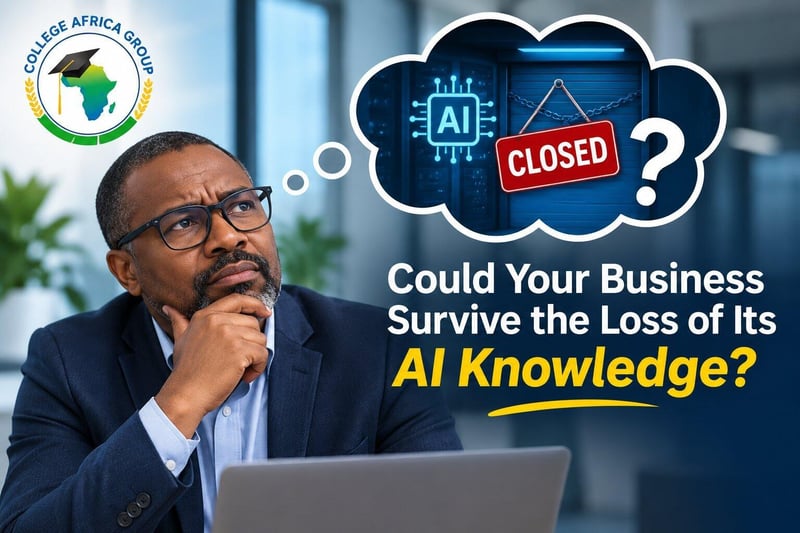
Could Your Business Survive the Loss of Its AI Knowledge?
Durban, November 28, 2026
CAG Executive Question of the Week
If your preferred AI provider ceased operations tomorrow, how much of your accumulated business knowledge could you transfer to another AI platform without starting again?
Businesses are increasingly using artificial intelligence to develop corporate strategies, training programmes, policies, business processes, marketing content and operational procedures.
Over time, employees build sophisticated prompts, customised AI environments and extensive libraries of business knowledge. Each interaction can contribute to a growing collection of valuable corporate intellectual property (IP).
But where is that intellectual property being stored, and how easily could the business recover it?
The Emerging Risk of AI Dependency
Businesses have traditionally understood the importance of backing up financial records, customer databases, operational documents and other critical business information.
However, the same discipline needs to be applied to knowledge developed through artificial intelligence.
Consider an organisation that has spent several years developing its AI capabilities. Its accumulated intellectual property could include:
Corporate methodologies and business frameworks.
Master prompts and customised AI instructions.
Training programmes and operational procedures.
Marketing strategies and approved content.
Business process improvements.
Industry-specific knowledge and research.
Lessons learned from previous AI interactions.
Corporate policies and decision-making frameworks.
Much of this information may exist within AI conversations, customised assistants, projects and platform-specific memory.
If an AI provider closes, discontinues a service, changes its commercial model or restricts access, recovering and transferring that knowledge could become a significant business challenge.
Even when information can be exported, reconstructing the working AI environment may require considerable time and effort.
Own Your Knowledge. Rent Your Intelligence.
“Businesses should never have to rebuild years of accumulated intellectual property simply because they change AI providers. Your corporate knowledge should belong to your business, not be dependent on the AI platform you use. AI providers may come and go, but your intellectual property must remain accessible, transferable and under your control.”
— Arnold Muscat, Director, College Africa Group (CAG)
College Africa Group believes businesses should consider separating their corporate intellectual property from the AI platforms they use.
The principle is relatively simple: maintain a structured, company-controlled knowledge repository outside the AI platform.
This could be established using Microsoft SharePoint, OneDrive, Google Drive or another appropriately secured corporate storage environment.
Rather than leaving valuable intellectual property scattered across hundreds of AI conversations, businesses should consolidate approved knowledge into structured reference documents.
These documents become the permanent corporate knowledge base, while artificial intelligence becomes a tool that works with that knowledge.
Putting the Principle Into Practice
College Africa Group has been developing its own independent intellectual property repository.
Rather than relying exclusively on the memory of a particular AI platform, CAG maintains structured reference documents covering areas such as:
Business productivity methodologies.
AI Workflow Discovery frameworks.
Corporate content and approved language.
Master AI prompts and operating instructions.
Productivity measurement methodologies.
Content quality standards.
SEO and AI visibility strategies.
The objective is to make this knowledge reusable across different AI environments, including ChatGPT, Microsoft Copilot, Claude and Google Gemini.
Where supported, an AI platform can be directed to the relevant external folder or knowledge repository. Alternatively, approved reference documents can be supplied directly to the platform.
This approach reduces the need to repeatedly teach different AI systems the same business principles, methodologies and requirements.
It also allows organisations to evaluate alternative AI providers without necessarily rebuilding their entire knowledge base.
Intellectual Property Protection Is a Management Responsibility
Establishing an independent repository is only part of the solution.
Businesses should also consider:
Ownership and responsibility for maintaining corporate knowledge.
Document version control and approval procedures.
Regular backups and recovery testing.
Employee access permissions.
Confidentiality and POPIA compliance.
Compatibility with alternative AI platforms.
An independent repository will not automatically reproduce every AI conversation, memory, integration or customised configuration. Businesses must deliberately identify and preserve the knowledge that matters.
The objective is not to eliminate reliance on technology but to reduce unnecessary dependency on any single provider.
AI Business Continuity Should Form Part of Corporate Strategy
As organisations prepare their AI strategies for 2027, management should consider intellectual property portability alongside productivity, security, governance and return on investment.
The value of artificial intelligence extends beyond the answers it generates. It also lies in the business knowledge, methodologies and improved processes developed through its use.
That knowledge should remain accessible to the organisation, regardless of which AI platform it chooses tomorrow.
The College Africa Group Perspective
College Africa Group encourages businesses to evaluate their AI adoption strategies from a broader business productivity and governance perspective.
Through its AI Workflow Discovery services, CAG helps organisations examine existing business processes, identify productivity opportunities and determine how workplace skills, Microsoft 365, automation and artificial intelligence can support sustainable business improvement.
AI platforms will continue to evolve. Providers may change, new competitors will emerge, and existing technologies may eventually be replaced.
Your corporate intellectual property should outlive your AI provider.
Release information
Issued on behalf of
College Africa Group
Media contact
College Africa Group
Arnold Muscat