
Who Really Controls Your Business Knowledge — You or Your Cloud Provider?
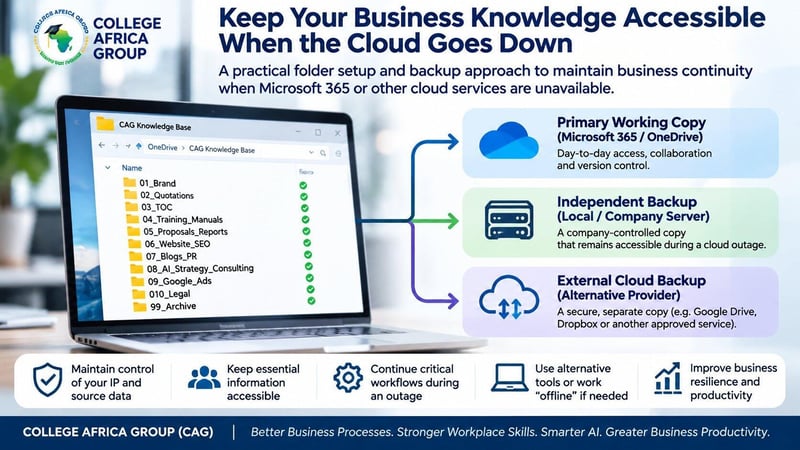
The recent Microsoft 365 disruption has raised an uncomfortable question for business leaders: if your organisation cannot access its information when a cloud platform fails, how much control does it really have over its business knowledge?
Across South Africa, businesses increasingly rely on Microsoft 365, OneDrive, SharePoint, ChatGPT and Microsoft Copilot to store information, manage operations and produce essential business documents.
These technologies have transformed workplace productivity. Employees can collaborate across locations, automate repetitive tasks, analyse financial information and generate reports faster than ever before.
But the November 2026 Microsoft 365 disruption exposed a business continuity risk that many organisations may not have adequately considered.
What happens when the information your employees need is temporarily inaccessible?
The Difference Between Owning Information and Controlling Access
A company may legally own its documents, financial models, customer information, procedures and intellectual property.
However, ownership does not guarantee immediate access.
When business information exists exclusively within a cloud application, an AI conversation or an online storage environment, access may depend on the availability of that provider's infrastructure.
For Arnold Muscat, Director of College Africa Group (CAG), this distinction deserves greater attention from business executives.
"Businesses are investing heavily in AI and cloud technology, but they should be asking a more fundamental question: if that technology becomes unavailable tomorrow, can our employees still access the information they need to operate?"
Muscat believes organisations should treat their business knowledge as an independent corporate asset rather than something inseparable from the software used to create it.
Your AI Outputs Are Becoming Part of Your Intellectual Property
Artificial intelligence is increasingly used to prepare proposals, analyse spreadsheets, develop business procedures, produce training materials and support management decisions.
Much of this work represents valuable organisational knowledge.
Yet employees may leave important information inside ChatGPT conversations, Copilot interactions or individual accounts without transferring approved outputs into the organisation's own document management system.
This creates several practical risks.
Knowledge may become difficult to locate, important outputs may not be independently preserved, and employees may become dependent on particular applications to retrieve work they have already completed.
College Africa Group recommends that organisations establish a structured knowledge repository containing original source data, approved AI-generated outputs, templates, procedures and other essential intellectual property.
The repository should be organised according to business functions, with appropriate access controls, document ownership and version management.
Importantly, the original source information should be retained separately from AI-generated interpretations and summaries.
AI can help create business knowledge. It should not become the only place that knowledge exists.
Is OneDrive Alone Enough?
OneDrive and SharePoint provide valuable collaboration, synchronisation and document management capabilities.
However, they remain part of Microsoft's technology ecosystem.
An organisation that stores all its essential information exclusively in OneDrive may still face accessibility challenges during certain Microsoft service disruptions.
The answer is not to stop using OneDrive.
It is to establish an independent business continuity arrangement.
For example, a company could maintain its primary working documents in Microsoft 365 while keeping securely managed copies of critical information on a local company server, encrypted offline storage or an independent cloud provider.
These copies must be accessible without depending on the unavailable service, and their recovery procedures should be tested.
A synchronised folder alone should not be mistaken for a complete backup strategy. Accidental deletions, corrupted files and ransomware can also affect synchronised information.
Could Your Employees Continue Working Without AI?
There is another important consideration.
Even when information remains available, employees must possess the skills needed to use it.
A finance employee who understands Excel formulas, reporting procedures and data validation can continue important work without relying entirely on an AI assistant.
A project manager who understands scheduling principles can still review project information when automated tools are unavailable.
An HR team with access to approved templates and established procedures can continue essential administrative work.
Businesses may also consider alternative AI platforms, provided these are approved, operational and suitable for handling the relevant information.
However, switching AI providers is not always straightforward. Organisations must consider confidentiality, POPIA requirements, data access permissions and the accuracy of AI-generated outputs.
The strongest business continuity strategy combines accessible information, capable employees and documented alternative processes.
Five Questions Every Business Executive Should Ask
College Africa Group recommends that executives review the following:
Where are our original source documents, business procedures and intellectual property stored?
Are approved AI-generated outputs saved independently of the applications that produced them?
Can employees access essential information if Microsoft 365 or another cloud service becomes unavailable?
Do we maintain secure, tested backups outside our primary technology environment?
Can employees continue critical business processes manually or through alternative approved systems?
These questions should form part of a broader business process and productivity review.
Business Productivity Requires More Than Technology
College Africa Group's approach to workplace productivity begins with understanding business objectives and existing processes before recommending additional technology.
Microsoft 365, AI assistants and automation can improve productivity considerably, but they cannot replace sound information management, workplace skills and business continuity planning.
Organisations should identify critical workflows, determine which information those workflows require and ensure employees can continue essential activities when their preferred technology becomes unavailable.
As Muscat explains:
"The objective is not to become less dependent on technology by going backwards. It is to become more resilient by ensuring that our knowledge, skills and business processes remain under our control."
The recent Microsoft disruption should therefore prompt a broader executive discussion.
Who controls your business knowledge, and could your organisation continue operating if access to its primary cloud platform disappeared for a day?
For South African businesses investing in Microsoft 365 and artificial intelligence, the answer could reveal an important opportunity to strengthen operational resilience.
About College Africa Group
College Africa Group (CAG) is a South African corporate training and business productivity consulting provider established in 2003.
CAG specialises in AI Workflow Discovery, business process improvement, Microsoft 365, Microsoft Excel, ChatGPT, Microsoft Copilot and practical workplace skills development.
Through its process-first approach, CAG helps organisations identify productivity opportunities while maintaining appropriate human oversight, information management and business controls.
Learn more: AI Workflow Discovery South Africa
Release information
Issued on behalf of
College Africa Group
Media contact
College Africa Group
Arnold Muscat