
Why Do Our Year-End Numbers Never Match?
Johannesburg, November 14, 2026
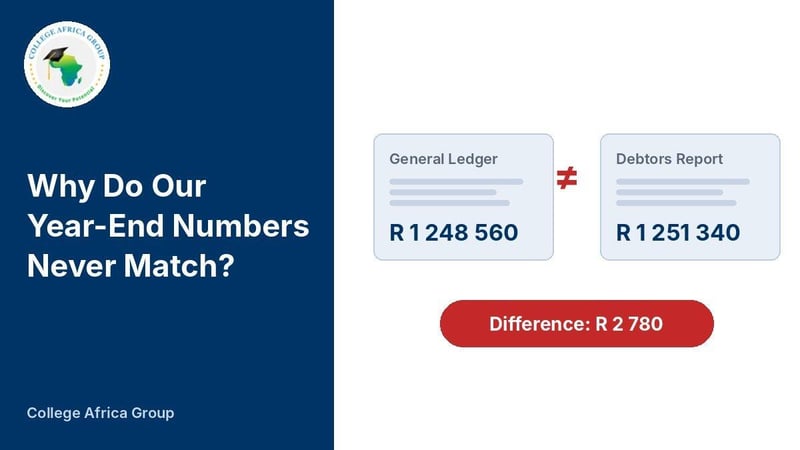
Every year, as December approaches, a familiar conversation takes place in finance offices across South Africa. The debtors' report shows one figure, the general ledger shows another, and the management pack circulated last month shows something different again.
Someone is asked to "find the difference", and a team that should be closing the year spends days tracing numbers back through spreadsheets instead.
For organisations with December or February year-ends, this is rarely a once-off. It happens every year and is quietly accepted as part of the process. That raises an uncomfortable question for any executive: if our numbers never match at year-end, how confident should we be in the numbers we relied on for decisions during the rest of the year?
Small errors, built up over twelve months
In College Africa Group's experience of training finance, reporting and operational teams, year-end differences are seldom caused by one large mistake.
They accumulate gradually. A SUM range stops one row short after new data is added. A figure is typed over a formula as a "temporary" fix and never reversed. A lookup returns the wrong match.
A copy of last month's file becomes the working version. Two departments use different cut-off dates for what is supposedly the same report. Each error is small. Together they turn the year-end into an investigation.
Research supports what many finance managers already suspect. Professor Raymond Panko of the University of Hawai'i, who has studied spreadsheet errors for decades, reports that audits of real-world operational spreadsheets found errors in 94% of the spreadsheets examined.
His conclusion is that the software is not the problem: people make errors, and spreadsheets that are not properly checked carry those errors forward into business decisions. (Source: Panko, "What We Don't Know About Spreadsheet Errors Today", https://arxiv.org/abs/1602.02601)
Why this matters beyond the finance department
Mismatched numbers are not simply an accounting inconvenience. Next year's budget is often built in the same workbooks. Pricing, stock orders, incentive payments and board reports may all rest on figures nobody has fully reconciled. Every hour spent finding a difference is also an hour not spent understanding what the numbers are telling the business.
AI raises the stakes further. Microsoft Copilot and ChatGPT can now write formulas and summarise a workbook in seconds, but they work with the data and structure they are given. Ask AI to summarise a workbook with a broken range and it will produce a confident answer from the wrong numbers.
"Most year-end reconciliation problems are not accounting problems. They are spreadsheet habits nobody checked during the year," says Arnold Muscat, Founder and Managing Director of College Africa Group. "AI can help you work faster, but someone in the team still has to know when the numbers are wrong. Fix the habits and the year-end becomes much shorter."
A practical response
The answer is not another round of checking in December. It is building reliability into the work throughout the year. College Africa Group applies a simple sequence: start with the source data, understand the process, define the required output, and only then decide which skills, tools or AI to apply, always validating the result against the source.
In practice, this usually means agreeing one source for each key figure rather than several competing copies, using Excel Tables and formulas that expand automatically as data grows, adding control totals and check cells that show immediately when two reports disagree, and setting a clear rule that formulas are never overwritten with typed values. J
Just as important, employees need the Excel skills to trace precedents, audit a workbook and explain how a number was produced.
None of this requires new software. It requires stronger workplace skills and better spreadsheet discipline. The result is a shorter year-end close, fewer unexplained differences, more reliable budgets and finance teams that spend their time analysing results rather than hunting for them.
Can you spot the problem?
To show how easily these errors hide, College Africa Group has published a short year-end reconciliation exercise as part of its Weekly Workplace Skills Challenge. t
The workbook contains a summary whose totals do not agree with the detail. Readers are invited to find the problems themselves, without using AI, and then compare their answers with the published solution at https://collegeafricagroup.com/workplace-skills-challenge/
Build reliable reporting before the next year-end
College Africa Group provides practical Excel training in South Africa for finance, reporting and operational teams, from foundational skills through to advanced analysis, together with Excel consulting and workbook audits.
Organisations that want shorter year-ends and more reliable management reporting can find out more at https://collegeafricagroup.com/ms-excel-training-south-africa or contact This email address is being protected from spambots. You need JavaScript enabled to view it. or 083 778 4903.
About College Africa Group
College Africa Group (Pty) Ltd is a South African corporate training, consulting and business productivity company established in 2003. It helps organisations across South Africa and Southern Africa improve business processes, strengthen workplace skills and adopt AI practically and responsibly. Better Processes. Stronger Skills. Smarter AI.
Release information
Issued on behalf of
College Africa Group
Media contact
College Africa Group
Arnold Muscat