
Recycled PVC And HDPE Pipes Support Circular Economy While Protecting Critical Infrastructure
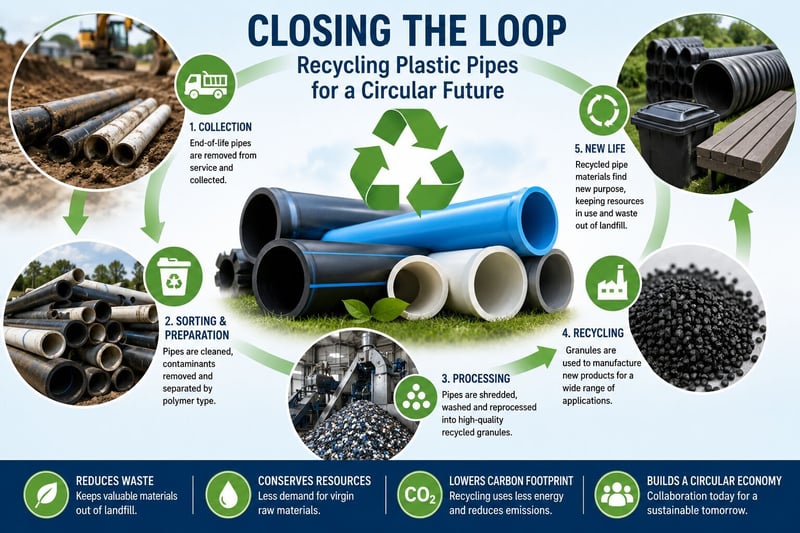
As South Africa continues to build a circular economy, plastic pipes are proving that sustainability doesn't end when infrastructure reaches the end of its service life. Both PVC and HDPE pipes can be successfully recycled once removed from service. However, ensuring they are recycled responsibly once they have reached their end-of-life is critical to protecting future infrastructure and public safety.
Designed to last and to be recycled Unlike many short-life or single use plastic products, PVC and HDPE pipes remain in service for more than 100 years. Their exceptional durability reduces replacement frequency and conserves valuable resources. When eventually removed during maintenance or infrastructure upgrades, they become valuable recyclable materials rather than landfill waste.
According to Plastics SA's latest 2025 recycling report[1], South Africa recycled 485 000 tonnes of plastics during the year. PVC accounted for 18 238 tonnes, while HDPE contributed 77 799 tonnes to the country's recycling output. An overall output recycling rate[2] of 30.1 % for all plastics was achieved in 2025, with PVC recording an 11% recycling rate and HDPE a 34% recycling rate.
“Both PVC and HDPE pipes are recyclable. The challenge is ensuring that they are recycled and reused responsibly, without compromising the safety and performance of future infrastructure,” says Jan Venter, CEO of the Southern African Plastic Pipe Manufacturers Association (SAPPMA).
Why recycled material cannot be used in new pressure pipes
The ability to recycle plastic pipes does not mean recycled material can simply be incorporated into new pressure pipes. As this distinction is often misunderstood, Venter explains why SAPPMA strictly prohibits the use of recycled material from external sources in the manufacture of certified pressure pipes:
“Pressure pipes operate under continuous internal pressure for decades while transporting drinking water, wastewater, gas and industrial fluids. Because they form part of critical infrastructure, manufacturers must guarantee consistent mechanical strength, long-term creep resistance and predictable performance throughout their design life. Unknown recycled material from external sources introduces variables that cannot always be verified, making it unsuitable for these safety-critical applications”.
He adds that international and South African standards (ISO/SANS 4427 for HDPE and equivalent standards for PVC pressure pipes) only permit manufacturers to reprocess their own clean, in-house production scrap under tightly controlled conditions. External recycled material is not permitted because its composition, contamination history and long-term performance cannot be guaranteed.
“Short-term cost savings should never come at the expense of safety, quality or infrastructure reliability. SAPPMA’s strict position should not be interpreted as opposition to recycling, but should be seen as a reflection of responsible engineering and our unwavering commitment to protecting critical infrastructure,” Venter says.
The legacy additive challenge
Another important consideration is the presence of legacy additives in older PVC pipes. Historically, lead stabilisers were widely used around the world and older infrastructure may still contain these historic formulations, requiring appropriate identification and sorting during recycling.
South Africa addressed this issue proactively. SAPPMA members voluntarily phased out lead stabilisers between 2006 and 2012 (five years ahead of comparable European targets). Today all locally manufactured SAPPMA PVC pipes use modern calcium-zinc and organic stabiliser systems, verified through factory audits and the Southern African Vinyls Association’s (SAVA) Product Stewardship Commitment.
Giving old pipes a new purpose
Although unsuitable for new pressure pipes, recycled PVC and HDPE remain valuable engineering materials used in products such as electrical conduit, cable ducting, drainage products, building profiles, fencing, pallets, wheelie bins, plastic lumber and numerous industrial components.
“Stating that a product is recyclable does not necessarily mean that it should be recycled back into the same product. In critical infrastructure applications, responsible recycling means giving recovered materials a valuable second life in other durable products where their performance can be fully assured,” Venter explains.
The 2025 Plastics SA report revealed that rigid packaging took up 16% of the market for recycled plastics, followed closely by agriculture (12%) and building and construction (11%). All of these offer viable end-markets for recycled plastic pipes.
Recycling plastic pipes also delivers measurable environmental benefits by conserving finite resources, reducing energy demand compared with manufacturing virgin polymers and keeping valuable engineering materials in productive use rather than sending them to landfill.
Building a truly circular pipe industry
With South Africa's circular economy continuously growing and evolving, the plastics pipe industry is demonstrating that sustainability is about far more than simply increasing recycling rates. It is about ensuring every material is used in the application where it delivers the greatest environmental, economic and engineering value.
By combining responsible product design, long service lives and carefully managed end-of-life recycling, PVC and HDPE pipes continue to set the benchmark for sustainable infrastructure.
“The question is no longer whether plastic pipes can be recycled, but how to recycle them responsibly. When every stakeholder, from contractors and municipalities to manufacturers and recyclers, plays their part we can keep valuable materials in circulation while protecting the safety, reliability and performance of South Africa's critical infrastructure,” Venter concludes.