
South Africa Recycles 485,000 Tonnes of Plastics in 2025 as Recycling Rate Rises to 30.1%
South Africa's plastics recycling industry continued its remarkable growth trajectory during 2025, even as the country's manufacturing sector contracted and ongoing weaknesses in the national waste management system threatened to undermine further progress.
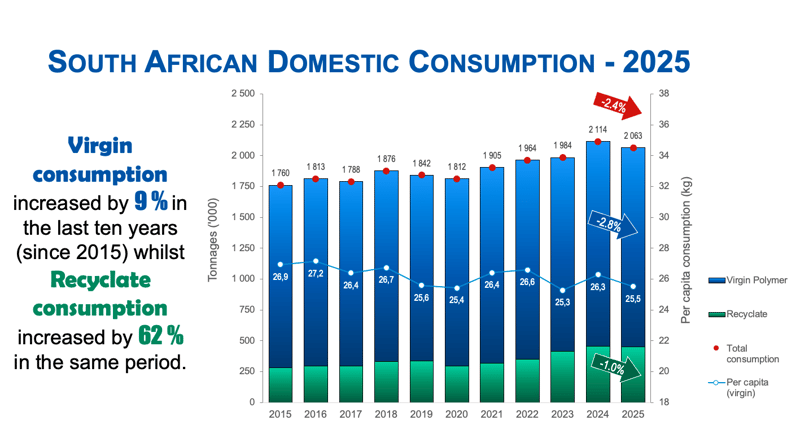
The latest plastics consumption and recycling figures for the year ending December 2025, released by Plastics SA, show that although domestic virgin polymer consumption declined by 2.8%, plastics recycling continued its upward trajectory, with total plastics recycled increasing by 3% to 485,000 tonnes.
The findings reinforce South Africa's position as one of the world's leading performers in mechanical plastics recycling, while highlighting the urgent need to strengthen waste collection and support local manufacturing.
Unlike many recycling reports that focus solely on packaging, these figures represent the entire South African plastics industry, including packaging, building and construction, agriculture, mining, automotive, consumer goods and all other plastics applications.
Sector-specific analysis will be released later this year.
According to Anton Hanekom, Executive Director of Plastics SA, the figures demonstrate both the resilience of the recycling industry and the vulnerability of South Africa's broader manufacturing sector.
"Recycling works. The latest figures show growth despite very difficult trading and operational conditions. Over the past ten years, domestic consumption of recyclate in South Africa has grown by an impressive 62%. That is a remarkable achievement and proof that the industry continues to invest, innovate and build a circular economy even under extremely challenging conditions."
Manufacturing Under Pressure
While recycling continued to grow, the report paints a less encouraging picture for South Africa's manufacturing sector.
Total domestic plastics consumption declined from 2.114 million tonnes in 2024 to 2.063 million tonnes in 2025, with virgin polymer consumption falling from 1.656 million tonnes to 1.610 million tonnes.
The decline reflects ongoing pressure on local manufacturers from increasing imports, weak economic growth, rising operational costs and electricity constraints.
The contraction was evident across several major polymers, with PE-LD/LLD, PVC, polystyrene (PS) and polyurethane (PUR) all recording lower consumption during 2025.
In contrast, polypropylene (PP), PET and HDPE remained relatively resilient, supported by continued demand in packaging and selected industrial applications.
Hanekom says the decline in virgin polymer demand reflects broader economic realities rather than reduced consumer demand for plastics.
"A decline in virgin polymer consumption is rarely good news. It tells us local manufacturers are producing less, investing less and facing increasing pressure. The plastics industry remains one of South Africa's largest manufacturing sectors, so when manufacturing slows, our entire economy feels it”.
A Decade Of Circular Economy Progress
Despite weaker manufacturing output, the country's circular economy continued to strengthen.
The report shows:
485,000 tonnes of plastics were mechanically recycled during 2025.
South Africa achieved an overall plastics output recycling rate of 30.1%, up from 28.4% in 2024.
Circular plastics content in new products increased from 16% ten years ago to 22% today.
Domestic recyclate consumption reached 453,000 tonnes, representing a 62% increase over the past decade.
Very few sectors within South Africa's manufacturing economy can point to sustained growth over the past decade.
Plastics recycling is one of them.
PET continued its impressive growth, reaching 108,222 tonnes recycled, while HDPE, polypropylene and polystyrene also recorded increases.
Although PVC recycling declined slightly during 2025, it remains an important component of South Africa's recycling landscape.
Formal Collectors And MRFs The Crucial, Yet “Missing Link” Between Collection And Recycling
One of the strongest messages emerging from the 2025 report is the increasingly critical role played by formal collectors, buy-back centres (BBCs) and Material Recovery Facilities (MRFs).
"Formal collectors and Material Recovery Facilities are the gatekeepers of South Africa's recycling system. They ultimately determine what gets recycled and what ends up in landfill. For that reason, they deserve a permanent seat at the table whenever South Africa's waste management policies and recycling strategies are developed. We regard them as the missing link in many of these discussions and would welcome their greater participation in helping shape practical, workable solutions for South Africa's recycling future," says Hanekom.
According to the report, formal collectors, MRFs and buy-back centres supplied 70% (nearly 340,000 tonnes) of recyclables into the recycling system during 2025, making them by far the largest single source of recyclable material for South African reprocessors.
These facilities perform the essential function of receiving, sorting, grading and preparing recyclable materials before they are sold to recyclers.
Without efficient sorting and quality control, valuable plastics become contaminated and ultimately end up in landfill instead of being recycled.
Impacts Of A Broken Waste Management System
The report also notes that the South African recycling value chain remains long and inefficient, with significant losses occurring through contamination and poor sorting practices.
Large volumes of recyclable material are still being discarded because waste is either not separated at source or arrives at sorting facilities contaminated.
Says Hanekom:
"South Africa still has a broken waste management system. Our recyclers cannot recycle material they never receive. Every day thousands of tonnes of valuable recyclable material are unnecessarily lost to landfill because collection systems fail, waste is contaminated or sorting infrastructure is inadequate. We have demonstrated that recycling works. Now we need a waste management system that works just as well."
Recycling Creates Livelihoods
Beyond its environmental benefits, plastics recycling continues to make a significant socio-economic contribution.
The 2025 report estimates that plastics recycling supported an estimated 111 000 income-generating opportunities throughout South Africa's recycling value chain, including employment within recycling factories as well as collection, transport, sorting and associated supply chain activities.
Of these, nearly 8 000 people are employed directly in formal recycling operations, highlighting the industry's important contribution to employment, skills development and inclusive economic growth.
Protect Local Recycling By Buying Local
Hanekom believes South Africa has built one of the strongest plastics recycling industries on the African continent, but warns that continued success depends on growing demand for recycled-content products.
"It is important to guard and protect what we have. Consumers, businesses and government all have a role to play by supporting locally manufactured products that contain recycled plastic. Every purchase helps create demand for recyclate, supports local manufacturing, protects jobs and strengthens South Africa's circular economy. Buying products manufactured in South Africa using recycled plastic helps keep both our manufacturers and recyclers competitive”.
He adds that while the industry has demonstrated what is possible, continued growth will depend on fixing municipal waste collection, strengthening sorting infrastructure, supporting formal collectors and MRFs, expanding local manufacturing and creating stronger markets for recycled materials.
"The latest figures prove that South Africa's plastics recycling industry continues to move in the right direction. The challenge now lies in ensuring that our waste management system, our municipalities and our procurement policies work just as hard as our recyclers do,” Hanekom concludes.