
Sustainability insights in South Africa (i.e. Environment, climate and nature insights, SA - 2026)
1.Summary of key findings
- South Africa recorded one of its warmest years on record, ranking within the top ten since 1951 based on observations from 26 climate stations. The national annual mean temperature was approximately 0.4 °C above the 1991–2020 reference average. Long-term analysis indicates a statistically significant warming trend of about 0.17 °C per decade between 1951 and 2025.
- From 2012–2021, South Africa saw an estimated 4,500 heat-related deaths annually, 3 times as many as annually in 1990-1999.
- South Africa boasts the largest expanse of agricultural land on the African continent. Between 2000 and 2011, the extent of land used for crop cultivation and livestock farming declined, but has since stabilized. By 2020, this area covered more than 96 million hectares — nearly 80% of the nation’s total land surface. Of this, approximately 87% was designated as permanent meadows and pastures, while close to 12.5% was classified as arable land suitable for crop production. In 2023, land dedicated to agriculture and animal production in South Africa accounted for roughly 79% of the nation’s total area.
- In 2024, South Africa’s greenhouse gas (GHG) emissions totalled approximately 569.8 million tons of CO₂-equivalent. This marked a 2.6% increase from the previous year — an additional 14.4 million tons compared to 2023, when emissions stood at 555.4 million tons. On a per capita basis, emissions reached 9.31 tons CO₂eq, significantly higher than the global average of 6.57 tons. Overall, South Africa contributed about 1.1% of global GHG emissions.
- According to Statistics South Africa, the country’s Gross Domestic Product (GDP) grew by a commendable 0.8% in the second quarter of 2025. This achievement underscores the vital role of the Department of Forestry, Fisheries and the Environment (DFFE) in strengthening South Africa’s economic resilience. A notable R16.6 billion inventory buildup — driven by mining, transport, and manufacturing — further illustrates improved supply chain stability, supported by DFFE’s environmental policies.
- The results from the Climate Change perception report, shows that South Africa, though a developing country, is concerned about the climate change and have a sense of Environmental responsibility. According to the results, at least 85% of respondents, between 2017 and 2023, indicated that they are concerned about climate change. If this was enough, the country further score a scale of 6.23, indicating a moderate to strong sense of personal responsibility for environmental protection.
2.Introduction
This article presents a comprehensive a general idea of the South Africa ‘s environment, climate, and nature, using economic, environmental, and social statistics to highlight both areas of progress and ongoing pressures. It draws upon official statistics and analytical reports, mostly produced by government departments and entities including the Annual State of Climate report from Weather SA; to inform decision-making, strengthen coherence across these topics, and enhance public understanding.
This work is closely aligned with Chapter 5 of the National Development Plan (NDP): Ensuring environmental sustainability and an equitable transition to a low-carbon economy.
3. The ever changing climate and environment: the tale of South Africa
3.1 Climate
South Africa recorded one of its warmest years on record, ranking among the top 10 since 1951 based on data from 26 climate stations. The country’s annual average temperature was approximately 0.4 °C above the 1991–2020 reference period. Long-term analysis reveals a statistically significant warming trend of about 0.17 °C per decade between 1951 and 2025.
In 2025, South Africa experienced widespread above‑normal rainfall, with most regions recording significantly higher totals. The notable exception was the Western Cape, extending into the southern interior of the Northern Cape. Along the South Coast and parts of the Northern Cape, rainfall was well below normal, and several areas endured extremely dry conditions.
It is also noted that in the early of the year 2025, South Africa experienced above‑normal temperatures across much of the interior, while isolated areas in the west, extreme north, and east recorded relatively wet conditions. Tropical moisture triggered Level 6–8 rain warnings, raising the risk of localised flooding along the KwaZulu‑Natal coast and Midlands, where residents and motorists were urged to remain cautious. By mid to late February, intense rainfall led to widespread flooding and landslides across eastern South Africa, particularly in KwaZulu‑Natal. The South African Weather Service issued multiple alerts for heavy rain and flooding across the province and neighbouring regions. The impacts were severe: fatalities and injuries in low‑lying towns, landslides in residential areas such as Kwa Makhutha and Folweni, and extensive infrastructure damage including destroyed roads, bridges, and homes. Thousands of people were displaced to emergency shelters, and the economic toll was staggering, with losses estimated in the billions—approximately R3.1 billion in KwaZulu‑Natal alone.
By March and April 2025, wetter‑than‑normal conditions persisted in the east and spread westward, covering most of South Africa. Early to mid‑March brought widespread disruptive rainfall and thunderstorms across multiple provinces, including KwaZulu‑Natal, Eastern Cape, Free State, Mpumalanga, Gauteng, Limpopo, North‑West, and the Northern Cape. The South African Weather Service issued repeated impact‑based warnings for severe thunderstorms, disruptive rain, localised flooding of roads and settlements, strong winds, lightning, and hail. Between 12–16 March, these alerts spanned a broad portion of the country, underscoring the persistence of the intensely wet weather pattern.
3.2 Insight into environmental indicators connected to species
Climate change and factors, such as land-use change and pollution, continue to place pressure on biodiversity. Long-term declines are also evident across several of South Africa’s species as shown in SANBI’s Species status report for trends between 1990 and 2024. In 2025 it can be noted that:
· Since the 2015 Red List assessment, the conservation status of many waterbird species has deteriorated sharply, with several species recently being uplisted from Least Concern to higher IUCN threat categories.
· A notable example is the African darter (Anhinga rufa), which has suffered significant habitat loss, particularly at breeding sites, compounded by the effects of environmental pollution.
· Freshwater mammals have also faced steep declines, with the Red List Index (RLI) dropping markedly since 2004 and continuing its downward trajectory from 2015 through to 2025.
· Among all taxonomic groups, freshwater fishes are at the greatest risk of extinction, with severe declines recorded between 2007 and 2016.
3.3 Agricultural land in South Africa
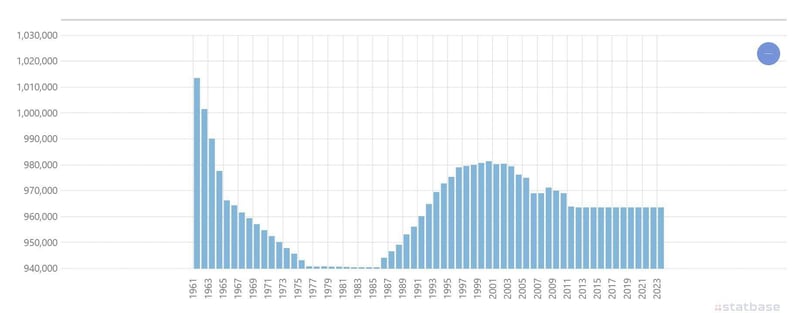
In 2023, South Africa’s agricultural land area measured 963,410 km² — identical to the figure recorded in 2022. FAOSTAT data shows that since 1961, the country’s agricultural land has contracted by a factor of 1.05. The lowest extent was documented in 1985 at 940,330 km², while the peak was reached in 1961, when the area totalled 1,013,350 km².
3.4 Air pollution levels in South Africa
In 2025, South Africa’s average air pollution level measured 15.50 μg/m³, reflecting a 17.55% decrease compared to 2024, when it stood at 18.80 μg/m³. IQAir data shows that the highest recorded pollution was in 2022, reaching 23.40 μg/m³, while the lowest was observed in 2025 at 15.50 μg/m³.
4. The environment, the economy and businesses
According to Statistics South Africa (Stats SA), the agriculture, forestry and fishing industry grew by 2.5%, contributing 0.1 percentage points to GDP. This growth was driven by increased economic activity in horticulture and animal products and reflects the positive contribution of sustainable agricultural and forestry initiatives to economic development.
The mining and quarrying sector recorded growth of 3.7%, contributing 0.2 percentage points to GDP. This performance highlights the importance of effective environmental governance, compliance and rehabilitation measures in supporting responsible resource extraction, including the production of platinum group metals, gold and chromium ore.
The electricity, gas and water industry also recorded modest growth of 0.2%, supported by increased electricity production and consumption. This underscores the importance of sustainable approaches to water and energy resource management in strengthening economic activity while safeguarding the country’s natural resources.
It was further noted that the 1.7% growth in trade, catering and accommodation, including the benefits generated by eco-tourism, as well as the 0.5% increase in personal services associated with community initiatives, demonstrate how conservation and environmental management can contribute to inclusive economic growth.
Employment data from the Quarterly Labour Force Survey (QLFS) forms a key input into our industry-based assessment of “green jobs” in South Africa. Between the first quarter of 2008 and the first quarter of 2026, the share of green jobs has fluctuated between 8% and just over 9% of total employment in the country. These roles are primarily concentrated in sectors such as agriculture, mining, and utilities.
5. Environment and society
Climate change awareness
Between 2007 and 2017, public awareness of climate change in South Africa rose sharply. The share of people reporting they knew “a lot” or “a fair amount” nearly doubled, while those claiming no knowledge at all dropped from 45% to 19%. Awareness continued to grow between 2017 and 2023, climbing from 34% to 50%. Yet, 17% of respondents still reported knowing nothing about climate change.
Climate change scepticism
In 2023, about 10% of South Africans rejected the idea of significant global climate shifts, while 32% attributed observed weather changes solely to natural variability rather than human activity. Together, this means 42% of the public either denied climate change outright or dismissed human responsibility for it.
Meanwhile, 31% believed climate change stems from a combination of natural and human factors, reflecting partial scepticism about the extent of human influence. Only 17% primarily attributed climate change to human actions, aligning with the scientific consensus, while 11% remained uncertain about its causes.
Concern about climate change
In 2023, nearly half (45%) of South Africans aware of climate change reported being extremely or very worried about it. Around one‑third (34%) expressed moderate concern, saying they were “somewhat worried.” By contrast, only 15% indicated little or no concern, and 6% were uncertain.
Overall, these findings show that the majority of South Africans who are aware of climate change view it as a cause for concern, with varying levels of intensity.
Awareness of the energy transition/just transition
Two‑fifths (41%) reported having heard or read “a little” about the transition, while 31% said they were familiar with it “quite a bit” or “a lot.” Nearly a quarter (23%) had never heard of it, and 5% were unsure. Awareness varied across socio‑demographic groups: rural residents and those in informal urban areas showed lower awareness compared to urban dwellers. Regional differences were also evident, with Gauteng and the Western Cape recording the highest awareness, and Limpopo, North West, and the Northern Cape the lowest.
To test the assumption that few South Africans know the term “just transition,” respondents were asked directly about their familiarity with it. Only 9% indicated they understood the term. A majority (65%) had never heard of it, 13% had heard of it but did not understand its meaning, and another 13% said they did not know how to respond.
Approval of the just transition
In principle, nearly two‑thirds (62%) of South Africans expressed support for the energy transition. A smaller share, 9%, disapproved of the shift away from coal, with 4% strongly opposed. Meanwhile, one‑fifth (20%) adopted a neutral stance, neither approving nor disapproving of the transition.
Concern about the impact of the just transition
In 2023, only a small share of South Africans expressed no concern about the energy transition: 10% said they were not worried at all about being negatively affected, and 15% believed it would not affect them personally. By contrast, a significant majority (71%) acknowledged the possibility of negative consequences linked to the just transition.
As expected, specific economic concerns were closely tied to broader worries about personal impact. The most frequently cited issue, mentioned by one‑third of respondents, was the risk of higher electricity costs, reflecting fears of rising energy prices. A similar proportion (32%) expressed concern about potential job losses. Nearly a quarter (24%) worried about the reliability and availability of electricity supply during the transition, while one‑fifth (19%) were specifically concerned about harm to the local environment. Additionally, 17% highlighted worries about negative health impacts.
Specific perceived benefits of the just transition
The most widely recognized benefit of the energy transition, cited by just over half of South Africans (51%), was the expectation that load shedding would lessen or end altogether. This stands out as the most significant perceived gain, reflecting hopes for a more reliable electricity supply.
Around two‑fifths (41%) anticipated positive economic impacts, and a similar proportion believed electricity prices could decrease as a result of the transition. Just under a third (30%) expected net job creation. One‑fifth highlighted potential improvements in public health, while an equivalent share pointed to reduced air pollution. Another fifth felt the transition could open opportunities for specific groups, particularly women and youth.
By contrast, a smaller share (13%) identified environmental health as a distinct benefit, suggesting that while ecological gains are acknowledged, they are less top‑of‑mind compared to economic and social outcomes.
Release information
Issued on behalf of
DFFE
Media contact
DFFE
Fulufhelo Mavhungu