
Sun, Wind, and Trust - The Reliability of Renewables in South Afric
South Africa like other countries, at global level, contributes towards the reduction of carbon emission. This efforts were done in various ways, including efforts to set up renewable Energy plants.
On the second side, the demand of Renewable Energy became obvious during the period of “load shedding”. During this period, the capacity of the coal based-electricity grid, was unable to meet the operational requirements of the citizen, hence an alternative electricity was needed.
In the past 13 years, the government of South Africa through the National Energy Regulator of South Africa (NERSA) has concurred with the gazetted Integrated Resource Plan (RE).
The recent figures, shows that the total RE capacity allocation from ministerial determinations is 36 700 MW, with an effective capacity of 28 900 MW.
In addition, the Department of Energy and Electricity(DEE) has procured 10 731 MW from 145 RE independent power producer (IPP) projects, through 10 bid windows (BWs) and risk mitigation IPPs (renewables).
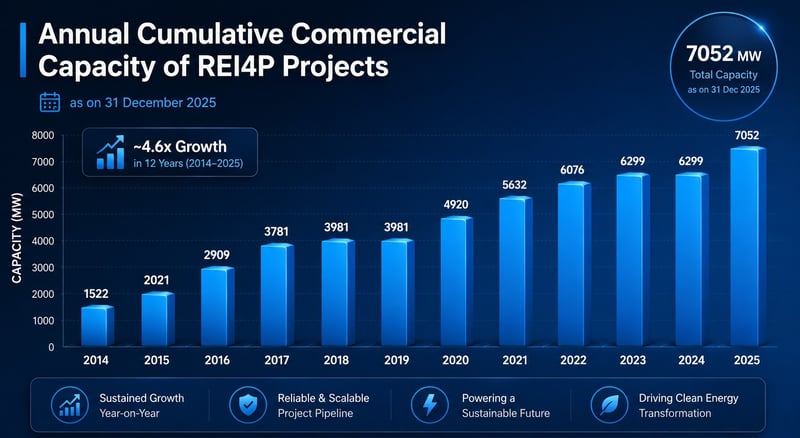
Another remarkable achievement, is that by the end of December 2025, the total grid-installed capacity of projects was 7 083 MW from 97 REI4P projects and three risk mitigation IPP power plants. Of this installed capacity, 7 052MW was in commercial operation.
As if that was not enough, it can also be noted that in 2025, eight (Bid window 5) BW5 projects reached commercial operation and their total contracted capacity is 753 MW.
Renewable Energy Performance And Generation
This remarkable achievement in renewable energy, are further observed in their sub-categories.
Firstly, the load factors of wind, solar PV and CSP plants were 37%, 26%, and 32%, respectively.
Next, the Biomass technology achieved the highest load factor of 76%, followed by hydro with a load factor of 54%.
And lastly, the landfill gas achieved 32% in 2025.
Therefore, the achieved energy from REI4P projects in 2025 of 4 670 GWh, amounts to about 26% of the total REI4P power plant sent out in that period.
Another interesting figures constitutes of Coal technology produced about 81% of the energy mix, followed by RE at 9%, and 3% imports from the Southern African Development Community (SADC).
The share of Eskom gas was about 1% of the total system energy.
Contribution Of Renewable Energy To Social Economic Development (SED)
“Renewable energy in South Africa not only drives greater demand for power but also plays a vital role in strengthening the nation’s economy.”
The REI4P power plants have surpassed their obligations across all categories.
In the category of employees who are citizens, the programme achieved 1,869 against an average obligation of 1,639.
Notably, 94% of these employees were black South Africans, 52% were skilled black workers, and 75% came directly from the communities hosting the REI4P projects.
These figures clearly demonstrate that the REI4P programme is not only meeting its commitments but is actively driving meaningful employment opportunities for South Africans.
Education received the largest share of SED contributions at 55%, while healthcare accounted for the smallest portion at just 5%.
Social welfare made up 16% of the total expenditure, and skills development contributed 11%.
Meanwhile, IPPs’ own administration costs represented approximately 13% of overall SED spending.
"Black ownership in the project company and operations contractors stood at 41% and 39%, exceeding the required thresholds of 31% and 19%, respectively. The local community held 8% of the shares in the project company, aligning precisely with their stipulated obligations."
In Conclusion
The fast paced growing of renewable Energy and its impact in South Africa, are undeniable.
The reality of existing Renewable Energy plants, not only proves that the country did made valuable efforts to plan well, but also prioritised its Economic growth.
As of 31 December 2025, a total of 118 licensed renewable energy (RE) power plants were in commercial operation, comprising 97 REI4P projects and 21 non-REI4P facilities.
Beyond these, the Energy Regulator approved the registration of 601 additional generation facilities, with a combined capacity of approximately 7,459 MW.
During 2025, REI4P projects produced around 17,808 GWh of electricity, while non-REI4P projects generated about 554 GWh.
The cost of energy from REI4P projects amounted to roughly R38.5 billion.
Based on data from Independent Power Producers (IPPs) and Eskom, the total cost of deemed energy was estimated at R404 million.
Curtailments at certain RE plants occurred mainly during night and early morning hours, when demand was low and supply exceeded requirements.
Analysis of socio-economic development (SED) data submitted to NERSA in 2025 shows that REI4P power plants in commercial operation consistently exceeded their employment and ownership obligations in every quarter, as set out by the Department of Energy and Electricity (DEE).
The REI4P projects that reported SED information generated combined revenues of about R17.2 billion.
Of this, approximately R222 million was spent on SED initiatives and R68 million on enterprise development (ED).
These figures represent 1.29% and 0.39% of total reported revenues, respectively.
While SED spending surpassed the annual target of 1% of revenue, ED expenditure fell short of the same benchmark.
Release information
Issued on behalf of
DFFE
Media contact
DFFE
Fulufhelo