
South Africa’s protected areas cover 11.28 million hectares, representing 9.2% of mainland area in 2020
Why Protected areas?
Protected areas are essential not only for the conservation of biodiversity but also for maintaining ecological sustainability and enhancing resilience to climate change. As integral components of South Africa’s ecological infrastructure, they safeguard ecosystems that provide critical ecosystem services, including clean water supply, flood regulation, soil erosion control, carbon sequestration, and scenic landscapes. These areas also contribute significantly to biodiversity-based tourism, which forms an important part of the country's tourism economy .
Furthermore, protected areas support rural livelihoods and stimulate local economic development, particularly in areas where wildlife-based enterprises and conservation industries offer greater economic and employment opportunities than conventional agricultural activities. Biodiversity conservation and protected area management directly generate more than 20,000 jobs in South Africa, many of which are linked to conservation authorities and protected area management. Consequently, protected areas represent not only environmental assets but also valuable social and economic resources that contribute to sustainable development.
Key findings from the national protected area extent account include:
· Protected Area Extent: In 2020, South Africa's protected area estate covered approximately 11.28 million hectares, representing 9.2% of the country's mainland surface area.
· Major Contributors: The largest contributors to the protected area network are Nature Reserves, National Parks, and Protected Environments, which collectively account for the majority of the country's protected land.
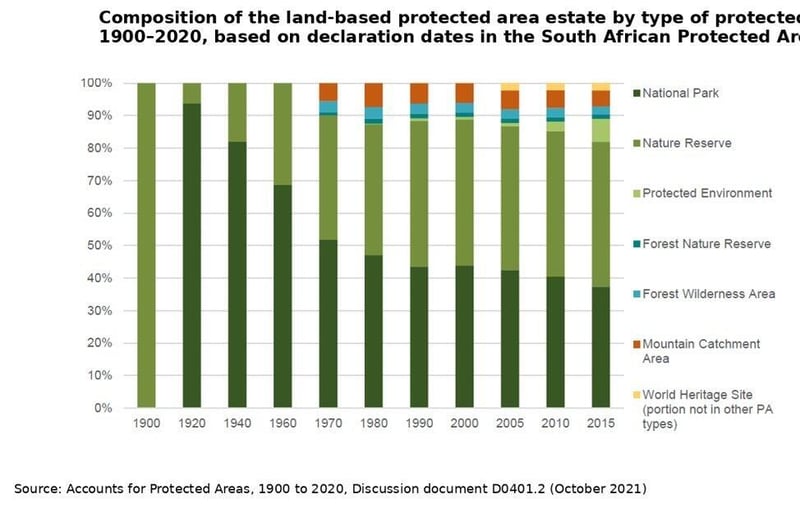
· Nature Reserves: Nature Reserves constitute 4.1% of South Africa's mainland area and account for 44.5% of the total protected area estate, making them the largest protected area category. They dominate the protected area network in all provinces except Mpumalanga and the Northern Cape. Nature Reserves also make the most significant contribution to the protection of the Forest, Fynbos, Grassland, and Indian Ocean Coastal Belt biomes.
· National Parks: National Parks cover 3.5% of the mainland area and contribute 37.4% of the protected area estate. They represent the largest proportion of protected areas in Mpumalanga and the Northern Cape. National Parks play a particularly important role in conserving the Desert, Nama-Karoo, Savanna, and Succulent Karoo biomes, where they provide the greatest level of biome protection.
· Third largest: Protected Environments, despite being a relatively recent type of protected area, make the third largest contribution to the protected area estate. They contribute 7,1% to the protected area estate and cover 0,7% of the mainland area . The largest increase in absolute terms was in the most recent accounting period 2015 to 2020, during which 507 116 ha were declared as protected environment. By the end of 2020, Protected Environments made the largest proportional
contribution to protecting the Albany Thicket biome.
· Important in recent years: Protected Environments have been an important protected area type in recent years. The provinces
in which their contribution is proportionally large based on extent at the end of 2020 are Eastern
Cape (where they make up 38,0% of the province’s protected area estate), and North West (where
they make up 10,3% of the province’s protected area estate).
· The four national parks that account for about 3 million ha of PA: The earliest declaration date for National Parks recorded in SAPAD is 1926, under the then National Parks Act, 1926 (Act No. 56 of 1926). These included the Kruger National Park, and later Addo Elephant National Park, Kalahari Gemsbok National Park, and Mountain Zebra National Park. These four National Parks combined accounted for over 3 million ha of PA and increased the total extent of South Africa’s land-based protected area estate to 2,7% of the country’s mainland area at the time. Although not included in this analysis, the first Marine Protected Area was declared in 1964.
· Third Largest Contributor: Although Protected Environments are a relatively recent category within South Africa’s protected area network, they represent the third-largest contributor to the protected area estate. By 2020, they accounted for 7.1% of the total protected area estate and covered 0.7% of the mainland surface area. The most significant expansion occurred during the 2015 to 2020 period, when an additional 507,116 hectares were designated as Protected Environments. By the end of 2020, this protected area category made the largest proportional contribution to the conservation of the Albany Thicket biome.
· Growing Importance of Protected Environments: In recent years, Protected Environments have become an increasingly important component of South Africa’s protected area estate. Their contribution is particularly significant in the Eastern Cape, where they comprise 38.0% of the province’s protected area network, and in the North West Province, where they account for 10.3% of the protected area estate. This highlights their growing role in expanding and strengthening biodiversity conservation efforts across the country.
· Historical Contribution of Early National Parks: The earliest National Parks recorded in the South African Protected Areas Database (SAPAD) were established in 1926 under the National Parks Act, 1926 (Act No. 56 of 1926). These included Kruger National Park, followed by Addo Elephant National Park, Kalahari Gemsbok National Park, and Mountain Zebra National Park. Together, these four parks covered more than 3 million hectares and increased the extent of South Africa’s terrestrial protected area estate to approximately 2.7% of the mainland surface area at the time. Although not included in this analysis, it is noteworthy that South Africa’s first Marine Protected Area was declared in 1964, marking an important milestone in the country's broader conservation history.
· Increase in South Africa’s Land-Based Protected Area Estate: The size of South Africa's land-based protected area estate increased substantially after 1960 following the introduction of legislation that facilitated the declaration of additional protected area categories. By 2000, protected areas covered 8.92 million hectares or 7.3% of the mainland area. Between 2000 and 2005, the protected area estate expanded by 325,872 hectares (3.7%), with National Parks accounting for most of the increase through the proclamation of Namaqua and Camdeboo National Parks. Additional growth was achieved through the declaration of several Nature Reserves and conservation areas, including Impendle, Bewaarkloof, Mariepskop, and Balele/Enlanzeni Valley Game Park.
Release information
Issued on behalf of
DFFE
Media contact
DFFE
Fulufhelo Mavhungu