
Cellulite Is Not What You Think - The Science Behind the Dimples Nobody Talks About
Written by: Easy Slimming (Pty) Ltd Save to Instapaper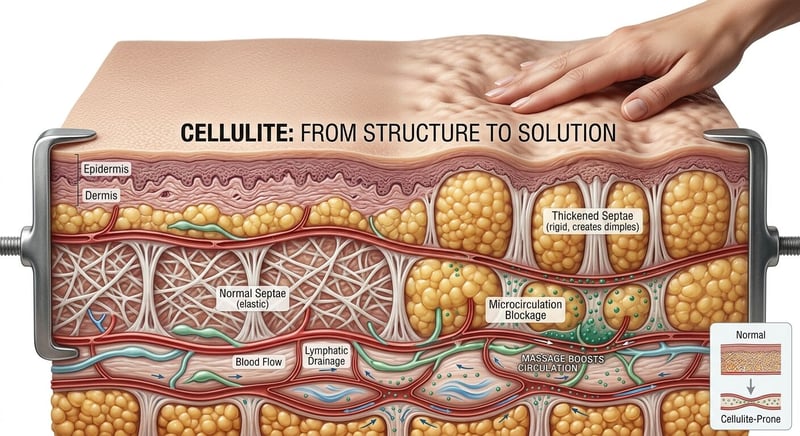
The Question Behind the Dimple
There is a strange contradiction in the beauty industry.
We spend billions trying to remove cellulite.
Yet many of the explanations given to consumers are still remarkably simple:
Lose weight. Burn fat. Use a cream. Exercise more.
But cellulite is considerably more complicated than that.
Medical reviews estimate that roughly 80% to 90% of post-pubertal women experience cellulite, particularly around the thighs, buttocks and hips. It can affect women across body shapes and fitness levels.
And perhaps the most important fact is this:
Cellulite is not the same thing as body fat.
The fat underneath the skin is involved, but so are the skin, connective tissue and the fibrous structures that anchor the skin to deeper tissue.
That raises a more interesting question:
If cellulite is partly an architectural problem beneath the skin, are we approaching it the wrong way?
What Causes Cellulite on Thighs and Buttocks?
To understand cellulite, forget the surface of the skin for a moment.
Imagine the tissue underneath it as a series of small compartments.
Subcutaneous fat sits beneath the skin, while bands of connective tissue called fibrous septae run through that tissue and connect the skin with deeper structures.
When those structures interact with the underlying fat, the surface can develop the familiar dimpling or “orange-peel” appearance.
Research suggests that these fibrous septae play an important role in cellulite formation. In fact, studies examining treatments that specifically target these bands have provided some of the strongest evidence that they are central to the condition.
The result is almost a tug-of-war.
The tissue underneath pushes upward.
The fibrous bands pull downward.
And the skin surface reveals the battle.
This is one reason why simply removing fat does not necessarily remove cellulite.
The American Academy of Dermatology specifically notes that cellulite differs from ordinary fat and that treatments capable of removing fat may have little or no effect on cellulite.
Why Do Slim Women Have Cellulite?
This is where the conventional weight-loss explanation starts falling apart.
If cellulite were simply caused by excess body fat, you would expect it to disappear as someone became leaner.
But cellulite is common among women who are not overweight.
Body weight can influence how visible cellulite becomes, but it isn't the whole explanation. Genetics, connective-tissue structure, skin characteristics, hormonal influences, age and the distribution of subcutaneous tissue can all contribute.
In other words:
You can be fit and still have cellulite.
You can be thin and still have cellulite.
You can exercise regularly and still have cellulite.
And none of that means your body is “broken”.
How Does Water Retention Affect Cellulite?
This is where things become even more interesting.
Cellulite is a complex, multifactorial phenomenon involving not only fat and connective tissue, but also the microcirculation and fluid environment within the tissue.
Changes in local fluid balance can make the skin appear more swollen or uneven.
That does not mean that cellulite is simply “toxins trapped in your legs”.
That popular explanation goes much further than the evidence allows.
But it does mean that temporary changes in tissue fluid and swelling can influence how the skin looks.
And this may help explain why massage-based approaches sometimes create a noticeable short-term visual improvement.
The important word is:
appearance.
Not eradication.
Best Cellulite Reduction Treatments at Home: What Actually Makes Sense?
This is where consumers deserve more honesty.
There are professional treatments with evidence of reducing the appearance of cellulite, including procedures that target the fibrous septae beneath the skin. Some can produce results lasting months or years.
But those are medical or procedural interventions.
A bottle of body oil is not a substitute for subcision.
A body scrub is not going to surgically release a fibrous band.
And a bath soak isn't going to permanently remodel the architecture of subcutaneous tissue.
So what can an at-home routine realistically do?
It can potentially target the things that influence how the skin looks and feels — hydration, exfoliation, temporary circulation-related changes and the overall appearance of skin texture.
That is a much more realistic claim.
And arguably a more useful one.
Do Body Scrubs Help Reduce Cellulite?
A body scrub can certainly make skin feel smoother.
Exfoliation removes surface dead skin cells and can temporarily improve the visual texture and brightness of the skin.
Massage itself may also temporarily change the appearance of cellulite by increasing local blood flow and altering tissue fluid distribution.
The American Academy of Dermatology notes that massage-based cellulite treatments can produce temporary improvements, although results vary and may not last after treatments stop.
So does a scrub cure cellulite?
No.
Can exfoliation and massage make the skin look and feel smoother?
That is considerably more defensible.
And that distinction matters.
Can You Fully Get Rid of Deep Cellulite?
This may be the question nobody in the beauty industry wants to answer.
Probably not permanently with a home skincare routine.
Even the medical literature describes cellulite treatment as challenging, with many approaches producing unpredictable or short-lived improvements.
The deeper the structural component, the less realistic it becomes to expect a topical product to completely eliminate the dimpling.
Some professional procedures can produce much more significant changes because they physically target the structures responsible for the dimples.
But even medical treatments aren't necessarily a universal “cure”.
So perhaps the better question isn't:
How do I permanently destroy my cellulite?
Perhaps it is:
“How much improvement can I realistically achieve without invasive treatment?”
That is a very different question.
How to Improve Skin Elasticity and Firmness
Skin is not simply a wrapping around the body.
Its thickness, collagen structure, elasticity and hydration all influence how the underlying tissue appears through the surface.
Research into cellulite treatments has found that improving characteristics of the dermis can sometimes make cellulite less noticeable, although these effects may be temporary.
This is why skincare has a role — but probably not the role that advertising has traditionally promised.
A well-formulated body-care routine can support:
smoother-feeling skin,
better surface hydration,
exfoliation,
temporary changes in skin appearance,
and a more consistent self-care routine.
It is not the same as physically cutting the fibrous septae beneath the skin.
That distinction is important enough to repeat.
Benefits of Massage for Cellulite: Temporary or Real?
Here's where things get controversial.
Massage isn't going to magically dissolve cellulite.
But that doesn't mean it is useless.
Massage can temporarily alter blood flow, tissue fluid distribution and the appearance of the skin. The American Academy of Dermatology reports that some massage-based cellulite approaches produce visible improvements, although these tend to be temporary.
This makes massage particularly interesting as part of a consistent home routine.
Not because it “melts fat”.
But because the physical manipulation of tissue can change the way that tissue looks and feels.
That is a much more scientifically reasonable explanation.
So What About Natural Anti-Cellulite Oil in South Africa?
This is where the market becomes difficult to navigate.
Search for “natural anti-cellulite oil South Africa” and you'll find everything from basic moisturising oils to highly concentrated essential-oil blends making extraordinary promises.
The ingredient list matters.
So does the claim being made.
A topical product should not be presented as though it can perform a medical procedure beneath the skin.
Instead, consumers should ask:
What is this product realistically designed to do?
The Easy Slimming Anti-Cellulite Combo, for example, takes a three-step topical approach combining a body scrub, detox oil and bath soak. Its current formulation information lists ingredients including grapefruit essential oil, rosemary essential oil, shea butter and cypress oil, and the company positions the routine around skin appearance, circulation, firmness and home use.
Easy Slimming Anti-Cellulite Combo
That doesn't mean the combo can surgically change the fibrous architecture underneath the skin.
It means the approach is aimed at the surface-level and routine-based side of cellulite management.
And for some consumers, that may be exactly what they are looking for.
The Three-Part Approach
The logic behind a multi-step routine is relatively straightforward.
1. Exfoliate
A body scrub helps remove surface buildup and leaves the skin feeling smoother.
2. Massage
Applying an oil with deliberate massage introduces mechanical manipulation into the routine while conditioning the skin.
3. Soak
A warm bath can become part of a regular relaxation and body-care ritual.
None of these steps should be confused with a medical cellulite procedure.
But together they create something that a single “miracle cream” cannot:
a repeatable routine.
And consistency matters when the goal is improving the appearance and feel of skin rather than promising overnight transformation.
Natural Vitamins and Supplements for Firm Skin
This is another area where consumers should be careful.
The internet is full of claims that oral supplements can “flush cellulite”, “destroy fat pockets” or rebuild connective tissue.
The evidence is considerably less exciting.
The American Academy of Dermatology currently states that there is no evidence that supplements can reduce cellulite.
That doesn't mean nutrition is irrelevant to skin health.
Adequate protein, vitamins, minerals, hydration and an overall balanced diet are important for maintaining healthy skin and connective tissue.
But there is a substantial difference between:
supporting general skin health
and
claiming that a supplement eliminates cellulite.
Consumers should know the difference.
The Uncomfortable Truth About Cellulite
Perhaps cellulite has survived decades of beauty treatments for a simple reason:
we keep trying to solve a structural problem with a single-product mindset.
Cellulite involves multiple tissues.
It can involve the dermis.
It involves subcutaneous fat.
It involves fibrous septae.
And the surrounding tissue environment matters too.
That makes the promise of a one-week miracle cream incredibly attractive.
It also makes it scientifically questionable.
The more honest approach is to separate three different goals:
Temporary visual improvement.
Long-term skin care and conditioning.
Structural cellulite reduction.
They are not the same thing.
So... Does an Anti-Cellulite Routine Actually Work?
That depends on what you mean by work.
If “work” means permanently removing every dimple from the body, the evidence does not support that expectation from an ordinary home skincare routine.
If “work” means improving the feel, hydration and appearance of the skin while incorporating exfoliation and massage into a consistent routine, that is a much more reasonable objective.
And if someone wants a more dramatic or durable reduction, medical cellulite treatments exist and can be discussed with a qualified dermatologist or cosmetic physician.
There is no shame in wanting smoother skin.
There is also no shame in deciding that cellulite is simply part of normal human anatomy.
The interesting part is that both choices can be rational.
Maybe the beauty industry's biggest mistake was convincing women that cellulite needed to be “cured” in the first place.
Or maybe there is nothing wrong with wanting to improve something about your appearance if doing so makes you feel more comfortable in your own skin.
The choice, ultimately, belongs to you.
The important thing is knowing what the science actually says before someone sells you the answer.
Get new press articles by email
Easy Slimming (Pty) Ltd is a South African health, wellness and white label supplement company committed to making quality wellness products accessible to both consumers and entrepreneurs. We offer a growing range of natural health, beauty, weight management and lifestyle products, alongside custom white label solutions that enable businesses to launch their own wellness brands with low minimum... Read More
Latest from
- The Entrepreneurship Trap - Why Most South African Startups Fail Before They Make Their First Sale
- The Bloating Mystery - Why Your Stomach Can Look Fat Even When You Aren’t Gaining Fat
- Why Does Your Face Look Older Even When You’re Losing Weight?
- When Stress Stops Feeling Like Stress - The Physical Warning Signs Nobody Talks About
- The Silent Epidemic - Why Adult Acne and Eczema Rates Are Surging Across South Africa, and the Hidden Cost of Corticosteroid Abuse
- The Unregulated Formulation Crisis - Why Transparency is the Ultimate Line of Defence in South Africa’s Natural Weight Loss Supplements Industry
- The Blueprint for Sustainable Change - An Investigative Look at Constructing a Healthy Slimming Routine for Beginners in South Africa
- The Transparency Equation - An Investigative Audit into South Africa’s Weight Management Industry and the Hidden Science of Product Labeling
- Ozempic Side Effects South Africa - The Weight Loss Crisis Nobody Is Talking About
- How to Fix Cracked Heels - What South African Foot Specialists Want You to Know Before Buying Another Foot Cream
- Could Cracked Heels Be Warning You About More Than Dry Skin?
- Why Dermatologists Say Your Moisturiser Could Be Making Your Acne Worse
- Why Dermatologists Say Daily SPF Is One of the Most Powerful Anti-Ageing Products You Can Own
- Why South Africans With Darker Skin Are More Likely to Experience Post-Acne Marks Than Permanent Scars
- Why More Dermatologists Are Talking About Skin Barrier Repair Instead of Miracle Skincare Products
The Pulse Latest Articles
- The 1% Problem: Are We Misjudging Cryptocurrency? (September 7, 2026)
- N3yh Moves Beyond Sleepwear With Its First Leisurewear Collection (September 3, 2026)
- N3yh Moves Beyond Sleepwear With Its First Leisurewear Collection (September 2, 2026)
- Safari Travelers Are Asking What Happens Beyond The Game Drive (September 2, 2026)
- Kruger National Park Is Waking Up For Spring (September 2, 2026)