
New White Paper Proposes 51% Design Test for South Africa's R26 Billion ESD Spend
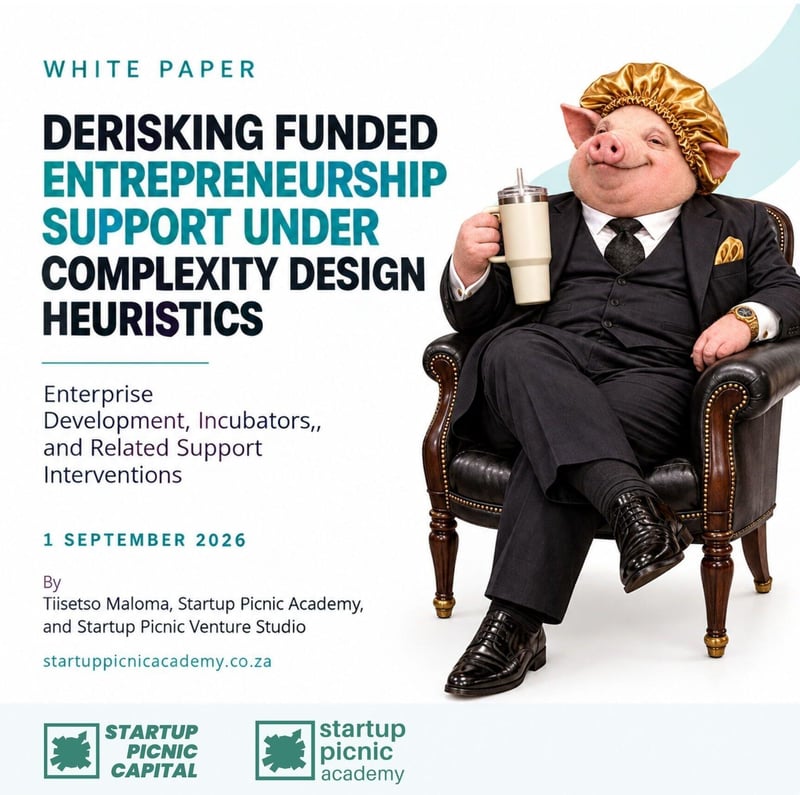
A first-principles guide argues that funded entrepreneurship support should be designed around entrepreneurial reality, not administrative process.
SOUTH AFRICA, 9 September 2026 — A new white paper by Tiisetso Maloma, Startup Picnic Academy, and Startup Picnic Venture Studio proposes a simple design test for South Africa's funded entrepreneurship support: at least 51% of programme spend should reach entrepreneurs as value they control.
The paper, Derisking Funded Entrepreneurship Support Under Complexity, arrives as the country's Enterprise and Supplier Development (ESD) ecosystem commits an estimated R26 billion annually, according to the B-BBEE Commission. Yet programme results remain inconsistent. Many initiatives report activity — training delivered, mentors assigned, reports filed — without demonstrating lasting gains in firm survival, productivity, or growth.
"Entrepreneurship does not run on a fixed plan," says Tiisetso Maloma, author of the paper and founder of Startup Picnic Academy and Startup Picnic Venture Studio. "Customers, competitors, technology, and regulation keep changing. In that environment, more process and more administrative control do not automatically produce better results."
The paper argues that many support programmes are designed around stable administrative structures, while entrepreneurship operates under changing and uncertain conditions. It proposes six design heuristics for Funded Entrepreneurship Support (FES), covering Enterprise Development, Supplier Development, incubators, accelerators, and entrepreneurship-focused skills programmes.
The six heuristics are:
1. Majority Principle (51%) — most of the budget becomes entrepreneur-controlled value.
2. Entrepreneur-Controlled Value — support leaves the entrepreneur able to act.
3. Started-Already — prefer founders who have completed at least one cycle of action and market feedback.
4. Time-Average Tactic — stage support in tranches, released when there is a signal.
5. Fast-and-Frugal Training — teach a few tactics that can be applied immediately and repeated.
6. Skin in the Game — those who deliver support should face consequences tied to founder-usable value.
"The 51% is a fence, not a scientific constant," says Maloma. "It makes the principle of beneficiary-benefit measurable. If a programme cannot show that most of its budget becomes value the entrepreneur can use, the design deserves scrutiny. The question is simple: where is the money actually going?"
The paper draws on established work in complex adaptive systems and decision-making under uncertainty, including Knight (1921), Simon (1955), Holland (1992), Gigerenzer (2008), and Taleb (2018). It is careful to state what it is not: it does not audit named programmes, calculate a national overhead ratio, or present the heuristics as proven causal laws. They are design tests for decision-making under uncertainty.
"The imperative is not to spend more on support," says Maloma. "It is to discover better ways of turning support into entrepreneurial capacity, action, and opportunity."
The full white paper is available for download. Interviews with the author are available on request.
About Tiisetso Maloma
Tiisetso Maloma is an entrepreneur, author, and founder of Startup Picnic Academy and Startup Picnic Venture Studio. His publications include Forget the Business Plan Use This Short Model, The Anxious Entrepreneur, Future of Township Economies, and Quick Innovation MBA.
About Startup Picnic Academy
Startup Picnic Academy designs and delivers short, practical courses and tools for founders and trainers, working with corporates, non-profit organisations, and colleges.
About Startup Picnic Venture Studio
Startup Picnic Venture Studio builds startups at the intersection of intellectual property, finance, technology, and AI.
Release information
Issued on behalf of
Startup Picnic Venture Studio
Media contact
Startup Picnic
Queen