
New white paper - Derisking family office capital by making complexity simple to see, with the barbell strategy and supporting heuristics
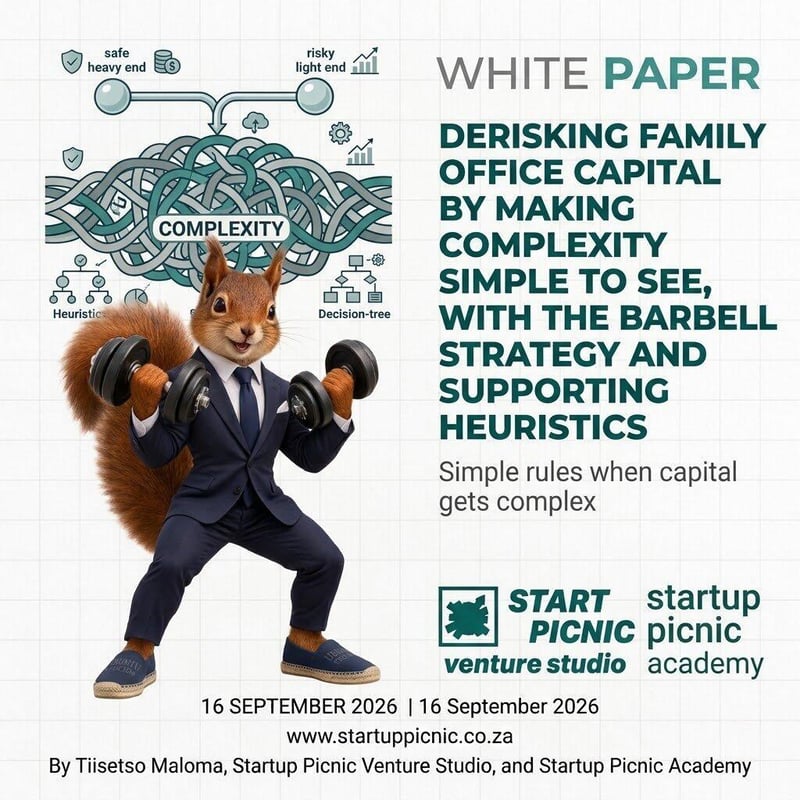
Tiisetso Maloma's new paper explains complexity in plain language and adds supporting heuristics to the barbell approach to family-office capital
JOHANNESBURG, South Africa — 16 September 2026 — A new white paper by entrepreneur and author Tiisetso Maloma, founder of Startup Picnic Venture Studio, seeks to make one of the more difficult problems in capital allocation easier to understand: complexity and uncertainty in the context of family-office capital.
Titled Derisking Family Office Capital by Making Complexity Simple to See, with the Barbell Strategy and Supporting Heuristics, the paper has two central contributions.
First, it attempts to translate complexity and uncertainty into simpler language for the family-office context. Complexity is often difficult to explain because outcomes can be shaped by many interacting factors, changing conditions, adaptation and the sequence in which events occur. The paper uses ordinary examples, simple arithmetic and a fable to make these ideas easier to see.
Second, it uses the barbell strategy as a central organising idea and adds supporting heuristics around it. The barbell provides the shape; the heuristics are intended to help a family office think about how that shape can be maintained when circumstances change.
“Complexity is a difficult thing to explain and understand,” says Maloma. “We thought: how can we endeavour to explain it in a way that makes sense in the family-office context?”
The paper starts with a simple distinction: a family office can observe many possible investment outcomes, but its own balance sheet will experience only one sequence of events. It cannot experience every possible future and then receive the average outcome.
That distinction becomes important when markets, businesses and people interact, when outcomes can be highly uneven, and when the order of events affects what happens next.
The paper calls this complexity and does not attempt to eliminate it or turn uncertainty into something that can be precisely calculated. Instead, it seeks to make the problem easier to see.
The second part of the paper turns to the barbell strategy. Rather than presenting the barbell as a new invention or a universally appropriate investment strategy, the paper treats it as a heuristic for thinking about capital when prediction is limited: preserving the ability to continue operating while retaining some exposure to opportunities that could produce disproportionately large outcomes.
Around this central idea, the paper proposes seven supporting heuristics, including respecting the single path, sizing risky commitments so that the family remains able to operate, staggering commitments, preferring what can be understood and potentially sold, considering the generation that must live with the capital, treating local knowledge as a filter rather than a forecast, and questioning the “middle” that can appear moderate without necessarily providing sufficient protection or liquidity.
The heuristics are presented as ways of thinking rather than a tested investment system. The paper does not prescribe portfolio percentages, asset classes, jurisdictions or a particular family-office structure.
“The barbell is the shape,” says Maloma. “The supporting heuristics are habits that help keep the shape honest.”
The paper illustrates its ideas through “The Two Purses,” a fable about two people who receive the same R50 million but make different decisions about how to hold and deploy it. The story is not presented as evidence for one strategy over another. Instead, it asks a practical question: after a difficult sequence of events, can the family still act?
The paper draws on ideas from complexity, uncertainty, ergodicity, decision-making and economics, including work associated with Frank Knight, Herbert Simon, W. Brian Arthur, Gerd Gigerenzer, Nassim Nicholas Taleb, John Kelly and Ole Peters.
“The purpose is not to make complexity simplistic,” Maloma says. “It is to make it easier to see.”
The paper is not investment advice and does not claim that its barbell approach or supporting heuristics are appropriate for every family office. Its purpose is to offer a plain-language framework for thinking about capital when the future is uncertain and the environment is complex.
About Tiisetso Maloma
Tiisetso Maloma is an entrepreneur, author and founder of Startup Picnic Venture Studio. He writes books and develops practical tools to help people ideate, innovate and launch. His work focuses on complex systems, innovation, township economies, rhetoric and risk.
Startup Picnic Venture Studio builds companies at the intersection of intellectual property, finance, technology and AI.
Download the white paper
Download Derisking Family Office Capital by Making Complexity Simple to See, with the Barbell Strategy and Supporting Heuristics
Release information
Issued on behalf of
Startup Picnic Venture Studio
Media contact
Startup Picnic
Queen