
Conference Calls For Greater Inclusion And Community Voices In Social Impact Programmes
Written by: BizCommunity Editor Save to Instapaper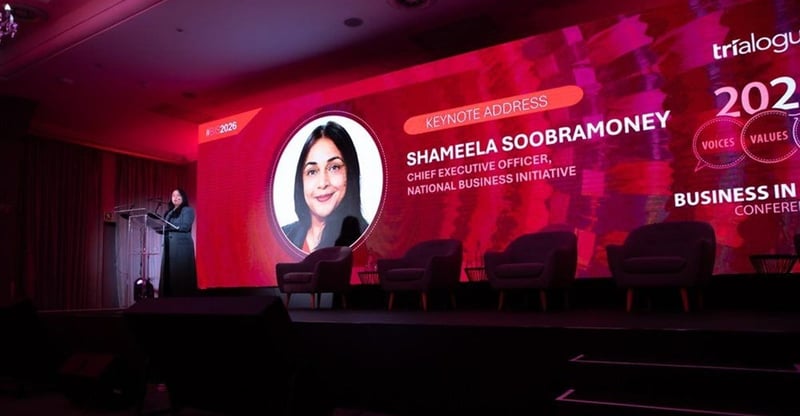
Across two days of keynote addresses, panel discussions and delegate engagement, participants were called on to promote justice and greater inclusion in their social impact work and programmes. Company representatives were urged to amplify diverse voices, including community stakeholders, beneficiaries and young people, in order to build more effective programmes.
Critical discussions emerged challenging prevailing development narratives, the inclusion of the right voices in shaping and delivering development impact, and whether the values driving decision-making are genuinely aligned with the outcomes communities need.
Values are how we lead
National Business Initiative CEO Shameela Soobramoney delivered the opening keynote address, setting the tone for the conference and bringing the theme – ‘Voices. Values. Vision.’ – to life. Speaking to the issue of inadequate inclusion, Soobramoney noted the importance of designing development solutions with the individuals or communities they are intended to serve if impact is to be sustainable.
The tension between intention and implementation was plainly named in the opening keynote address as Soobramoney challenged delegates to reflect on the distinction between preparation and participation as the point where policy intent meets, or fails to meet, implementation needs.
She acknowledged sector progress, such as more sophisticated environmental, social and governance frameworks, greater transparency and a CSI sector that has remained resilient even as global funding cuts have exposed the vulnerability of civil society. However, she was equally direct about the challenges of poverty, inequality, unemployment, slow economic growth and environmental degradation that persist alongside progress. "The challenge isn't commitment," she said, "the challenge is coherence.”
Soobramoney was unambiguous on the importance of considered values as the key to closing the gap, arguing that values are not what organisations performatively publish, but what shows up in trade-offs, when profit conflicts with inclusion or short-term performance conflicts with long-term resilience. “When values lead business follows, because every decision a business makes is an act of world making and future building,” she commented, encompassing what organisations choose to fund, build, lobby for, measure or ignore.
She called on the corporate sector to reframe CSI as a catalyst for economic inclusion rather than temporary relief and to move from fragmented efforts toward aligned, collaborative action that converges around shared strategic priorities. "The opportunity for CSI is collaborative action for systemic change," she said, noting that strategic alignment of funding is critical. "Impact is not failing because of a lack of funding but because of a lack of alignment."
She closed with a call to action for businesses to reflect on their real values by questioning who is in the room when consequential decisions are made, what is being measured or ignored, and what behaviours organisations are rewarding internally. She urged leaders to create deliberate space for systemic thinking, cautioning that without it, neither values nor capital would be deployed to their full effect. "If we cannot create space for thinking," she asked, "how can we become architects of the change?"
The power of dreams – imagining a new plan for South Africa
The closing keynote reinforced these messages with greater urgency. Development Impact Fund CEO Lorenzo Davids was frank in his challenge to delegates that the sector has become too comfortable with the scale of its failure.
He said that funding proposals rarely reflect the reality of South Africa as one of the most unequal countries in the world and called for more ambitious interventions. "We use the data to write funding reports to maintain the system that doesn't change the data," he said.
Davids argued that the sector has become more invested in its own solutions than in solving problems, a dynamic that produces well-branded programmes and modest, measurable outputs while the structural challenges deepen. He called for a fundamental shift in orientation away from institutional self-preservation and toward what he described as "country duty", a commitment to designing collaborative, large-scale responses commensurate with the scale of national need.
Reinforcing conference participants’ increasing recognition of the need for greater inclusivity, he took particular aim at the language of development itself, calling for the word ‘beneficiaries’ to be retired entirely. Citizens, nongovernmental organisations and funders, he argued, are equal partners in the project of rebuilding the country. "We have funding without a national imagination," he said. "We simply want money, but we have no dream of what we're going to do."
His challenge to delegates was to move beyond the incremental and instead to design plans larger than any single organisation, to take their unfixable problems to funders, and to lead with conviction rather than compliance. "Every budget is a belief system in disguise," he said.
“Stop using the severity of need as the basis for funding,” he told delegates. He said “severity of need” wasn’t the issue. “The issue is justice. It is creating a framework of justice in which we work as a country to become respectful, safe, equitable, inclusive and prosperous for all.”
In closing, Davids called on the sector to find the courage to dream at the scale the country demands, to face the chaos, sit with it honestly, and return not with a funding proposal, but with a plan for South Africa.
The conference, sponsored by the FirstRand Foundation, Absa, MTN, Wesgro, Telkom, the Vodacom Foundation, Wesgro and Volkswagen South Africa, featured six content-rich plenary sessions:
- Mobilising leadership, employees and partners around a common purpose, presented with the FirstRand Foundation
- Building futures: Pathways to economic activity, presented with Absa
- Education, investment and the case for catalytic capital, presented with Edu Invest powered by Wesgro
- Supporting the ecosystem, not just the programme, presented with MTN
- Building foundations: Why ECD infrastructure matters, presented with the Development Bank of Southern Africa
- Partnerships that turn digital access into meaningful inclusion, presented with the Vodacom Foundation.
Volkswagen Group Africa returned as the notebook sponsor, while Standard Bank was this year’s nonprofit sponsor.
Get new press articles by email
We submit and automate press releases distribution for a range of clients. Our platform brings in automation to 5 social media platforms with engaging hashtags. Our new platform The Pulse, allows premium PR Agencies to have access to our newsletter subscribers.
Latest from
- Meta Says AI Could Add R528 Billion To South Africa Economy Over The Next Decade
- Western Cape Flood Disaster Highlights Urgent Need For Support In Affected Communities
- Anthropic Keeps Claude Mythos Under Tight Control Following Advanced Security Testing
- Agro Processor Scale-Up Programme Targets Growth And Innovation For South African SMEs
- University Of Pretoria Advances Sustainable Energy Strategy With Large-Scale Solar Investment
- SACAP Highlights Critical Role Of Registered Counsellors In Early Mental Health Intervention
- South Africans Embrace Portfolio Careers As Professionals Seek Greater Flexibility And Security
- FSA Members Preserve More Than 300000 Hectares Of Natural Ecosystems Across Forestry Land
- Parsons Power Park Advances South Africa Energy Transition With Major Solar Development
- African Energy Chamber Backs SNPC Drive To Expand Congo Energy And LNG Development
- Location Bank Earns Siinda Recognition For AI Tool Simplifying Enterprise Data Management
- South Africa Intensifies Youth Employment Drive Following Sharp Rise In Unemployment Rate
- Firexpo 2026 To Explore How Fire Risk Impacts Building Performance And Business Continuity
- QuickEasy BOS ERP Transforms Manufacturing Planning With Integrated Factory Floor Control
- Strong Grain And Produce Supplies Push South Africa Food Inflation Down To 2.8 Per Cent
The Pulse Latest Articles
- South African Women Are Missing This Essential Nutrient (May 20, 2026)
- Opinion Piece: Rethinking Performance: Why Behaviour Remains The Missing Link In Evaluation (May 20, 2026)
- 125 Years Of Hansgrohe And The Designers Who Made Axor A Luxury Language (May 19, 2026)
- World Whisky Day: Whisky Lovers Challenged To Stop Saving Their Best Bottles (May 15, 2026)
- Hidden Inefficiencies Are Draining South African Businesses (May 15, 2026)