
Johannesburg Embraces 15‑Minute City Principles With Central Park Precinct
Written by: BizCommunity Editor Save to Instapaper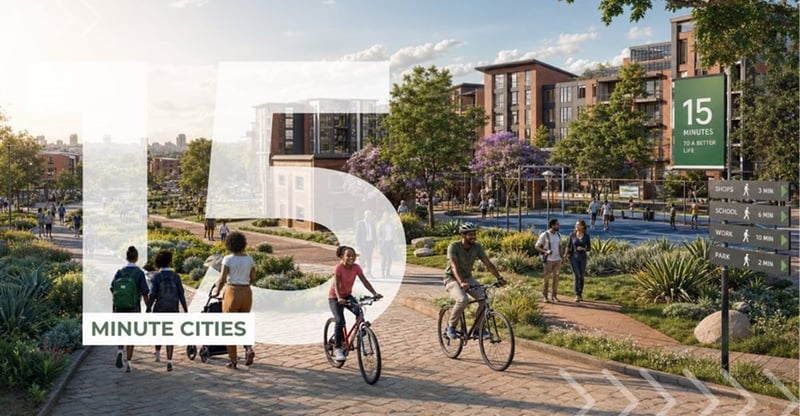
The global 15-minute city movement reframed what urban living can look like. South Africa is still catching up. Some developments, like the extraordinary Central Park precinct in Johannesburg, are pointing the way, promising sustainable, safe, and affordable housing communities that offer aspirational lifestyles.
This is something worth investing in for the sake of humanising our economic powerhouse urban areas and healing some of the wounds left by apartheid land planning. It feels particularly pertinent with the current fuel price crisis and the ongoing troubles the city faces with energy security.The idea that a city should work for you, not the other way around, is not new. But it has never been more urgently tested than in Johannesburg, right now.
Carlos Moreno, a Colombian-French scientist at Sorbonne University, gave the concept its modern name in 2016. The principle is disarmingly simple: every resident should be able to reach their daily needs: work, school, healthcare, groceries, green space, and leisure, within 15 minutes on foot or by bicycle. No car required. No hour-long slog in traffic across a sprawling grid, no need to rebuild entire train and bus networks.
From theory to policy
Moreno's idea found its most prominent advocate in Paris Mayor Anne Hidalgo, who made the 15-minute city the centrepiece of her re-election platform in 2020.
In practice, this has meant converting roads into cycling lanes (Paris now has over 1,000 km of cycling infrastructure), reclaiming schoolyards as weekend public space, and actively incentivising neighbourhood-level retail to keep local economies alive.
But Paris is not alone. Melbourne adapted the concept into its '20-minute neighbourhood' initiative, embedding it into metropolitan planning policy with transit-oriented development as the enabling spine. Portland, Oregon, has set a target for 90% of its residents to meet daily needs on foot or by bike by 2030. It is already at 64% and climbing.
Busan, South Korea, is piloting dedicated 15-minute city zones as part of its official urban policy. Latin American and African cities from Bogotá to Nairobi are exploring frameworks built around proximity rather than mobility.
The movement has earned UN-Habitat endorsement and an Obel Award. Carlos Moreno's 2024 book charts its rise from a Parisian experiment into a global policy conversation.
Why it matters beyond the buzzword
The appeal of the 15-minute city is not purely environmental, though the numbers are striking: researchers estimate that a 10% shift from car to walking and cycling in Cape Town alone could eliminate 190,000 metric tonnes of greenhouse gas emissions annually, with an associated social value of over R36m.
The other argument is human. Car-centric cities fragment communities, deepen inequality, and impose enormous time costs, particularly on those who cannot afford to live near their work. Research consistently shows that short, walkable commutes correlate with improved mental health, stronger social networks, and higher quality of life.
For property investors, the economics are equally clear. Properties in established 15-minute neighbourhoods command up to 30% more than equivalent stock in car-dependent suburban areas, driven by sustained tenant demand and persistently low vacancy rates.
The Johannesburg problem
Johannesburg occupies a complicated position in this conversation. The city is an economic powerhouse but has become one of the most sprawling on the African continent. It’s a direct product of apartheid spatial planning that deliberately separated where people lived and socialised from where they worked and shopped, combined with modern urbanisation and immigration, which have meant rapid unplanned growth.
The legacy is car-first urban planning that consistently disadvantages those who cannot afford a vehicle or a home near decent schools and job opportunities, and imposes significant productivity costs on everyone.
Walking infrastructure is deeply uneven: some affluent northern suburbs lack pavements entirely, while inner-city areas have wide pedestrian paths, but feel unsafe. Public transport is inadequate and fragmented.
True city-wide adoption of the 15-minute model in Johannesburg would require generational political will, sustained infrastructure investment, and a fundamental rethink of land-use policy. That is a long-horizon project, and the city's track record on delivery makes optimism difficult to sustain.
What a private precinct can do
This is why the private-sector response is worth examining. Where municipalities move slowly, developers have begun building the 15-minute city from scratch, not by transforming existing urban fabric, but by designing self-contained precincts where proximity is engineered in from the start.
Central Park City, a 3,450+ apartment mixed-use development rising in Johannesburg's Newlands/Sophiatown area, is among the clearest local examples of this approach. An on-site retail village, a crèche and aftercare centre, sports facilities such as pickleball, 5-a-side soccer pitches, and a skate rink, swimming pools, landscaped parks, cinemas, braai areas, running tracks, and more offer an ideal, healthy, safe lifestyle with a real sense of neighbourhood.
Top security, energy independence (solar with battery backup, gas geysers and hobs), as well as a potential independent fresh water supply, make for a truly livable community. With scale, shareable apartments (where bedrooms have their own bathrooms), and healthy tax and green bond incentives for both buy-to-let investors and primary homeowners, this lifestyle becomes more affordable, too.
The main design principle is that residents should not need to leave the precinct to meet their daily needs, apart from going to work and attending school or university, with ample public transport (bus and taxi ranks within a few hundred meters), and plenty of work and educational opportunities, within just 10 km. They should also be able to walk around safely, to the shops, or to recreational and fitness activities, even at night.
It is not a municipal plan. It does not depend on electioneering, a cycling revolution or a transformation of Joburg's entire transport network. It is a development team deliberately choosing to treat proximity between retail, childcare, sport, and home as a design standard rather than a marketing add-on. The location also meets a significant need for decent, safe cohabiting accommodation for students and staff at two of South Africa’s largest universities, WITS and the University of Johannesburg, which are also within 10km.
For Joburg residents navigating a housing crisis, large-scale urbanisation, an energy and water crisis, and a transport crisis simultaneously, the reality is probably that the 15-minute city will not arrive for everyone wholesale. But its principles of proximity, mixed use, self-sufficiency, walkability, and safety are already evident in sustainable developments that attract long-term investment, maintain low vacancy rates, and show the way to the future.
The bottom line
Whether it comes from city hall or a developer's brief, the underlying idea is the same: a city worth living in is one you can actually get around, quickly, inexpensively, and safely. In Johannesburg, visionary developments like Central Park are making the change, and existing tax incentives for investors buying new residential units, as well as green bond interest rate discounts for sustainable developments like this, help move the needle in the right direction.
The 15-minute city is not a silver bullet. But in a city with so much to offer, the question of how close we can bring daily life together to build stronger, healthier communities is one worth taking seriously.
IGrow opens sales to both homeowners and investors at Madison Square, the first development in The Central Park City precinct, in July. Occupation planned for April 2027.
Get new press articles by email
We submit and automate press releases distribution for a range of clients. Our platform brings in automation to 5 social media platforms with engaging hashtags. Our new platform The Pulse, allows premium PR Agencies to have access to our newsletter subscribers.
Latest from
- Municipality Extends EPWP Contracts To Secure Service Delivery Ahead Of Local Government Elections
- Camp in 45,000 Acre Solio Reserve Provides Day And Night Game Drives Walking Safaris And Photography Support
- Tsiba Launches #WeAreTSIBA Theme to Honour Community and Shared Purpose
- Reframing Business Models for a Sustainable World Calls Sustainability a Core Strategic Imperative
- How SMEs Can Identify Real AI Opportunities Amid Hype
- Wheat And Maize Weaken As FAO Reports 3.5% Drop In Cereal Price Index
- Savanna Uganda Launches Unlimited Voice And Data Model For Kampala And Greater Kampala
- Living Soils Programme Trains Emerging Women Farmers In Regenerative Methods And Boosts Local Food Security
- Nedbank IMC Releases 2026 Agenda Shift Happens Programme Focuses on Marketing Creativity and Leadership
- Majority Of South African SMEs Struggle With Working Capital Amid Extended Payment Cycles
- Top 10 Social Entrepreneurs Pitch to Food Lover’s Market With Ecovado Among Leading Finalists
- South African Marketers Embrace AI as Standard Practice in 2026 Social Media Landscape Report
- The Odd Number Tops Agency Scope South Africa for Overall Client Satisfaction and Agency Performance
- South African Agencies Must Bridge Generational Digital Skills Gap
- South African Education Model Faces Strain As Labour Market Fails To Absorb Graduates
The Pulse Latest Articles
- Bundox Moves Beyond Safari Packages With “experience Our Wild Africa” (July 3, 2026)
- Tutor Doctor South Africa Celebrates Double Award Wins (June 30, 2026)
- Rethinking Performance: Part 5 Aligning Judgement In Performance Evaluation (June 30, 2026)
- Axor: Redefining The Architecture Of Luxury Living (June 29, 2026)
- The Real Ai: How African Ingenuity Drives Growth And Distinguishes The Continent’s Logistics Sector (June 25, 2026)