
Accelerating South Africa's EV transition at SA AutoWeek 2026
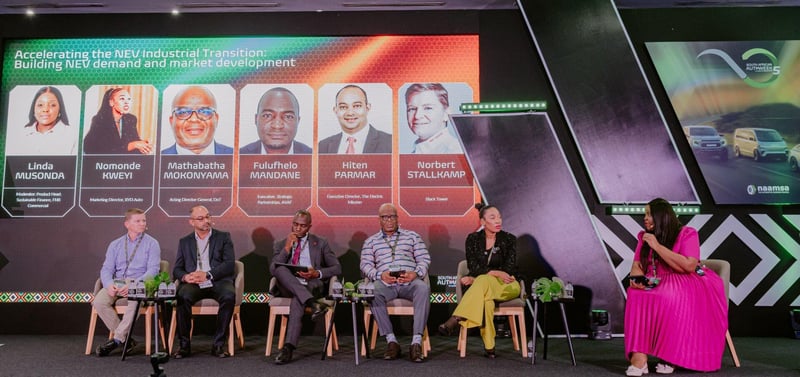
The fifth South African AutoWeek, hosted by naamsa | The Automotive Business Council, took place at the Durban ICC from 13 to 16 October 2026.
The Electric Mission's Executive Director, Hiten Parmar, joined the panel discussion on "Accelerating the NEV Industrial Transition: Building NEV demand and market development”, alongside policy, industry and finance leaders at SA AutoWeek 2026.
The discussion was a valuable exploration into the future of mobility in South Africa, examining the role of electric mobility in driving economic growth and employment, and the decision-making required across government, industry and finance to create a sustainable transport system for the country.
Parmar's contribution focused on debunking the common myths that still shape perceptions of electric vehicles in South Africa, and on the steady growth of the domestic electric vehicle market and what that growth signals about consumer readiness. He also outlined the progress being made on public charging infrastructure across the country, before looking ahead to what's next for the market and where the focus needs to be to keep momentum building.
Parmar shared the stage with Mathabatha Mokonyama, Acting Director-General at the Department of Transport; Nomonde Kweyi, Marketing Director at BYD South Africa; Fulufhelo Mandane, Executive: Strategic Partnerships at Absa Vehicle and Asset Finance; and Norbert Stallkamp of Black Tower. The session was moderated by Linda Musonda (Cele), Product Head: Sustainable Finance at FNB South Africa Commercial.
The conversation comes at a critical time for the local industry. Around the world, governments and manufacturers are moving decisively towards zero emission vehicles - battery electric and hydrogen, and South Africa cannot afford to fall behind the pace of these international developments. Vehicle and component manufacturing is one of the country's most important industrial sectors, and much of what is built here is destined for export markets such as the European Union and the United Kingdom, which are themselves transitioning to zero emission vehicles by 2035. South Africa’s Automotive Masterplan has the ambition to retain and grow these export markets by producing the vehicles and components they will demand in a decarbonized future, protecting the jobs, investment and skills the sector supports.
Transitioning South Africa's current automotive production base of internal combustion, hybrids and plug-in hybrid platforms requires policy certainty and supporting investments in new platforms and production lines. With a growing domestic market for electric vehicles, the support requires the pathway needed for manufacturers to commit to zero emission vehicle production on South African soil. Clear, consistent policy and technical standards, with supportive financing, will be essential to ensure these challenges are met in time.
Bringing policy makers, vehicle manufacturers and financiers together on a single platform, the panel reflected the collaborative approach that South Africa's transition demands. A call to action is to translate the African Union’s Continental Framework on Electric Mobility, endorsed in April, into regional development, as South Africa has the potential to build an architecture that links local assembly to the development of the regional value chain.
Release information
Issued on behalf of
The Electric Mission
Media contact
Electric Mission
Electric Mission