
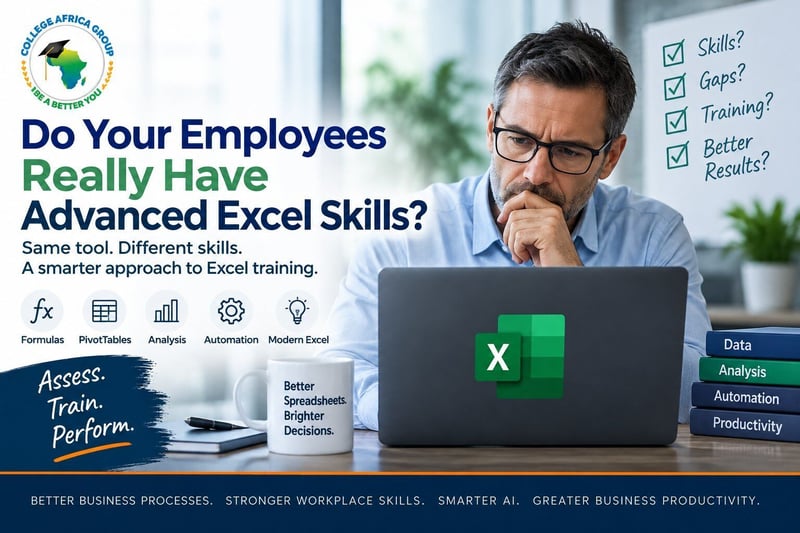
Do Your Employees Really Have Advanced Excel Skills?
Durban, September 09, 2026
A Finance Manager asks HR to arrange Advanced Excel training for the team.
It sounds straightforward.
But one employee struggles with formulas. Another can build PivotTables but still uses manual processes that take hours.
A third is comfortable with XLOOKUP and What-If Analysis. Another has started experimenting with newer Microsoft 365 Excel functions and AI.
They all use Excel every day.
But they do not necessarily need the same Advanced Excel training.
CAG Executive Question of the Week
Before sending employees on Advanced Excel training, do you actually know which Excel skills they already have — and which skills the business needs them to improve?
That question matters more than the course title.
“Advanced Excel” Is No Longer One Set of Skills
For years, organisations have tended to divide Excel users into three convenient categories: beginner, intermediate and advanced.
The workplace is more complicated than that.
An employee may be excellent with formulas but weak at analysing data.
Another may understand PivotTables but spend unnecessary time manually cleaning and preparing information.
A manager may know traditional Excel extremely well but have little exposure to newer Microsoft 365 functionality.
This creates a training problem.
Sending everyone on the same Advanced Excel course may be easier administratively, but it does not necessarily solve the business problem.
Start With the Work, Not the Course
The better question is not:
“Which Excel course should our employees attend?”
It is:
“What are our employees trying to accomplish in Excel, and what is stopping them from doing it efficiently?”
A monthly management report, for example, may involve:
Cleaning and restructuring data.
Correcting formula errors.
Copying information between workbooks.
Rebuilding reports every month.
Checking calculations manually.
Preparing information for management.
Repeating steps that could be simplified or automated.
These activities begin to reveal the real training requirement.
Sometimes the answer is better Excel skills.
Sometimes it is a poor business process.
Often, it is both.
“The question is not whether an employee knows Excel. The real question is whether they are using Excel effectively to solve the business problems they are responsible for.”
Arnold Muscat, Director, College Africa Group
Advanced Excel Training Should Reflect the Job
College Africa Group has restructured its Advanced Excel training around the way Excel is increasingly used in business.
Rather than treating Advanced Excel as one large collection of functions, the pathway develops different workplace capabilities.
Employees may need stronger skills in formulas, data management and reporting.
Others may require advanced analysis and productivity skills, including XLOOKUP, What-If Analysis and business modelling.
More experienced users may be ready for Modern Excel, including newer Microsoft 365 functionality, dynamic formulas, Power Query and more efficient ways of working with data.
The objective is not to teach employees the largest possible number of Excel features.
It is to help them perform their actual work better.
Test the Foundations First
An employee's job title does not necessarily indicate their Excel capability.
Someone may have used Excel for ten years while repeating essentially the same techniques for ten years.
Another employee may have used it for only two years but developed considerably stronger analytical skills.
College Africa Group has therefore developed a free Excel Skills Assessment that businesses and individuals can download and complete.
The practical assessment helps indicate whether the essential Excel foundations are in place before progressing to higher-level training.
It is not about labelling someone as beginner, intermediate or advanced.
It is about making a better training decision.
Where Does AI Fit Into Advanced Excel?
AI is also changing the Excel skills discussion.
ChatGPT and Microsoft Copilot can assist employees with formulas, explanations, analysis and troubleshooting.
That does not make Excel knowledge obsolete.
It makes validation more important.
If an AI assistant suggests a formula, somebody still needs to determine whether that formula is appropriate.
If AI analyses financial or operational data, somebody remains responsible for checking the source data, assumptions and conclusions.
An employee who understands Excel can question an AI-generated answer.
An employee who does not understand the underlying calculation may simply accept it.
That is a significant business risk.
AI can accelerate Excel work. It cannot assume responsibility for its accuracy.
What Should Advanced Excel Training Improve?
The business case for Advanced Excel training should ultimately be visible in workplace performance.
Effective training should contribute to:
Faster preparation of management reports.
Less repetitive spreadsheet work.
More accurate formulas and calculations.
Better analysis of business information.
More efficient data preparation and reporting.
Greater use of modern Microsoft 365 capabilities.
Better-informed business decisions.
Responsible use of AI with appropriate human validation.
Course completion is not the real measure of success.
Improved workplace capability is.
Rethink Your Advanced Excel Training
College Africa Group's Advanced Excel pathway is designed around practical workplace capability — from advanced formulas, data and reporting through to business analysis and Modern Excel.
Before deciding where employees should start, organisations should understand the work employees perform, the skills they already have and the capability gaps affecting productivity.
That creates a better training decision and, ultimately, a better business outcome.
Better Business Processes. Stronger Workplace Skills. Smarter AI. Greater Business Productivity.