
Why Are You Giving Every Employee the Same AI Training?
Johannesburg, September, 29, 2026 - CAG Executive Question of the Week
Does your Finance Manager, HR Manager, Project Manager and Sales Manager really need to learn exactly the same things about AI?
Who should read this?
CEOs, business owners, HR and L&D leaders, Finance Managers, Operations Managers and executives responsible for AI adoption, workplace productivity and employee development.
One AI Course. 200 Employees. Is That Really the Answer?
- A company decides it is time to introduce AI.
- The obvious next step seems straightforward: find an AI course and train everyone.
- Finance attends. HR attends. Sales attends. Project managers attend. Senior management attends.
- Everyone learns about prompts, ChatGPT, Microsoft Copilot and some useful AI techniques.
- The training may be good.
- But there is a more important question:
What do these employees actually do all day?
A Finance Manager analysing a monthly variance report has a completely different productivity problem from an HR Manager drafting policies or a project manager preparing a project status report.
So why would we expect exactly the same AI training to deliver the same business value to all three?
Start With the Role, Not the AI Tool
Businesses should be careful not to repeat an old training mistake with new technology.
The objective should not simply be to teach employees how to use AI.
It should be to help employees use AI within the work they are already responsible for doing.
Consider how different the opportunities can be.
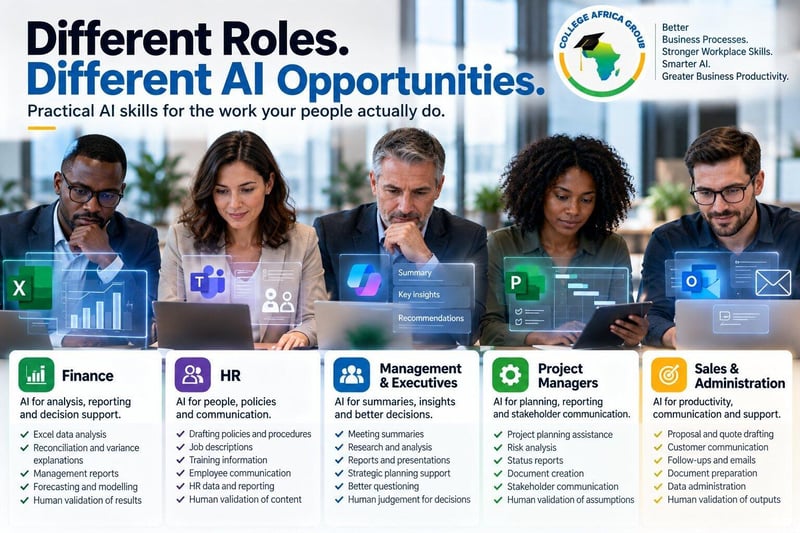
Finance teams may benefit from AI-assisted Excel analysis, reconciliations, variance explanations, management reporting and financial commentary.
HR teams may use AI to assist with policies, job descriptions, employee communications, training material and administrative processes.
Project managers may find value in project documentation, meeting summaries, risk identification, status reporting and stakeholder communication.
Sales and administrative teams may use AI for proposals, customer correspondence, follow-ups, document preparation and repetitive administrative work.
Managers and executives may use AI very differently again — summarising information, interrogating reports, researching issues, preparing meetings and exploring alternative decisions.
The technology may be the same.
The work isn't.
Before AI Training, Understand the Workflow
This is where AI adoption becomes a business-process question rather than a software question.
Before deciding what an employee should learn about ChatGPT or Microsoft Copilot, organisations should understand:
- What work does this role perform repeatedly?
- Where does that person lose time?
- Which activities require judgement?
- Which tasks depend heavily on Excel or Microsoft 365?
- Where is work duplicated?
- Which outputs could AI help produce?
- Who will validate those outputs?
This is the purpose of AI Workflow Discovery.
Rather than starting with a catalogue of AI features, start by examining the work.
The opportunities identified can then determine what training, process improvement and technology are actually required.
AI Does Not Remove the Need for Workplace Skills
- Role-based AI also exposes another important issue.
- An employee cannot effectively validate an AI-generated Excel analysis without understanding the underlying data and Excel.
- A project manager still needs to understand project management before evaluating an AI-generated risk assessment.
- An HR professional remains responsible for judging whether an AI-generated policy is appropriate.
- An executive cannot outsource business judgement to a chatbot.
- AI can help employees produce work.
- It does not automatically give them the professional knowledge required to determine whether that work is good.
That is why Advanced Microsoft Excel, Microsoft 365 and core workplace skills remain part of the AI productivity conversation.
Arnold Muscat's Comment
“I don't think the question businesses should be asking is, ‘How do we train everybody to use AI?’ The better question is, ‘What does this person actually do every day, and where can AI help them do it better?’
A Finance Manager and an HR Manager may both use ChatGPT or Microsoft Copilot, but they don't do the same work. Why would we train them as if they do?
Start with the work. Understand the process. Then teach people how to use AI where it genuinely helps.”
— Arnold Muscat, Director, College Africa Group
Different Roles. Different AI Opportunities.
There will always be a place for general AI awareness training.
Employees need to understand responsible AI use, confidentiality, governance, prompting, hallucinations and human validation.
But once organisations move beyond awareness and start looking for measurable productivity improvements, the conversation needs to become more specific.
The question changes from:
“How do we teach our employees AI?”
to:
“Where can AI improve the work these employees actually perform?”
That is a much better starting point.
Start With the Work
College Africa Group helps organisations identify practical AI opportunities through AI Workflow Discovery, AI Consulting and role-based workplace training.
The objective is not to introduce AI everywhere.
It is to identify where better business processes, stronger workplace skills, Microsoft 365, ChatGPT and Microsoft Copilot can combine to improve real work — with people remaining responsible for validating the results.
If you are considering AI training across Finance, HR, management, project teams or other business functions, start by understanding what each group actually needs AI to help them accomplish.
Better Business Processes.
Stronger Workplace Skills.
Smarter AI.
Greater Business Productivity.
Contact College Africa Group to discuss AI Workflow Discovery and practical AI training by business role.
Release information
Issued on behalf of
College Africa Group
Media contact
College Africa Group
Arnold Muscat