
At the Top of South Africa's Skyline, Education Pioneer Launches The Human Advantage
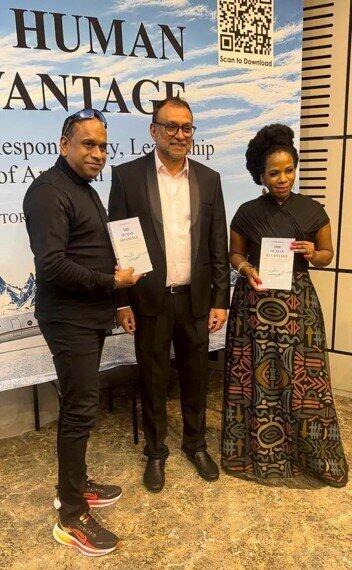
Education entrepreneur Jay Ramnundlall launches book and AIFT's future-focused higher education qualifications at The Leonardo in Sandton, as South Africa advances its AI ambitions.
Against the striking backdrop of The Leonardo, the Alpvest Institute for FutureTech (AIFT) celebrated two significant milestones on Friday, 20 November 2026: the Johannesburg launch of its new generation of higher education qualifications and the official launch of The Human Advantage: Judgement, Responsibility and Leadership in the Age of Artificial Intelligence, authored by Group Chief Executive Officer Jay Ramnundlall.
The event took place at The Leonardo Hotel's Isabella Suites, an iconic Sandton development. Rising approximately 234m above Johannesburg's financial district, The Leonardo is South Africa's tallest building and a powerful symbol of architectural ambition. This provided a fitting setting for a discussion about South Africa's technological future and the responsibilities that accompany rapid innovation.
From architectural ambition to artificial intelligence
The symbolism of the occasion extended beyond the venue itself.
Just as The Leonardo represents the ambition to push the boundaries of engineering and architectural achievement, The Human Advantage examines the opportunities and responsibilities arising as artificial intelligence (AI) pushes the boundaries of technological capability.
The book explores a fundamental question confronting business leaders, governments, educational institutions and society: As artificial intelligence becomes increasingly capable of analysing information, making decisions and acting autonomously, what responsibilities must remain firmly in human hands?
Its central proposition is that technological progress must strengthen human capability rather than diminish it. We may delegate intelligence to machines, but we must never surrender human judgement, responsibility or accountability.
Ramnundlall’s book challenges the assumption that greater technological intelligence necessarily produces better or more responsible decisions. It introduces three interconnected governance concepts: Accountability Distance, Agency Envelope and Responsibility Threshold. These provide a framework for understanding how organisations can establish boundaries around autonomous AI systems while retaining meaningful human oversight and accountability.
The hidden threat to tomorrow's professionals
A central argument of The Human Advantage concerns the future of graduate employment and professional development. While much of the public debate about AI focuses on the possibility of large-scale job losses, Ramnundlall identifies another potentially serious consequence: the gradual disappearance of entry-level tasks through which young professionals traditionally acquire experience.
As AI increasingly performs routine research, administration, financial analysis, coding and other foundational activities, employers and educational institutions may need to redesign the pathways through which graduates develop expertise and professional judgement.
If AI removes the first rung of the career ladder, business and education must create new pathways through which tomorrow's professionals and leaders can develop.
AIFT launches a new generation of higher education qualifications
The event also marked an important milestone in AIFT's institutional development. Deputy CEO of AIFT Professor Louis Fourie and CEO of AIFT Kegan Shunmugam introduced the institution's expanding portfolio of higher education qualifications designed to respond to emerging technological, professional and entrepreneurial opportunities.
The portfolio includes flagship qualifications such as the Bachelor of Commerce in Artificial Intelligence and Bachelor of Science in Future Technology, alongside qualifications across information technology, cybersecurity, business, commerce and public administration.
AIFT's educational approach emphasises the integration of technological knowledge with critical thinking, creativity, professional competence, ethical judgement and responsible leadership.
The institution aims to prepare graduates who can use emerging technologies effectively while retaining the independent judgement required to evaluate and govern their application. This also highlighted opportunities for collaboration with employers, professional bodies and other stakeholders in workplace learning, research, innovation and graduate development.
A significant moment for South Africa's AI ambitions
The launch coincided with President Cyril Ramaphosa's November 2026 visit to Silicon Valley to advance South Africa's ambitions in AI, technological innovation, investment and human capability development.
The timing reinforced the relevance of the book's central argument.
While national AI strategies necessarily address infrastructure, investment, research, digital transformation and economic competitiveness, The Human Advantage focuses on an equally important dimension: ensuring that human judgement, responsibility and accountability remain central to technological progress.
The book also examines the opportunities for African countries to develop their own technological capabilities, support entrepreneurship and participate more meaningfully in the global AI economy.
From a childhood without electricity to the age of AI
The publication reflects Ramnundlall's personal journey spanning more than four decades in business, technology and education.
Growing up in modest circumstances in Avoca, KwaZulu-Natal, in a home without electricity and with limited access to water, he subsequently established PC Training and Business College and Richfield, contributing to the development of computer education and technology-enabled learning in South Africa.
Today, as Group CEO of AIFT, he remains closely involved in educational innovation and the development of qualifications responding to emerging technological requirements.
His involvement in overseeing and quality-assuring academic curricula and learning materials contributed significantly to the thinking behind The Human Advantage.
Taking the conversation to Africa
Following the Johannesburg launch, Ramnundlall is scheduled to deliver a keynote address at CIO100 Africa in Kenya on 27 November 2026, entitled: ‘The Human Advantage: What AI Can't Do for the African Enterprise’.
The address will extend the book's arguments to the wider African business environment, examining the responsibilities of CEOs, CIOs, corporate boards and institutional leaders in an era of increasingly autonomous artificial intelligence.
The message is clear: the future of AI must remain a human responsibility.
About the book
Title: The Human Advantage: Judgement, Responsibility and Leadership in the Age of Artificial Intelligence
Author: Jay Ramnundlall
Publisher: African Knowledge Centre Ltd, Mauritius
Paperback ISBN: 978-99993-0-742-0 eBook ISBN: 978-99993-0-743-7
Digital flipbook: https://online.flippingbook.com/view/279427488/
About AIFT
The Alpvest Institute for FutureTech (AIFT) is a South African private higher education institution offering qualifications across emerging technologies, information technology, commerce, business management and public administration.
Through its expanding academic portfolio and campus network, AIFT seeks to develop technologically competent, professionally capable and ethically responsible graduates prepared for the changing world of work.
Release information
Issued on behalf of
Olivia Jones Communications
Media contact
Olivia Jones Communications
Agnes Matladi