
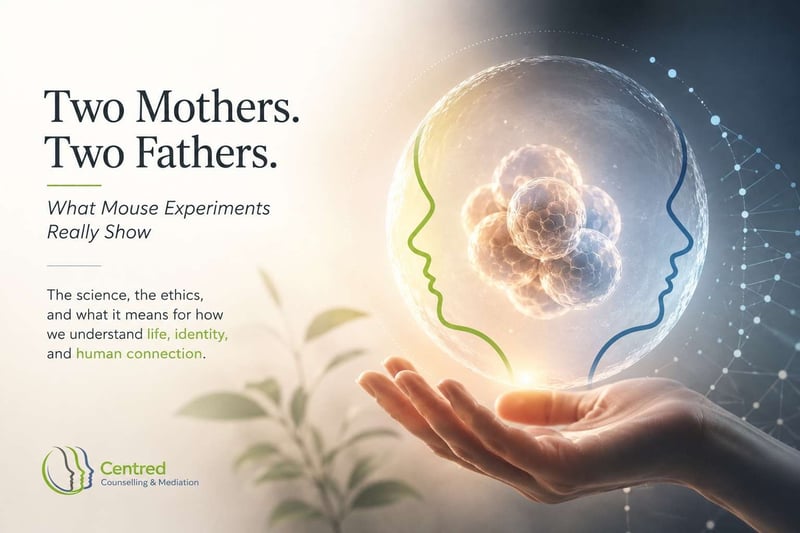
Two Mothers, Two Fathers, and the Future of Science: What Mouse Experiments Really Show
When headlines appear claiming that scientists created mice from “two mothers” or “two fathers,” many people immediately wonder:
Is natural reproduction becoming obsolete?
Does biology no longer matter?
Could this happen in humans soon?
The reality is far more complex — and far more scientifically fascinating.
Recent experiments involving mice have shown that scientists can, under highly controlled laboratory conditions, create offspring using genetic material from two females or two males.
But these studies do not mean mammalian reproduction has been replaced or fundamentally rewritten.
Instead, they reveal just how intricate human and animal development truly is.
What Actually Happened?
Researchers used advanced genetic engineering, stem-cell manipulation, and reproductive technologies to create embryos using DNA from two female mice, and in separate experiments, two male mice.
The process was extremely complicated and required a combination of high-tech interventions:
Gene editing
Manipulation of embryonic stem cells
Artificial reproductive techniques
Surrogate mothers
This was not “natural fertilisation” in any ordinary sense.
Why Is This Such a Big Scientific Discovery?
For decades, scientists believed mammals absolutely required one maternal genetic contribution and one paternal genetic contribution to successfully develop.
These experiments challenged that assumption — at least partially.
However, the studies also revealed something equally important: male and female genetic contributions are not interchangeable.
The Hidden Layer Beyond DNA: Genomic Imprinting
One of the biggest lessons from these experiments involves a biological process called genomic imprinting.
This refers to chemical “instructions” attached to genes that determine:
Which genes switch on
Which genes switch off
How embryos develop safely
Maternal and paternal DNA are programmed differently.
Even if two parents of the same sex contribute the correct total amount of DNA, the embryo will fail to develop normally if those specific imprinting patterns are missing or incorrect.
To overcome this, researchers had to use complex gene-editing techniques to delete specific imprinting markers on the DNA before combining them.
Without this highly artificial intervention, the embryos from two mothers or two fathers could not survive.
Why Were “Two Mothers” More Successful Than “Two Fathers”?
One fascinating outcome was that mice created from two females were generally healthier and more viable than mice created from two males.
Scientists believe this is because egg cells contribute far more than just DNA.
Eggs also provide:
Essential cellular machinery
Nutrients
Early developmental signals
Mitochondrial support
This highlights an important biological reality: reproduction involves far more than simply combining genetic material.
Does This Mean Human Reproduction Is About To Change?
No.
These experiments were conducted in mice under narrow, controlled laboratory conditions with incredibly low success rates.
Many embryos did not survive.
Some offspring developed severe genetic and developmental abnormalities.
The procedures required invasive genetic intervention that is currently impossible, unsafe, and illegal to attempt with humans.
At present:
This is not remotely close to standard human reproduction.
It is not medically practical or viable.
It raises massive global ethical and safety concerns.
What Can We Learn From This?
Although these experiments are often sensationalised online, the real scientific value lies elsewhere.
This research may help scientists better understand:
Area of Impact
Scientific Value
Infertility
Discovering why certain embryos fail to implant or develop.
Developmental Disorders
Mapping how genes switch on and off during early growth.
Stem-Cell Biology
Learning how to reprogram cells for regenerative medicine.
Genetic Diseases
Understanding the mechanisms behind inherited imprinting conditions.
It also reminds us that biology is extraordinarily sophisticated.
The human body is not simply a machine built from interchangeable parts.
Development depends on deep layers of genetic, cellular, and epigenetic processes that scientists are still trying to fully comprehend.
Final Thoughts
Science continues to push the boundaries of what we once believed possible.
But breakthroughs like these should be understood carefully — not through fear, misinformation, or sensational headlines.
These mouse studies do not erase biological realities.
Instead, they deepen our understanding of how complex life truly is.
And perhaps most importantly, they show that even after decades of scientific progress, nature remains far more intricate than we often assume.
Centred Counselling
If you enjoy thoughtful discussions exploring psychology, human behaviour, science, emotional wellbeing, and the complexities of modern life, follow Centred Counselling for more evidence-based content.
Get new press articles by email
SEO Website Design South Africa is a premier digital agency dedicated to bridging the gap between aesthetic excellence and technical performance. Specializing in WordPress development, we believe that a website is only as good as its ability to be found. That is why every site we build is engineered with Search Engine Optimization (SEO) at its core—not as an afterthought, but as a... Read More
Latest from
The Pulse Latest Articles
- Sotru Launches To Stop Supplier Fraud At The Moment Of Payment (June 23, 2026)
- The Death Of The Dinner Party? Why South Africans Are Choosing Convenience Over Traditional Entertaining (June 23, 2026)
- Wildbeest Media Launches 2026 Tourism Marketing Campaign Service For South African Travel Brands (June 22, 2026)
- Opinion Piece: The Chair Is Not The Person: A Ceo’s Hardest Leadership Lesson (June 22, 2026)
- Pura And Soweto Cyclists Celebrate Youth Day 50 Years After The 1976 Uprising (15) (June 18, 2026)