
Beach Clean-up helps turn litter into livelihoods, and gives a revived buy-back centre its first push
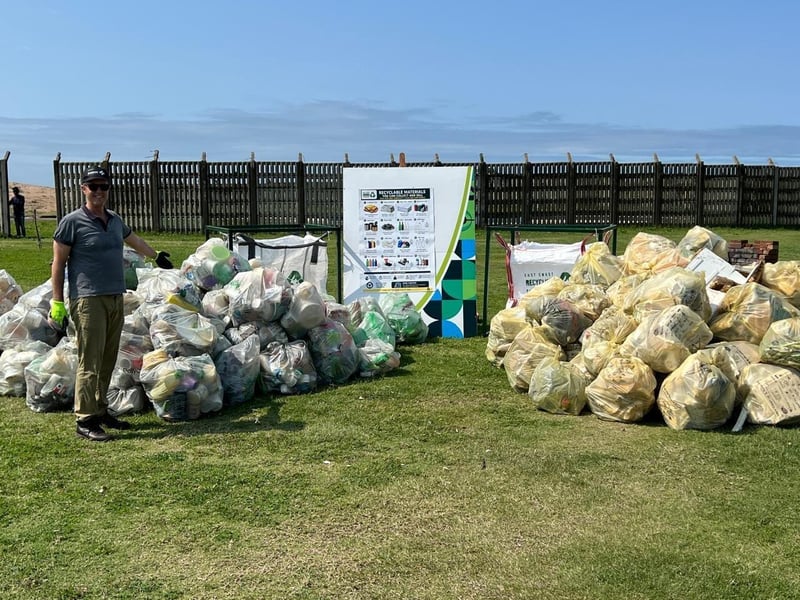
Green Corridors' East Coast Recycling Partnership tests a two-bag system and prepares the Dakota Beach Buy Back Centre to serve the informal settlement as a micro-business pilot.
When the Municipality's World Clean Up Day volunteers hit Dakota Beach, on World Clean Up Day last month, the East Coast Recycling Partnership (ECRP), a Green Corridors initiative, asked them to do one thing differently: separate recyclables at the source, with a two-bag approach.
The Municipality's Cleansing and Solid Waste (CSW) unit led the event, supported by schools and corporate volunteers. It focused on south Durban beaches, with clean-ups at Cuttings, Reunion and Dakota/Isipingo. ECRP took part only at Dakota Beach, south of Durban, the site beside the informal settlement where the Dakota Recyclers Informal Settlement Buy Back Project is in its start-up phase. The settlement sits in ecologically sensitive beach dunes, which made it a good fit for a recovery-focused approach.
Volunteers from schools, corporates, and the local community , paired up, with one carrying a bag for non-recyclable waste and the other a bag for recyclables. The recyclable bags were shared between Verigreen/Supa Mama's, and Dakota Recyclers.
ECRP were able to weigh everything collected at the Dakota Beach BBC and the following was recorded:
- 1,142kg of non-recyclable waste which was taken to landfill by the Parks Department.
- 890kg was collected in separate bags for recycling comprising 234kg of plastic and 656kg of glass.
A large share of the non-recyclable waste was polystyrene, which is technically recyclable but has no market locally.
"Separating at the source meant the recyclables came out clean and usable, instead of being lost in a general waste pile," said Gary Cullen, Project Manager of ECRP. "It also showed us what the problem materials are, to enable us to strategize how we can manage that waste.”
The Dakota Recyclers Centre was first set up in 2024 but served only a small group of informal collectors. . The ECRP is now assisting to expand that Centre and enable the Dakota Recyclers to begin a business buying back recyclables from informal reclaimers thereby supporting livelihoods among the approximately 4000 residents of the Dakota Beach informal settlement
The model is simple. Residents bring recyclables to the centre, where each material is weighed and paid for at its own rate. Payment is immediate. The centre stores the material, and ECRP periodically transports it to a facility in KwaMashu to be baled and sold. It sells directly, with no middleman, and the proceeds go back to the centre. The centre buys all recyclables: metals, paper, cardboard, plastics and glass brought in.
Dakota Recyclers, which runs the centre, is led by Mpume Magutshwa, a resident of the settlement who has been involved in the initial project in 2024. She and several young people began collecting, sorting and selling to a buyer who they would call occasionally.. With the centre now able to weigh and pay immediately and store securely on site, the opportunity is opened for more people to benefit as reclaimers and for Dakota Recyclers to generate greater revenue from the sale of baled materials..
The pilot is also designed to produce verifiable data for funders and brand owners: how many people take part, how often, what they earn, and what costs and revenues look like. That will show the extent of government and donor support needed for this buy-back model to be a self-sustaining way to divert recyclables from informal settlements and support local livelihoods in addition to reducing waste in the natural environment.
Dakota is one of three informal settlement min-buyback micro-businesses currently being set up by ECRP with the aim of developing a solution for municipalities locally, nationally and globally.
During the next few months, the ECRP will track recyclable volumes and finances, and will provide financial management and bookkeeping support so that these centres run as well-managed businesses. Both the Municipality's Waste Manage and Parks departments supported the centre during the clean-up, and both are keen to see it work.
International organisations, The Alliance to End Plastic Waste, and Unilever (SA) are supporting the ECRP’s role in recycling in KZN.
Organisations, industry players and investors interested in playing a part in this collaborative partnership building a viable circular economy for SMMEs in KwaZulu-Natal can contact the project directly on
This email address is being protected from spambots. You need JavaScript enabled to view it..
Release information
Issued on behalf of
Green Corridors
Media contact
Versfeld & Associates
Sharlene Versfeld