
LinkedIn Declares War on AI Slop - What It Means for South African B2B Marketing
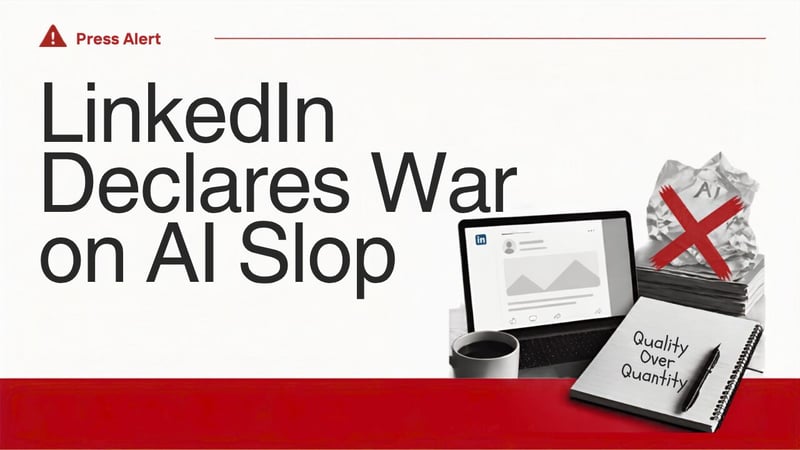
Johannesburg, 12 August 2026 LinkedIn has introduced a "Seems like AI slop" reporting button, giving its one billion members the power to flag and suppress low-quality AI-generated content. The move, confirmed by LinkedIn Chief Product Officer Hari Srinivasan, marks the platform's most aggressive stance yet against the flood of AI-generated posts that now dominate B2B feeds. For South African businesses that have leaned heavily on AI content tools, the implications are immediate and far-reaching.
How Big Is the AI Content Problem on LinkedIn?
It is enormous, and the data confirms what many professionals have long suspected. According to research by Pangram Labs, which analysed more than one million long-form LinkedIn posts in July 2026, 41% of all long-form content on the platform is now AI-generated. LinkedIn hosts 62% of all AI content scanned across major social networks, making it the single largest repository of machine-written professional content online.
The problem extends beyond volume. Originality.ai examined the output of 99 of LinkedIn's most influential voices and found that more than 50% of their posts were AI-generated. When the platform's thought leaders are outsourcing their thinking to machines, the credibility of professional content as a whole comes into question.
LinkedIn's own transparency data paints an even starker picture. In a single quarter (reported March 2026), the platform blocked 78.2 million fake accounts. It continues to intercept billions of automated posting attempts and catches hundreds of thousands of automated comments every day, according to Fortune.
What Exactly Has LinkedIn Changed?
LinkedIn has added a "Seems like AI slop" option to the three-dot menu that appears on every post. Any user can now flag content they believe was generated by AI without meaningful human input or editorial value.
Posts that accumulate flags face reduced distribution. According to Hari Srinivasan, LinkedIn's Chief Product Officer, flagged content will see its reach limited beyond the poster's immediate network. This means AI-flagged posts will not appear in feeds, search results, or recommendations for second and third-degree connections, effectively cutting off the viral distribution that makes LinkedIn valuable for B2B marketers.
In a telling move, LinkedIn has also removed its own "enhance your post" AI rewriting feature, which had encouraged users to run their drafts through an AI polisher before publishing. It has been replaced with a simpler proofreading tool that checks grammar and spelling without rewriting content. The platform is, in effect, admitting that its own tools contributed to the problem it is now trying to solve.
Why Is This the Biggest LinkedIn Algorithm Change in Years?
Previous algorithm updates adjusted what content was shown. This update changes the fundamental economics of content creation on the platform. For the first time, LinkedIn is crowdsourcing content moderation of AI quality, giving every user the role of editorial gatekeeper.
The impact compounds over time. A company or individual whose posts are repeatedly flagged will see systematic suppression of their content. This is not a temporary dip in engagement. It is a structural penalty that degrades an entire LinkedIn presence. For B2B organisations that have invested in AI-powered content at scale, the risk is not a single underperforming post. It is the erosion of their professional brand.
"This changes the cost-benefit calculation entirely," says Noleen Thompson, founder of LadyBugz Marketing and a specialist in B2B LinkedIn strategy. "For the past two years, many businesses have treated LinkedIn content as a volume game: generate more, post more, appear more. That strategy is now a liability. Every AI-generated post that gets flagged actively damages the account that published it."
What Does This Mean for South African B2B Marketing?
South African B2B marketers face a particular challenge. LinkedIn is the dominant professional platform in the country, and many local businesses have embraced AI content tools precisely because they solve the resource constraints that smaller marketing teams face. The temptation to let AI do the heavy lifting has been strong, and until now, there was little downside.
That calculus has shifted overnight. Companies running AI-generated thought leadership, employee advocacy content, and social selling programmes need to audit their content pipelines immediately. Any content that reads as generic, follows predictable AI patterns (numbered lists, vague motivational language, recycled frameworks), or lacks a genuine human perspective is now a target for user flags.
"South African B2B companies have a genuine advantage here," Thompson explains. "Our market is relationship-driven. We do business on trust, personal connection, and local expertise. Those are exactly the qualities that AI cannot replicate and that LinkedIn's algorithm now rewards. The businesses that lean into authentic, experience-based content will outperform those still relying on AI-generated filler, regardless of budget."
Is This the End of Fake Thought Leadership?
The era of manufactured authority is ending. When half of LinkedIn's top influencers are publishing AI-generated content, "thought leadership" has become a label rather than a practice. LinkedIn's new reporting mechanism gives audiences the tool to enforce the distinction.
What replaces it is harder to scale but far more valuable: genuine expertise shared in a human voice. Content that draws on real client engagements, honest assessments of what works and what does not, industry-specific insights that only come from experience, and perspectives that reflect the author's actual thinking rather than a prompt fed into a language model.
For corporate teams, this means rethinking employee advocacy programmes. Giving employees AI-generated posts to share under their names is no longer a shortcut to visibility. It is a fast track to having those employees' accounts flagged and suppressed. Effective advocacy now requires investing in employees' ability to share their own professional stories, even if the output is less polished and less frequent.
The LinkedIn Paradox: Why Did the Platform Encourage What It Now Punishes?
There is an uncomfortable irony in LinkedIn's position. The platform actively promoted AI content creation tools, including its own "enhance your post" rewriter, and integrated AI features across its publishing workflow. It encouraged the behaviour it is now penalising.
The reversal reflects a broader reckoning across social media. Platforms that embraced AI-generated content for engagement volume are now discovering that the resulting decline in content quality drives users away. LinkedIn's move is ultimately a defence of its core value proposition: being the place where professionals share real expertise. If every post reads like it was written by the same machine, there is no reason to scroll.
"LinkedIn is correcting course because it has to," Thompson notes. "The AI content flood was undermining the very thing that makes the platform valuable. Users were disengaging. The 'Seems like AI slop' button is LinkedIn admitting that quality matters more than quantity, and that humans are the best judges of what is genuine."
What Should Marketing Agencies and Content Creators Do Now?
The required response is immediate and practical. Based on the new reality, businesses and agencies should take the following steps:
1. Audit existing content. Review all scheduled and recently published LinkedIn posts. Identify anything that reads as generic or formulaic. Remove or rewrite content that could trigger user flags.
2. Restructure content workflows. AI remains a useful tool for research, ideation, and first-draft generation. But the final output must carry a distinct human voice, specific examples, and genuine perspective. The days of publishing AI drafts with minimal editing are over.
3. Invest in subject matter expertise. The most flag-proof content comes from people who genuinely know their subject. Build content programmes around your organisation's real experts, not around AI prompts.
4. Rethink employee advocacy. Replace AI-generated post templates with coaching and support that helps employees share their own experiences. Fewer, authentic posts will outperform higher volumes of machine-written content.
5. Monitor account health. Track engagement rates, reach metrics, and follower growth closely over the coming months. A sudden drop may indicate that content is being flagged.
6. Brief your social selling teams. Sales professionals using LinkedIn for outreach need to understand that AI-generated messages and posts carry new risks. Personalised, human communication is now a competitive advantage, not just a nice-to-have.
What Comes Next for LinkedIn Content Strategy?
LinkedIn's AI slop button is a leading indicator. Other professional platforms and search engines are moving in the same direction, prioritising original, expert-driven content over AI-generated volume. Google's helpful content updates have already devalued AI-written web pages. LinkedIn is now applying the same logic to social feeds.
For B2B marketers, the path forward is clear: treat content as a craft, not a commodity. The organisations that invest in genuine expertise, authentic storytelling, and human connection will be the ones that build lasting professional brands on LinkedIn. The rest will find their content quietly disappearing from feeds, flagged by the very audiences they were trying to reach.
"This is actually good news for businesses that do the work," Thompson concludes. "The noise is about to get quieter. For companies with real expertise and real stories to tell, LinkedIn just became a much more effective platform."
About LadyBugz Marketing
LadyBugz Marketing is a South African B2B marketing agency specialising in LinkedIn strategy, content marketing, and digital lead generation for professional services firms. With deep expertise in AI-augmented marketing workflows and original content creation, LadyBugz helps businesses build authentic professional brands that perform in an era of increasing AI content saturation.
Release information
Issued on behalf of
LadyBugz
Media contact
LadyBugz
Noleen Thompson