
Historic Irma Stern Masterpiece Goes On Display At UP Museums Until September 2026
Written by: BizCommunity Editor Save to Instapaper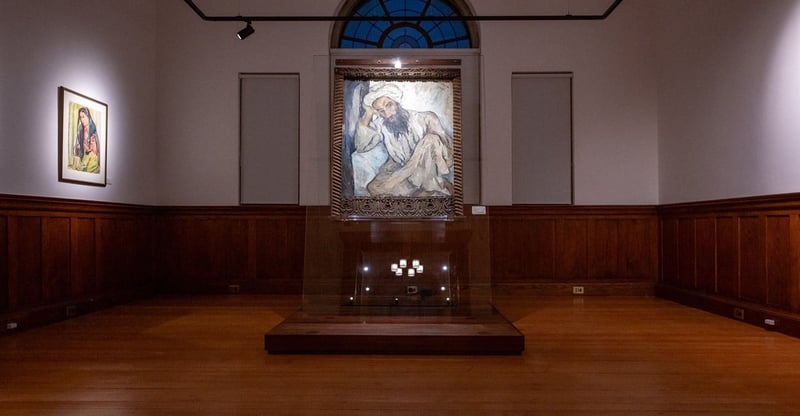
Irma Stern’s iconic Arab Priest (1945) takes centre stage at the University of Pretoria Museums, presented on a bespoke glass plinth for a rare, immersive viewing experience. The exhibition is open to the public until 9 September 2026.
South African artist Irma Stern’s painting Arab Priest was welcomed back to the country at an extraordinary reception hosted by the University of Pretoria (UP) Museums on International Museum Day (18 May).
The iconic painting – which became the most expensive South African artwork sold at auction when it was acquired by the Qatar Museums Authority for £3.1m in 2011 – will be on display at the Old Arts Building on UP’s Hatfield Campus until 9 September 2026.
During the reception and unveiling, held in the courtyard outside the Old Arts Building – which houses much of the UP Museums collections – the image of the Arab Priest was projected onto its gable. The area was lit dramatically as if it were a theatre set, and music master’s student Atlegang Milanzi wove among the guests playing his violin compositions, making it an unforgettable experience.
“UP Museums curates inside and out – our collections are beyond walls,” said Dr Sian Tiley-Nel, head of the UP Museums, “We are honoured to host Arab Priest and celebrate Irma Stern’s legacy in a university museum.”
Guest viewing the 'Arab Priest', exhibition at UP Museums
The 1945 oil painting, which Stern (1894–1966) painted towards the end of the Second World War on her second visit to Zanzibar, had been housed in the Lusail Museum in Qatar after its sale in 2011. It has returned to South Africa once before, and is now on view at UP until 9 September. Thereafter it will travel to the Iziko South African National Gallery in Cape Town for six months, before travelling to Doha.
Professor Engela Schlemmer, UP’s new Registrar, hosted the launch. She noted that this year’s InternationalMuseum Day, celebrated by 37,000 museums across 158 countries, is themed ‘Museums Uniting a Divided World’. Fittingly, this exhibition, The Return of the Arab Priest, united UP and Qatar. “In a divided world beset by geopolitical strife and tragedy, this global partnership is a wonderful example of the power of art to bring nations and communities together, [to] celebrate our cultures and join hands in opposing dogmatism and discrimination,” she said.
“The Return of the Arab Priest is deeply meaningful for all of us. It is a part of our country’s soul, returning home for a while, by the grace of our wonderful Qatari partners, generously permitted and facilitated by the South African Heritage Resources Agency (SAHRA). Thank you for embracing this important moment of friendship, of cultural kindredness extending across the miles,” Prof Schlemmer added.
Mamakomoreng Nkhasi-Lesaoana, executive officer for Heritage Resources Management at SAHRA, shared that the organisation had initially “refused the permit for the Arab Priest to leave the shores of South Africa”. That refusal had led to negotiations and “we ended up with a loan agreement that allowed for the Arab Priest to come to South Africa every five years, where it can then be enjoyed by the South African public through various exhibitions such as this one,” she said.
Guests viewing The Return of the Arab Priest exhibition, which took two years to plan and coordinate, are treated to 11 additional works by Irma Stern. Ten of these are on loan from the Irma Stern Trust. UP owns Still Life with Watermelons, which it bought in 1964 for the princely sum of R500. One of the archival letters in the accompanying display in two glass cabinets is about this purchase.
An image of the 'Arab Priest' being projected onto UP's inconic Old Arts Building
The oil paintings surrounding Arab Priest include one of a Malay woman painted in Cape Town in 1939 and titled simply Motjie. Another is of a woman from the then Belgian Congo, to which Stern also travelled.
Uthando Baduza, curator of Art Exhibitions and Galleries for the UP Museums, who curated the exhibition, said he has intentionally surrounded the priest with “honoured and noble women. The design and the structure of the building limited curatorial freedom, and therefore the approach was to take the limited space to generate dialogues and meaning by positioning the works along thematic and gender lines.”
The Stern works on loan include three reverential drawings on paper, such as one of people in a mosque. But Arab Priest takes pride of place. It is mounted on a specially designed glass plinth so that it appears to be floating and allows viewers to see both the painting itself and its back. Viewers can also see how it was first framed in simple wood and then later reframed in the more elaborate carving of a piece of a Zanzibar door. “It is the first time that the painting has been displayed in this way, and it’s the key feature of our curatorial approach,” Baduza said.
Dr Alastair Meredith, senior art specialist at Strauss & Co and guest speaker at the opening, praised this move. “The genius of this little show is the fact that it’s on this wonderful plinth, and you can walk around it. It has a real sculptural presence,” he said.
Dr Meredith also commented on how a poem written in response to the exhibition reflected on Stern’s character, ‘something art historians don’t pick up on much.’ Kapisha Ramraj, a UP honours student in visual studies, read the poem, which she had written as an assignment asking for a personal response to the exhibition. She noted that Stern had referred to herself in her writings as “The Blue One” who had been rejected and felt sad and lonely because people did not understand her art.
Ramraj contrasted this with South Africa’s national bird, the blue crane, which became the title of her poem. “Blue Crane, Blue Crane… Your place is here. We are your kin. Rest well, for you are home,” she read.
Dr Meredith went further in describing Stern’s character. He said Stern, who was born to a German-Jewish family in Schweizer-Reneke, a small town in the former Transvaal and now the North West province, was a “wonderfully famous, hugely important artist” and “the rock star of the secondary art market in South Africa, the first artist to break a million rand at auction in South Africa” – but she could be cantankerous, was incredibly difficult, and could be vindictive and ruthless (even selfish, he supposed) in terms of presenting her art career.
“As Kapisha mentioned, she was enormously insecure. She was insecure about her looks, about her body, about her background. One thing she was never insecure about, however, was her ability as a painter. She knew absolutely for certain that she was a damn fine modernist painter, and I think she always knew that no matter the criticism she received – and she received a lot of it, particularly in the 1920s and 1930s – she knew that ultimately her legacy would survive, and she would always be seen as a key international modernist,” Dr Meredith said.
Get new press articles by email
We submit and automate press releases distribution for a range of clients. Our platform brings in automation to 5 social media platforms with engaging hashtags. Our new platform The Pulse, allows premium PR Agencies to have access to our newsletter subscribers.
Latest from
- South African Brands Dominate Africa 200 Ranking As Pan African Growth Accelerates
- Lesotho Wins Major Appeal As South African Court Blocks R950m Frazer Solar Claim
- CFI Financial South Africa Highlights Financial Literacy As Driver Of Smarter Market Participation
- Stellantis And Qualcomm Deepen Collaboration On Smart Vehicle Connectivity And Safety Features
- Industry Survey Reveals Responsible Gaming Now Central To Online Betting Platform Development
- City Of Cape Town Launches Next Phase Of Renewable Electricity Wheeling With Pooled Model
- CIMA Warns Businesses To Redesign Models For A More Uncertain And Interconnected World
- APO Group Calls For More Relevant Storytelling To Build Credibility Across African Markets
- Air Products And Tronox Strengthen Long-Term Partnership With Advanced PSA3 Commissioning
- Pace Car Rental Expands Nationwide Following Years Of Strategic Fleet And Market Growth
- Steve Louw Releases Nashville-Recorded Album Featuring Renowned Americana And Rock Artists
- Takealot And DHET Launch Student Initiative To Boost Entrepreneurship And Flexible Income
- Afreximbank Reports Robust Q1 Results Driven By Trade Finance And Economic Development Goals
- Diamond And Gold Awards Highlight Excellerate Services’ Commitment To Consistent Quality
- Energy Sector Leaders Back Venezuela’s Reform Agenda To Revitalise Oil Production And Investment
The Pulse Latest Articles
- South African Women Are Missing This Essential Nutrient (May 20, 2026)
- Opinion Piece: Rethinking Performance: Why Behaviour Remains The Missing Link In Evaluation (May 20, 2026)
- 125 Years Of Hansgrohe And The Designers Who Made Axor A Luxury Language (May 19, 2026)
- World Whisky Day: Whisky Lovers Challenged To Stop Saving Their Best Bottles (May 15, 2026)
- Hidden Inefficiencies Are Draining South African Businesses (May 15, 2026)