
Philip Morris South Africa women leaders share lessons on inclusion, leadership and mentorship for #WomensMonth
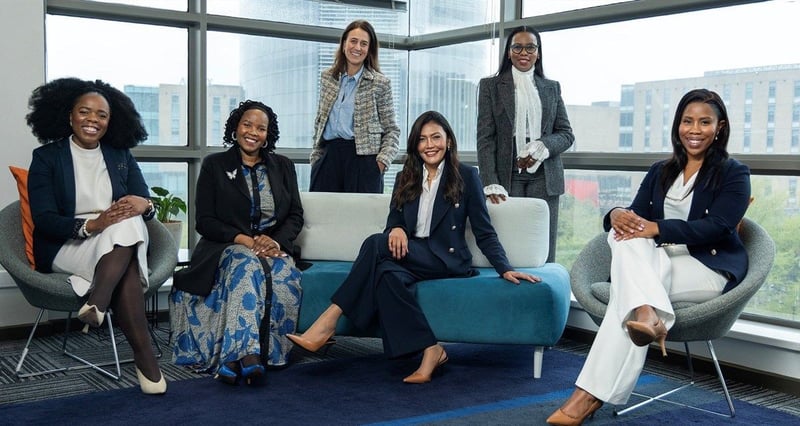
Their entry points differed from a factory floor, a laboratory, a law firm, a technology department, a people function.
What they share is experience of being the only woman in the room and a set of deliberate decisions about the kind of leaders they wanted to become.
Leading without a blueprint
Buena Barnes is the first South African woman to lead the organisation locally, a milestone she treats less as a personal achievement than as an obligation to make opportunity visible to others.
“Leadership isn’t about having all the answers,” she says.
“It’s about bringing together talented people with different experiences, ideas and strengths and creating an environment where they can do their very best work.”
She is careful not to let representation stand in for the harder work.
“Representation matters, but true inclusion goes further: creating opportunity, building capability and ensuring people feel they belong.
“Diverse teams make better decisions because they bring broader perspectives and lived experiences.”
That shapes how she reads her own leadership team.
“Being part of a leadership team made up of so many talented women, in an industry that men have traditionally dominated, is both inspiring and empowering.”
#WomensMonth | Clicks’ Fionna Ronnie says retail leaders need curiosity and courage
Evan-Lee Courie 7 Aug 2026The only woman in the lecture hall
When Ntokozo Sithole began studying mechanical engineering in pulp and paper technology at Natal Technikon, she was the only woman in her class. She was asked repeatedly why she hadn’t chosen something more “appropriate” for a woman.
Now director of manufacturing, she has spent decades across engineering, research and development, quality and production.
“I’ve often been described as a change agent, and I think that’s because I’ve never been comfortable leaving things exactly as I found them,” she says.
“Throughout my career I’ve been driven by continuous improvement, whether that’s transforming factories, developing people or challenging the status quo.”
Her advice to younger women is the most direct of the six.
“When I started studying, being an African woman in the field was almost unheard of.
“But every test I passed, every practical I completed and every challenge I overcame reinforced one thing: capability has nothing to do with gender.
“My advice is simple: believe in yourself before anyone else does. Stay curious, keep learning, welcome feedback and never stop challenging yourself to grow.
“Purpose and self-belief will take you much further than fear ever will.”
Competence first, then vision
Mary Mahuma, chief information officer for sub-Saharan Africa, describes a leadership style built in two distinct stages.
“Early in my career, I learned to lead with competence first, clear, well-reasoned technical judgment, because that was the fastest way to earn a seat at the table.”
What came afterwards was a shift from proving herself to enabling others.
“Over time, that shaped a leadership philosophy built on serving with vision: setting a clear direction for my teams while making it my responsibility to clear the path, build their capability, and put them in a position to execute that vision with confidence.”
She is explicit about what she owes the women behind her.
“It also made me deliberate about creating space for other women coming up behind me, so they don’t have to fight the same uphill battle for credibility that I did.”
Opening doors in science
Buhle Binta, head of scientific engagement, has presented before Parliament’s Portfolio Committee on Health during deliberations on the Tobacco Products and Electronic Delivery Systems Bill, and chairs the company’s transformation committee.
She is candid that the pipeline problem in science is not only about who gets in, but who gets supported once they are there.
“Science has the power to change lives, but only if we continue asking questions, challenging assumptions and making room for diverse perspectives,” she says.
“My own journey has shown me that women in STEM still face obstacles, particularly when it comes to opportunity and mentorship.
“I believe it’s our responsibility to open more doors, invest in the next generation of female scientists and create workplaces where women don’t just participate, they lead.”
Culture is a behaviour, not a policy
Palesa Moloi, director of people and culture, argues that inclusion is measured in daily conduct rather than in documents.
“It is one thing to speak about culture, but it is another to live it consistently through the way we lead, listen and create space for others to contribute.”
Her test for whether it has worked is a second-order one.
“Lasting transformation becomes possible when we cultivate an environment where people do not only feel seen, heard and empowered, but are inspired to extend that same sense of belonging, confidence and possibility to others.”
Courage and accountability
Annette van Niekerk, senior in-house counsel for Southern Africa, holds together two things governance roles are often assumed to keep apart.
“Transformation requires both courage and accountability,” she says.
“My role is to help the business move forward confidently while ensuring that innovation is grounded in integrity, sound governance and responsible decision-making.
“Diverse voices strengthen that process, which is why creating space for more women to influence strategic decisions is so important.”
#WomensMonth: Who runs the beauty world? Girls | Q&A with Skin Functional’s Shannon Dougall
Maroefah Smith 3 Aug 2026What they would tell a younger woman
All six work inside a business in the middle of a major shift. Their advice, though, has little to do with the industry they happen to be in. It converges on three points.
- Don’t wait for someone else to validate your potential. Sithole’s practical experience and Mahuma’s technical judgement demonstrated their capability early on, making a compelling case for their advancement before others did.
- Take the seat, then widen the table. All six talk about what they owe the women coming up behind them, not only what they owe those who came before.
- Expect your route to look nothing like anyone else’s. A factory floor, a laboratory, a law firm and a technology department have all led to the same table.
“When we empower people to lead with purpose and authenticity, that’s when real transformation happens,” says Barnes.
“I hope the next generation of women sees that there is a place for them at every table, in every industry, and that they can shape the future in ways they may never have imagined.”