
Cape Ballet Africa's Elysium quadruple bill shows company maturing in four-choreographer showcase
This is the standard I have been waiting for: the polish, assurance and sheer pleasure of performance that I remember from Debbie Turner’s Cape Dance Company years.
The ensemble now shows greater confidence, greater individuality among the dancers, and, importantly, a sense that they are no longer simply rising to the demands of the choreography. They are beginning to own it.
A company finding its confidence
The quadruple bill is particularly well chosen. George Balanchine’s Allegro Brillante opens the evening with classical clarity and considerable technical demand, set to Tchaikovsky’s Piano Concerto No. 3. The work gives nowhere to hide, but the company looks increasingly comfortable with its speed, precision and expansive movement.
It is also a handsome piece. Turner has always had a strong eye for costume and presentation, and the effect is elegant without distracting from the dancing.
At its centre, the leading couple (Gabriel Fernandes Da Silva and Paige McElligott) brought height, line and presence, but this is very much an ensemble work, and its success lies in how cleanly the company moves as one.
Nicolas Laubscher and the Cape Ballet Africa Company in Duende by Michelle Reid. Image by Helena FaganTindall pushes the dancers further
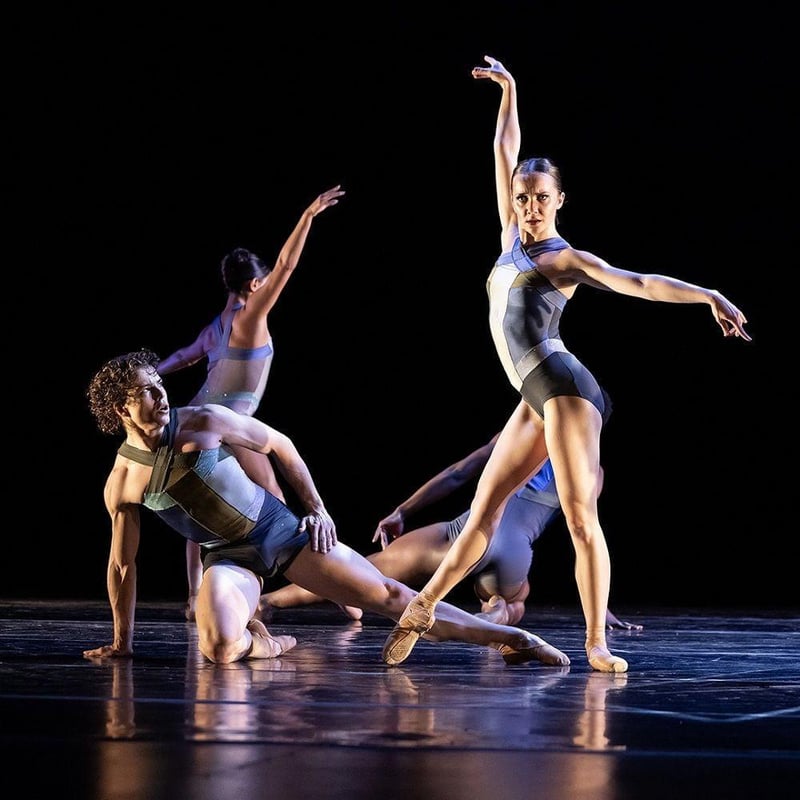
Then came my revelation of the evening: Kenneth Tindall’s new work, We Met At The Moon, Briefly.
I spoke with Tindall while he was creating it and knew that Cape Town itself had entered the process. He took the dancers out of the studio, including to the beach, asking them to work with balance and weight in a different environment.
Leane` Theunissen, Gabriel Ravenscroft in We Met At The Moon, Briefly . Image by Joan WardWhat I had not anticipated was how completely the company would respond to his choreographic language.
The result is superb.
It has a sharpness that recalls the best of Cape Ballet Africa’s contemporary work, but Tindall pushes the dancers further. The choreography shifts constantly in mood and formation, with dancers appearing, disappearing and returning as the focus moves across the stage.
The transitions are especially good: nothing stops so that something else can begin. One image seems to grow out of another.
The music builds the drama, but so does Tindall’s instinct for knowing when to isolate a dancer or pairing before folding them back into the group. His choreography is sculptural, demanding and unmistakably classical in its foundations, yet it never feels constrained by them.
Most striking was how naturally the dancers inhabited it. There was no sense of a visiting choreographer’s work sitting awkwardly on a company. They had absorbed it.
When choreography becomes part of the company
I also couldn’t help noticing some of their hand and finger movements, particularly those of Leanè Theunissen – the lasting impact of Elena Glurjidze’s training for the company’s box-office hit Swan Lake touring Australia next year?
Also, the sound in The Baxter Pam Golding Theatre is outstanding – even if it’s loud, it’s not piercing – and for this piece, volume was warranted. I could feel it in my heart centre and realised I was holding my breath near the end.
Duato brings wit and athleticism
After interval, Nacho Duato’s Remanso returned to the repertoire, set to Enrique Granados’s Valses Poéticos (Poetic Waltzes). Having seen the work before, I was struck this time by how impactful it has become.
Its three male dancers move between humour, athleticism and intimacy, appearing and disappearing around the large central structure with a playfulness that disguises the difficulty of the choreography.
Jan Kotze´ and Maryana Pobuta in The Moon Holds Us, Briefly . Image by Joan WardJoshua Williams, in particular, was extraordinary. There are dancers who execute choreography beautifully and others who seem to sharpen the atmosphere the moment they move. Williams increasingly belongs to the latter group. His attack was crisp, his turns exact and his stage presence magnetic.
He danced as though every part of him knew precisely where the movement was going before it got there. That in no way diminishes the performance of Nicolas Laubscher and Jan Kotzé. The trio worked beautifully together.
Duende brings personality to the stage
By the time Michelle Reid’s world premiere Duende closed the programme, the evening had shifted register again.
Reid has always had a distinctive choreographic personality: witty, slightly off-centre and capable of finding movement in music that another choreographer might ignore. Here she works with the Spanish guitar of Estas Tonne, borrowing the attitude and flavour of flamenco without attempting to turn ballet dancers into flamenco dancers.
There are suggestions of the form – an angle of the head, an arm, a turn, a flash of attitude – but Duende remains its own thing. Men and women appear in fringed trousers and white shirts, the fringe exaggerating every shift of the body and giving the choreography an added sense of movement.
Nicolas Laubscher in Duende by Michelle Reid. Image by Helena FaganIt is clever, sensual and great fun. The dancers seem to enjoy it too. The choreography leaves room to breathe, room for personality, and several of them seize it.
Williams has another remarkable moment towards the end when, for me, something shifted. I never saw the late Sir Geoffrey Neiman perform in his prime, yet for a few seconds I felt he was there: the quality of presence, flair and theatrical confidence suddenly brought him to mind.
Laubscher also stood out (his best performance to date, for me), as did Caio Tardelli, Aphiwe November, Thomas Larché and Abigail Obregon.
Given that Reid created Duende in Neiman’s honour, it made the moment unexpectedly moving – it’s a tribute that all those who knew, respected, admired and loved him have been waiting for.
Four choreographic voices, one company
More broadly, Elysium confirms how much Cape Ballet Africa has gained from exposing its dancers to different choreographic voices.
Balanchine demands speed and discipline; Duato requires wit and ease; Tindall stretches their contemporary classical vocabulary; Reid allows personality and theatrical instinct to come forward.
The company meets all four on their own terms.
Two years after Cape Ballet Africa made its debut, the potential is no longer the story. Elysium shows us what that potential has become.
I left wanting to flamenco my way up the Baxter steps.
That, in itself, is probably praise enough.
Follow Cape Ballet Africa on their social media platforms to keep up to date with performance schedules. Elysium is on until 10 October 2026. Book through Webtickets.