
The Artist Behind the latest Krotoa painting - Lizelle Kruger’s journey through South Africa’s complicated memory
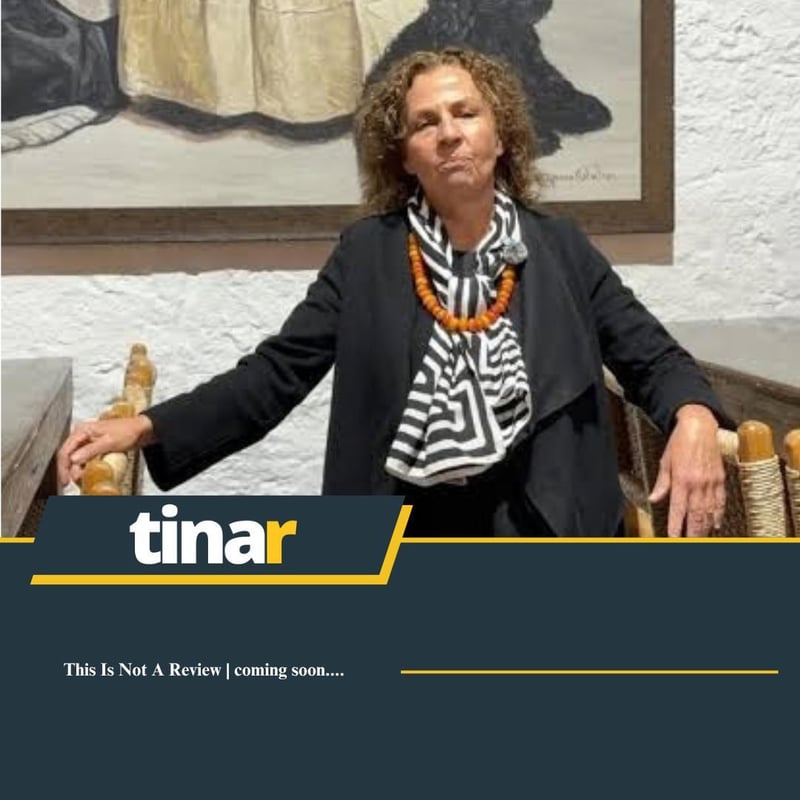
Yesterday, 24 September 2026, South Africa marked yet another Heritage Day, and artist Lizelle Kruger unveiled her long-awaited painting of Krotoa at the Castle of Good Hope in Cape Town. The work, which Kruger says is the culmination of more than nine years of research and artistic engagement, presents an opportunity to look beyond the painting itself and towards the woman who created it. Kruger’s relationship with the Castle stretches back many years, while her artistic career has moved through military institutions, Cape Town’s colonial history, the Karoo and questions of women, identity and memory. This Is Not A Review, but it is a look into the woman of yesterdays hour and the SABC’s highlight of this chapter.
For TINAR, Lizelle Kruger’s journey into artistry holds space for conversation because this artist behind a historical image is also part of the history through which that image is being interpreted. Kruger says her research into Krotoa led her to focus on restoring the innocence and dignity she believes were taken from her as a young girl caught between Khoi and Dutch worlds. The painting will now be housed in the Castle Chapel, placing Kruger’s interpretation of Krotoa within the very institution that sits at the centre of much of the colonial history surrounding her life.
Perhaps in some cases, to look at ones art demands that you seek to know the artist too, and so our journey into archives begins with this post. Kruger’s own origin story begins in Humansdorp in the Eastern Cape, where she was born in 1963. Her childhood is said to have been shaped by regular family journeys through Namibia and the arid landscapes of the Cape, including visits to places such as the Cederberg and Spitzkoppe, experiences that developed an enduring fascination with landscape, rock formations, people and the traces left behind on the land. She later studied at Technikon Orange Free State between 1982 and 1983 before continuing at Cape Technikon, where she completed a National Diploma in Fine Art in 1984, receiving recognition for her progress in fine art as well as for sculpture and ceramics. Her practice would subsequently move comfortably between oil, acrylic, charcoal, pastel, watercolour, drawing, mixed media, sculpture and ceramics. The landscapes and objects of the Karoo, particularly the areas around Sutherland, Merweville, the Koup and Tankwa Karoo, became central to her work, with family history, inherited identity, weathered objects and the passage of time repeatedly appearing as subjects.
Her professional journey then took her into an institution that gives her present work another layer of complexity, the South African Defence Force. After completing her studies, Kruger worked as a graphic artist in the Defence Force’s production department and later produced sculptural and mural work connected to military institutions, including a seven-metre by 2.3-metre ceramic mural for the Armscor building. Her exhibition history also records a 1993 SADF group exhibition in Pretoria. She eventually became associated with the Military Museum at the Castle of Good Hope, where she worked as an artist and established a long relationship with the institution. Her Castle history includes a 1996 group exhibition, a 2011 solo exhibition of drawings and, later, the creation of her Cape Town Memoirs and Dangerous Liaisons body of work within the Castle itself. This trajectory is significant to our earnest attention, because how does an artist whose professional life once included producing work within South Africa’s military establishment would later devote considerable artistic attention to the people, women, Indigenous communities and histories that sit on the marginalised side of the country’s complicated colonial and apartheid inheritance.
One could even claim that, that evolution was already visible in Kruger’s Cape Town work long before Krotoa. Her 2018 Cape Town Memoirs and Dangerous Liaisons exhibition placed women at the centre of historical scenes spanning the city from the 1920s to the 1960s, while explicitly remembering enslaved women, Indigenous Khoi communities and people whose labour and experiences have often been marginalised in conventional accounts of Cape Town. Kruger herself called for the remembrance of people who had been brought to the city by force, Indigenous Khoi people and the “unsung heroes” whose labour contributed to the city’s development. Her Krotoa painting therefore does not appear to be an isolated departure from her practice, but another point along a longstanding artistic engagement with memory, women, place and the people beneath the official versions of history. Maybe Krotoa brings that engagement into an especially sensitive space, a Khoi girl whose life unfolded amid the arrival and consolidation of Dutch colonial power, whose labour and linguistic abilities were used by that system, and whose later life was marked by displacement, rejection, confinement and banishment.
Some could even argue that perhaps that is why Kruger’s journey deserves to be highlighted alongside the painting rather than “disappear” behind it. Her career demonstrates how complicated South African memory can become when an artist’s own history intersects with the histories she chooses to revisit.
I am in three heads about this because a part of me has questions a part of me has conversation points, a part of me is curious The question may not perhaps be whether artists descended from communities that benefited from colonial or apartheid systems should engage with histories of oppression as they currently do, because while history belongs to all of us, and reinterpretation can create space for perspectives that were previously neglected. The harder question is what happens when reinterpretation begins to soften the evidence of coercion and violence itself.
Can the rewriting and reinterpretation of South African history, particularly when undertaken from within communities historically positioned closer to systems of power, unintentionally produce an image of Indigenous people and the enslaved as having been “willing” participants in systems that relied upon dispossession, violence, forced labour and the reduction of human beings to compliance? And when we place beautiful new images of historical figures into our heritage institutions, are we simply giving forgotten people dignity, or do we also have a responsibility to ensure that the brutality surrounding their lives remains visible? Kruger’s Krotoa now sits inside the Castle, and perhaps that is precisely where the conversation belongs, while some are deciding which version of history is most comfortable, we must continue to ask how and why art is being used to reshape remembering the past in ways that will eventually make things easier to live with than what it actually was.