
Zambia Strengthens Position As A Stable And Attractive Hub For Mining Investment Growth
Written by: BizCommunity Editor Save to Instapaper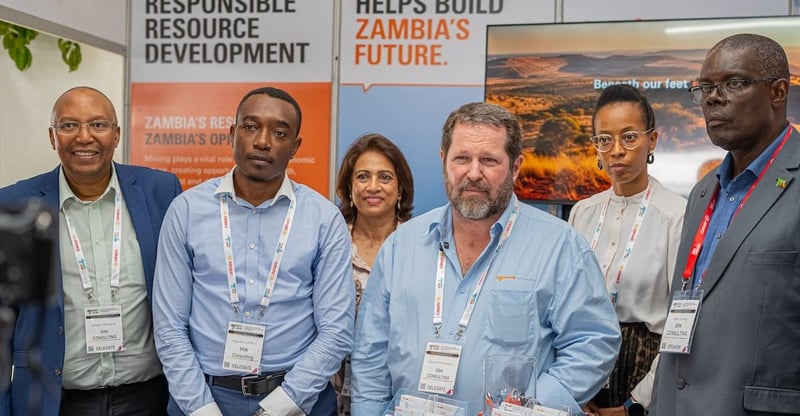
SRK Consulting's Joseph Mainama, Nyankhundi Phiri, Jaya Omar, Desmond Mossop, Charmaine Mafa, and Able Tunono at ZIMEC 2026
This growth trajectory is reinforced by several factors, including strong Zambian government support, starting with the introduction of a new online and transparent mining cadastre. In addition, legislation guiding the opening of new businesses makes Zambia an attractive investment destination. The country’s central location – connected to the planned upgrade of the Lobito Corridor to Angola and a new rail corridor to the east coast – further enhances its role as a potential future export hub for critical minerals to global markets.
Stability and accessibility
Mining is a long-term investment, and Zambia’s recent political stability suggests it could be established as a favourable destination, where investors can expect a reasonable return on investment (ROI) over the lifecycle of a mine. Civil unrest is relatively uncommon and does not threaten business operations.
Additionally, Zambia is easily accessible, with relaxed visa regulations for visitors from South Africa in particular. The dominance of English as the language of business makes it easier for South African companies to do business, compared to some of its Francophone and Portuguese-speaking neighbours.
The government has set a target to secure reliable energy for households and industry by 2032, as the current unreliable power supply remains a significant constraint for large mining and manufacturing operations. Solar projects are planned for domestic consumers, and energy independence among large-scale industries is being encouraged through both renewable sources, imported energy, and extension of the current grid.
With a well-established copper mining sector and much of the country’s mineral wealth unexplored, the Zambian mining industry is poised for a potential period of substantial growth and expansion. Image credit: Leon Louw for WhyAfrica
Mapping unexplored regions
Even as the country looks to push copper production, aiming to grow annual output of refined copper from 890,346 to three million tonnes by 2031, and expanding into a ‘new’ copper belt in the North-Western Province, diversification is part of Zambia’s mining growth strategy.
Plans to map the unexplored regions for critical and transitional minerals, including copper, cobalt, lithium, nickel, and rare earth minerals are in place, supported by a nationwide detailed geophysical campaign covering over half of Zambia’s land mass. Funded by both national government and private companies, the country’s ambitious exploration programme and comprehensive mapping of underexplored areas are important in attracting would-be investors who require data and information about what lies underground, before committing to costly new exploration projects.
SRK establishes base in Kitwe
Given this favourable outlook for Zambia, SRK is establishing a practice located at the heart of the country’s mining hub in Kitwe. Zambia’s mining culture means that the country has a wealth of home-grown expertise, and the new practice will be staffed by qualified and experienced local engineers and scientists in our employee-owned business model.
SRK Consulting (South Africa) chairman Vis Reddy during a panel discussion at ZIMEC 2026
Elevating standards and compliance
As new investors enter the country – including from the Middle East and India – expectations of meeting international best practice standards of mining extraction and environmental stewardship need to be met. In addition, wider adherence beyond local to global regulations, including the Copper Mark and the Global Industry Standard on Tailings Management (GISTM), makes investment in Zambia’s mining sector more attractive. Zambia is fully committed to its own success, and SRK is well placed to assist the country in achieving it.
With growth comes greater risks
However, the expansion of Zambia’s mining sector – the number of existing operators looking to optimise productivity, new entrants, and widespread exploration projects – will all necessarily lead to greater risks to both people and the environment. Geotechnical risks associated with both foundation conditions where dolomite is present, as well as deeper extraction (so-called super open pits and underground operations), plus those associated with water, ground, and air contamination, make safe mining practices of paramount importance for new ventures and for the preservation of Zambia’s environmental integrity.
The potential contamination of surface and underground aquifers that support local communities, and risks from storms and floods, especially regarding the safe operation of tailings dams, all require complex risk management, which SRK is ready to provide to new and existing Zambian operations.
With decades of experience in managing mining-related risks, a deep understanding of Zambia's ground conditions, and an employee-owned business model that aligns with localisation, SRK is well-positioned to assist Zambian clients in mitigating risks while optimising mining value at their operations and projects into the future.
A strategic partner in Zambia’s future
With ambitious plans for mining expansion and many of its rich mineral deposits yet to be explored, the future for Zambia’s mining sector looks promising. SRK will be there to assist, support, and advise on all aspects of the new and existing ecosystem and is committed to ensuring that mining practices in this southern African nation are sustainable in the long term, while delivering on objectives for the benefit of everyone. SRK is committed to partnering with mining companies in Zambia so that they attain the social licence to operate.
Get new press articles by email
We submit and automate press releases distribution for a range of clients. Our platform brings in automation to 5 social media platforms with engaging hashtags. Our new platform The Pulse, allows premium PR Agencies to have access to our newsletter subscribers.
Latest from
- Air Products And Tronox Strengthen Long-Term Partnership With Advanced PSA3 Commissioning
- Pace Car Rental Expands Nationwide Following Years Of Strategic Fleet And Market Growth
- Steve Louw Releases Nashville-Recorded Album Featuring Renowned Americana And Rock Artists
- Afreximbank Reports Robust Q1 Results Driven By Trade Finance And Economic Development Goals
- Diamond And Gold Awards Highlight Excellerate Services’ Commitment To Consistent Quality
- Energy Sector Leaders Back Venezuela’s Reform Agenda To Revitalise Oil Production And Investment
- Takealot Marks Fifteenth Anniversary With Comprehensive Snapshot Of South African E-Commerce Trends
- African Cultural Influence Continues To Shape Global Music And Advertising Trends
- Khoi Tech And Telkom Unveil New 5G Connectivity Solution To Support South Africa’s Digital Future
- SME South Africa Introduces Weekly Podcast Featuring Industry Experts And Entrepreneur Advice
- New Research Highlights Growing Role Of AI Agents In The Future Of Digital Commerce
- Hot 102.7FM Earns Multiple Global Radio Honours For Journalism And On-Air Excellence
- INNOVATION Media Consulting Highlights Urgent Need For Trust In The Age Of AI-Generated Content
- AMEC Launches New GEO Principles To Guide AI Visibility And Reputation Measurement
- Nine AI Myths Holding Businesses Back From Unlocking Competitive Advantage And Innovation
The Pulse Latest Articles
- South African Women Are Missing This Essential Nutrient (May 20, 2026)
- Opinion Piece: Rethinking Performance: Why Behaviour Remains The Missing Link In Evaluation (May 20, 2026)
- 125 Years Of Hansgrohe And The Designers Who Made Axor A Luxury Language (May 19, 2026)
- World Whisky Day: Whisky Lovers Challenged To Stop Saving Their Best Bottles (May 15, 2026)
- Hidden Inefficiencies Are Draining South African Businesses (May 15, 2026)