
South African wine clubs retain relevance as Blaauwklippen blending competition draws 79 entries
A bottle of wine is rarely just about what is in the glass. Sometimes it is about the people around the table, which may explain why wine clubs have managed to stick around. The Blaauwklippen Blending Competition offers a glimpse into why this old-school tradition still has a place in a changing wine world.
For more than four decades, Blaauwklippen invited people to step into the winemaker’s shoes. It began as a battle between local clubs, but now it’s a big deal for anyone who loves wine. You get to taste, play around with different blends, and create something of your own.
The numbers tell an interesting story. The competition attracted 78 entries in 2024, 65 in 2025 and 79 this year. The 2026 finalists came from Gauteng, the Western Cape and Namibia, with Carignan My Wayward Son, DeVine Club, Lyttelton Wyngilde and Ongava International Wine Tasters making the final four.
That is quite a turnout for a format built around something as simple as getting a group of people together to taste wine.
There is no requirement to be a professional winemaker. The competition is built around tasting, experimenting and figuring out what works. This year’s brief involved Cabernet Franc, two Cabernet Sauvignon clones and Malbec, leaving each club to decide how the four should come together. The format has remained remarkably simple. Get a group of people together, open some wine and see what happens.
Somewhere between those percentages and tasting notes is a much bigger question: why are people still doing this?
A club of their own
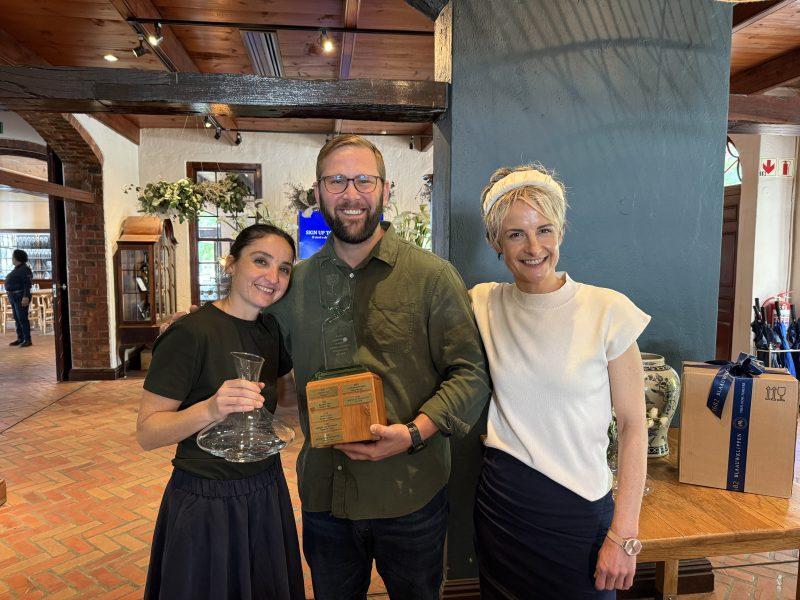
Carignan My Wayward Son took the title at this year’s Blaauwklippen Blending Competition, but there was nothing particularly formal about the way the Gauteng club approached the challenge.
The club was started in 2020 by four friends – Sam and Marleen Rolland, Sara Burness and Alex Reichle – who had studied at Stellenbosch University before going their separate ways across Gauteng. They wanted to keep sharing their love of wine after throwing their graduation hats, but in a way that worked for them.
Six years later, the club has evolved as members have moved, joined and left. This year’s active group was two couples, all juggling work, family and parenthood.
Their annual blending session is therefore not just a technical exercise. It is an excuse to sit around a table and spend time together.
Nadine and Ryan de Metz with Blaauwklippen winemaker Narina Cloete.
Beef bourguignon was on the group’s menu for this year’s blending lunch. They were hoping the rich beef shin and dried porcini mushrooms would complement the wines. They tasted through the options, talked about each one, tweaked the blend, and settled on a winner: 40% Cabernet Sauvignon, 40% Malbec, and 20% Cabernet Franc.
New member Ryan De Metz had never blended wine before, while the club’s oldest member is Sam’s 78-year-old father. That is a fairly good indication that you do not need a cellar full of rare bottles or a wine qualification to pull up a chair.
“The best and most memorable wines are shared with friends and family around the dinner table over a meal, stories and laughter,” Sam says.
Still at the table
That social side may be exactly where the modern wine club has an opportunity.
Sam believes wine clubs are still relevant, but says they need to evolve alongside the people drinking wine. Younger consumers are changing how and how much they drink, and traditional wine clubs can sometimes seem like places where newcomers are expected to arrive with a vocabulary of tasting notes already memorised.
Carignan My Wayward Son takes a less formal approach. Newcomers can learn by tasting alongside more experienced members, while the emphasis remains on sharing wine rather than proving who knows the most about it.
The competition itself reflects that variety. Some clubs have years of experience and established traditions, while others are smaller, informal groups. One previous finalist even involved a wife giving her husband a blending experience as a 60th birthday present. Another club had more than 20 members and met over several evenings to work on its blend.
There is no single recipe for a wine club, much like there is no single recipe for a good bottle of wine.
Sam remembers travelling in Greece with Marleen and seeing entire families, young and old, sitting around the dinner table for hours. It reminded him that wine brings people together in a way that’s valuable, especially now, when every meal risks becoming another quick checkbox on a long to-do list.
Perhaps that is where the answer lies.
The 79 entries in this year’s Blaauwklippen competition suggest that people are still willing to gather around wine. What they gather for may have changed. It might be a competition, a meal, a friendship or simply the chance to open something interesting with people whose company they enjoy.
The bottle is part of it. The people around the table are the reason it matters.