
Meetings Africa 2026 Emphasises ESG As Key Factor In Global Event And Conference Procurement
Written by: BizCommunity Editor Save to Instapaper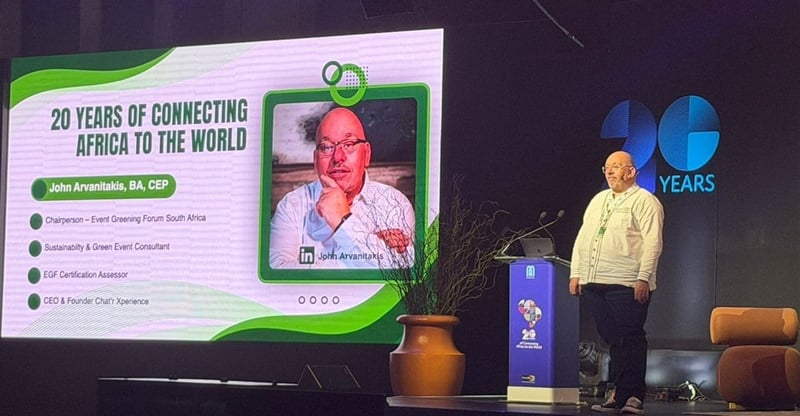
Source: Supplied | EGF Chairperson John Arvanitakis presents his talk at Meetings Africa 2026
But in 2026, connection alone is no longer enough.
The global landscape has shifted. Procurement frameworks have evolved. Corporate accountability has intensified. Today, when international buyers select a destination, they are not merely evaluating infrastructure, hospitality, and price. They are assessing:
• Risk exposure• Carbon accountability• ESG performance• Supply chain transparency• Long-term sustainability strategy
Every event now sits inside a company’s sustainability reporting framework — specifically within Scope 3 emissions. Event greening is no longer a moral discussion. It is a commercial one.
Understanding the language of procurement: ESG
ESG - Environmental, Social and Governance - has become the global benchmark for responsible business.
Environmental: Carbon emissions, energy consumption, water use, waste management.
Social: Local procurement, community impact, inclusion, labour practices.
Governance: Transparency, compliance, reporting integrity, risk management.
Sustainability is no longer a marketing line in a brochure. It is written directly into procurement frameworks and increasingly embedded in RFPs.If you cannot provide verifiable data, you become a procurement risk.
For multinational companies hosting events, the impact includes:
• Delegate travel emissions• Venue energy consumption• Catering supply chains• Exhibition freight and logistics• Waste generation
Your event becomes part of their ESG footprint.
Why Scope 3 Is the game-changer for events
In ESG reporting, emissions are divided into three categories:
• Scope 1 – Direct emissions (owned vehicles, fuel use, generators)• Scope 2 – Purchased energy (electricity, heating, cooling)• Scope 3 – Value chain emissions (travel, hotels, catering, freight, waste).
For the MICE sector, Scope 3 is where sustainability stops being marketing and becomes mathematics.
Events are dense, high-impact, short-duration gatherings of people, infrastructure, and logistics. Their carbon intensity is significant and measurable.
That measurement is now required.
Net zero: A promise or a plan?
The Net Zero Carbon Events Initiative set two key milestones:
• 50% emissions reduction by 2030• Net zero by 2050
2030 once felt distant. It is now four years away. A pledge is a promise. A pathway is a plan.
A credible Net Zero pathway requires:
• A measured carbon baseline• Defined reduction targets with timelines• Accountability mechanisms• Governance structures• Transparent annual reporting• A residual emissions strategy
Without measurable pathways, commitments remain symbolic.
The first Net Zero reporting cycle in 2024 revealed concerning data:
• Only 48% of signatories submitted reports• Many have not yet published formal pathways• Global reduction momentum is inconsistent
The issue is not commitment. It is pace.
Africa’s position: Underrepresented, not underprepared
Globally, Africa remains underrepresented in formal sustainability reporting structures:
• Europe dominates membership and operational presence• Africa accounts for a small percentage of active reporting
But this is not a weakness. It is an opportunity. Europe is retrofitting legacy systems. Africa can embed sustainability by design. Rather than catching up, the continent can leapfrog.
What serious sustainability looks like
Measured sustainability is scaling globally:
• Thousands of events now report carbon data• Supply chain contributors are providing verified information• Buyers increasingly require sustainability in RFPs
According to industry surveys, a growing percentage of event professionals report:
• Sustainability requirements embedded in procurement• Increased sustainability reporting• Formal sustainability strategies and policies
Buyers are no longer “considering” sustainability.
They are requiring it.
The environmental reality of events
Events undeniably have an impact. The question is how that impact is managed.
Average figures highlight the scale:
• Nearly 2kg of waste per delegate per day• Significant carbon emissions per attendee• Travel as the largest contributor
In large urban centres, systems may absorb this pressure. In smaller or rural destinations, impact can strain infrastructure and waste management systems significantly. Sustainability must therefore be structured across the entire event life cycle:
1. Bid stage: Include sustainability KPIs and carbon commitments.2. Planning: Engage suppliers early. Design out waste. Select aligned venues.3. Delivery: Monitor implementation. Measure impact. Capture evidence.4. Post-event: Report transparently. Identify improvements. Refine processes.
"You cannot manage what you do not measure".
Circular economy thinking: The new event model
• The old model: Take → Use → Dispose.• The new model: Design → Reduce → Reuse → Repurpose → Recycle.
Practical applications include:
• Modular exhibition systems• Reusable branding• Digital collateral instead of printed materials• Supplier take-back programmes
Circular thinking reduces both cost and environmental impact.
Avoiding Greenwashing
Increased sustainability messaging carries risk:
• Unverified carbon-neutral claims• Vague language without data• Emotional messaging unsupported by evidence
Credibility requires:
• Measured baselines• Independent verification• Transparent reporting• Evidence-based scoring
Measured impact matters more than intention.
The Event Greening Forum has launched EGF Certification for green events, which meets these requirements. The aim is that it will elevate standards, strengthen stakeholder confidence, and send a clear message that South Africa is committed to global sustainability leadership.
Professionalising event sustainability
Sustainability must become as fundamental as health and safety in event planning. You would not open an event without safety compliance.
Soon, you should not open one without sustainability compliance.
Event greening is not decorative. It is professional.
Structured certification programmes, minimum standards, and independent assessment provide:
• Evidence-based scoring• Verified reporting• Continuous improvement frameworks• Reduced procurement risk
Africa’s competitive opportunity
The next 20 years of Meetings Africa - and the broader MICE sector - will not be defined solely by connection.They will be defined by responsibility.
Africa has the opportunity to:
• Standardise sustainable event practices• Scale certification frameworks• Increase measurable reporting visibility• Strengthen destination credibility• Embed inclusive sustainability through local sourcing and SMME participation
Sustainability is no longer an environmental conversation. It is about competitiveness. It is about credibility. It is about trust.
The question is not whether events should be greened. The question is whether the industry will professionalise sustainability fast enough to lead.
Africa can show the world not only its creativity and hospitality but also its measurable responsibility. The future of global events will belong to responsible hosts.
Get new press articles by email
We submit and automate press releases distribution for a range of clients. Our platform brings in automation to 5 social media platforms with engaging hashtags. Our new platform The Pulse, allows premium PR Agencies to have access to our newsletter subscribers.
Latest from
- Fuel Price Surge May Trigger Economic Slowdown And Higher Living Costs In South Africa
- BrandMapp 2025 Shows OFM Strengthening Reach Among Affluent And Influential South African Audiences
- NjiaPay Raises Funding To Expand Payment Infrastructure Platform Across African Markets
- Automation Helps Payroll Teams Reduce Errors And Reclaim Time From Manual Processes
- Capitec Expands Smart ID Application Service In Branches To Improve Access Across South Africa
- Cape Town Tourism Reflects On Global Travel Trends And Uncertainty After ITB Berlin 2026
- Diners Club Winelist Awards Celebrate South Africa’s Finest Restaurant Wine Lists
- Oil Prices Surge Past $100 As Strait Of Hormuz Disruption And Iran Tensions Shake Global Markets
- Kaspersky Next Enhances AI Powered Threat Detection And Unified Security Operations For Businesses
- Bob Appoints Anita Erasmus As CEO Designate To Lead Next Phase Of Growth And Platform Expansion
- Richfield And Lions Cricket Expand Education Partnership To Support Players On And Off The Field
- Fraudulent School Addresses Undermine Feeder Zone Admissions And Fair Access To Education
- KSB Redevelops Historic Activia Park Site Into Modern Sustainable Facility Preserving Industrial Heritage
- Through Her Lens Initiative Launches In Lagos To Advance Women’s Leadership Across Global Creative Industries
- Realness Institute Appoints New Board And Alumni Council To Strengthen African Film Industry Development
The Pulse Latest Articles
- Byd Powered Car Of The Year Finalist Evaluation With Mobile Phev And Ev Charging (March 6, 2026)
- Strategy Is Easy. Execution Is Everything (March 5, 2026)
- The Paradox Of Leadership: Ntombizone Feni’s First Year As Ceo (March 4, 2026)
- Beyond The Pit: Why Mining Partnerships Are Being Redefined (March 2, 2026)
- A Refreshing Reset For Your Tastebuds (March 2, 2026)