
Beyond matric - Why South Africa needs more than one pathway to success
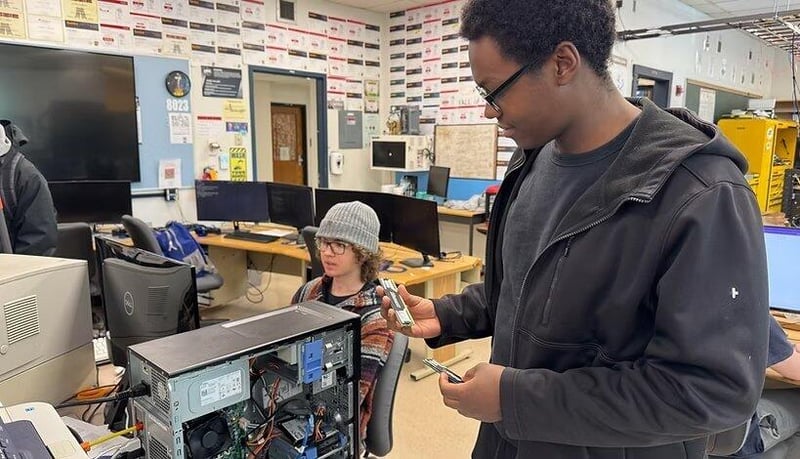
As nearly one million South Africans sit their 2026 matric examinations, a Johannesburg school is challenging the assumption that academic examinations are the only credible measure of educational achievement, and calling for greater recognition of vocational qualifications.
JOHANNESBURG, SOUTH AFRICA – For thousands of young South Africans, matric represents the culmination of 12 years of schooling and the beginning of their next chapter. But what happens to capable young people whose strengths, interests and abilities are poorly served by a predominantly academic, examination-driven education system?
With 962,832 candidates registered for the 2026 National Senior Certificate examinations, including 815,051 full-time candidates, national attention is once again focused on pass rates, university entrance and academic achievement.
These remain important measures of educational success. They do not, however, capture the full range of abilities young people possess or the different ways those abilities can be developed, demonstrated, and applied.
Internationally, vocational education is already an established and respected part of secondary schooling.
According to the Organisation for Economic Co-operation and Development's (OECD) Education at a Glance 2025 report, 44% of upper-secondary students across OECD countries were enrolled in vocational education programmes in 2023. In countries including Austria, Finland and the Netherlands, vocational education accounted for more than two-thirds of upper-secondary enrolments.
Importantly, these qualifications are not necessarily the end of a student's educational journey. The same OECD report found that 77% of upper-secondary vocational students were enrolled in programmes providing direct access to tertiary education, although the types of tertiary programmes available and admission requirements vary between countries.
Vocational education is therefore neither an educational dead end nor a lesser alternative to conventional academic study. In many education systems, it is a recognised route towards employment, further training and higher education.
A different pathway does not mean lower expectations
South Africa has an established technical and vocational education and training sector, but conventional academic pathways continue to dominate the school years.
For students whose strengths lie in practical problem-solving, applied learning, technology or other career-focused fields, the available school curriculum and assessment methods may not always provide sufficient opportunities to demonstrate their capabilities.
The challenge can be particularly significant for students with different learning profiles, including some neurodivergent students, who may have strong reasoning, creative or technical abilities but encounter barriers in conventional classroom and examination environments.
These are not necessarily students who lack academic potential. Some understand complex concepts but struggle to communicate that understanding through lengthy written examinations. Others engage more effectively when learning is connected to practical applications and meaningful projects.
"Too often, we meet capable young people who have spent years believing they cannot succeed, simply because they have struggled within an education system that does not recognise how they learn," says Jacqui McKelvey, Co-Founder and Principal of EDU360 Integrated Education in Johannesburg.
"We need to move away from the idea that every student must follow the same academic pathway to achieve success. Different abilities require different opportunities, not lower expectations."
The distinction matters. An alternative qualification should not mean reduced academic rigour or diminished ambition. It should provide another credible way for students to develop knowledge, demonstrate competence and prepare for further study or work.
Vocational education offers a credible international pathway
Internationally recognised qualifications such as Pearson's Business and Technology Education Council (BTEC) qualifications offer an established example of career-focused education.
According to Pearson, BTEC qualifications serve more than one million learners annually and are recognised in more than 70 countries worldwide.
Rather than relying exclusively on traditional examinations, BTEC programmes place considerable emphasis on applied knowledge, practical assignments, projects, and demonstrating skills in contexts relevant to particular industries.
Depending on the qualification, students may investigate real-world problems, develop technical solutions, complete practical tasks and produce evidence of their learning through structured assessments.
This does not make vocational education easier. It changes the way knowledge and competence are developed and assessed, while maintaining defined qualification requirements.
BTEC qualifications are offered at different levels, with progression opportunities into employment, further training and higher education. Pearson provides information on international university recognition and progression routes, although admission depends on the specific qualification, institution and programme requirements.
For South African students and families considering international vocational qualifications, understanding those progression arrangements is essential.
Building educational pathways around students' strengths
EDU360 Integrated Education, based in Rivonia, Johannesburg, offers several specialist educational pathways designed to accommodate differing learning needs, developmental profiles and educational goals.
Alongside academic and other specialist programmes, its College Vocational Pathway offers Pearson BTEC Level 2 and Level 3 qualifications in Information Technology, with an emphasis on practical, career-oriented learning.
The approach provides an alternative for students who may benefit from a more applied learning environment while working towards recognised qualifications.
It also reflects a broader educational principle: students should be supported to find pathways appropriate to their abilities, interests and aspirations, rather than being expected to demonstrate success through one prescribed route.
This does not mean that vocational education is necessarily the right choice for every student who encounters academic difficulties. Students need access to informed guidance, appropriate support and clear information about the qualifications they are pursuing.
Equally, vocational education should be presented as a positive educational choice for students with practical and technical interests, regardless of whether they could also succeed in a conventional academic programme.
South Africa needs more ways to recognise achievement
The debate extends beyond any individual school or qualification.
South Africa needs university graduates, but it also needs skilled technicians, IT professionals, entrepreneurs, artisans and people equipped to solve practical problems across industries.
A credible education system must recognise that these ambitions require different forms of preparation, without imposing a hierarchy that automatically places academic achievement above vocational competence.
The OECD's findings demonstrate that vocational and academic education can coexist as established secondary-school pathways, with opportunities for continued learning beyond school.
For South Africa, the question is how to make meaningful choices available earlier, ensure that qualifications offer transparent progression routes and provide students and families with reliable information about their options.
As another matric cohort approaches the end of its examinations, the national conversation should extend beyond how many students pass and how many qualify for university.
It should also consider whether young people have access to educational pathways that enable them to develop their abilities, earn credible qualifications and participate meaningfully in further education and the economy.
Matric remains an important achievement. It should not be the only measure by which South Africa recognises a young person's potential.
About EDU360 Integrated Education
EDU360 Integrated Education is a specialist education provider based in Rivonia, Johannesburg, offering individualised educational pathways for students with diverse learning needs.
Its Academic, College Vocational, Pivot and Key pathways provide differentiated approaches to learning and progression. The College Vocational Pathway offers Pearson BTEC qualifications in Information Technology, combining applied learning, practical skills development and structured educational support.
Release information
Issued on behalf of
Edu360 Foundation
Media contact
Edu360 Foundation
Jennifer Heslop Spencer