
AIE Expands Artisan Training to Close South Africa Skills Gap and Boost Industry Workforce
South Africa faces a severe shortage of qualified artisans such as electricians, welders, millwrights, and boilermakers to support infrastructure, the energy transition, mining modernisation, and manufacturing recovery, producing more than 10,000 fewer artisans than government targeted in 2024/2025, and remaining well below the NDP’s 2030 goal of 30,000 a year.
Closing this gap is achievable, but it will mean addressing constraints in the artisan-development pipeline. South Africa needs greater training capacity, but learners must also be able to move successfully from institutional training into the workplace and ultimately into qualified employment.
Limited apprenticeship opportunities currently restrict how many young people can qualify, even as an ageing workforce increases the pressure to develop new artisans. At the same time, many students and parents still view vocational training as less desirable than academic degree programmes, despite strong demand for artisans.
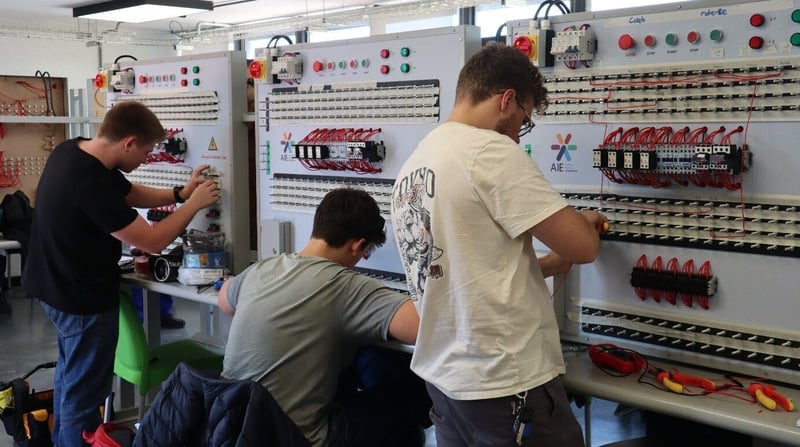
At the Academic Institute of Excellence (AIE), we are working to challenge that perception while addressing the skills gap by expanding access to training. We have made artisan training a substantial part of our technical-education strategy, treating it as a strategic discipline in its own right, and operate a dedicated School of Artisans & Technical Trades, built around the Quality Council for Trades and Occupations (QCTO) occupational-qualification system and a purpose-built artisan campus in Midrand.
Students train for roles across construction and infrastructure through occupational qualifications for electricians and plumbers; manufacturing, mining, and heavy industry through training for welders, boilermakers, fitters and turners, and millwrights; and the automotive and transport economy through programmes for diesel mechanics, motor mechanics, and automotive electricians.
But increasing training capacity addresses only one part of the shortage. Artisan development depends on learners being able to move from institutional training into the workplace, complete the practical experience required of them, and finally qualify in trades for which employers have genuine demand. That makes stronger alignment between training providers and industry as important as increasing the number of available training places.
Expanding training capacity must therefore go hand in hand with a system that responds directly to where industry needs skills and carries candidates all the way through to qualification and employment. Producing more trainees without sufficient workplace opportunities or increasing enrolments in trades where employers cannot absorb them simply shifts the bottleneck.
The objective must be to increase both the number of people able to access quality artisan training and the number who successfully emerge from that pipeline as competent artisans ready to enter the economy.
No single institution, public or private, can solve a shortage of this size. Government and SETAs must create the enabling framework, while training providers and employers need to work much more closely to ensure that learners can progress from training into workplaces where they can develop the practical competence needed to qualify. The opportunity lies in connecting those parts far more deliberately.
This is where accredited private providers have an important role to play alongside TVET colleges. They can add training capacity, respond quickly to changing industry demand, and help broaden access to occupational programmes in trades where the economy needs skills most. For institutions such as AIE, that means not simply enrolling more learners, but ensuring that the training we provide is relevant to the opportunities they will encounter outside the classroom.
Reaching the NDP’s goal of producing 30,000 artisans a year by 2030 will ultimately depend on South Africa treating artisan development as a national economic priority rather than an education issue alone. These skills underpin the infrastructure, energy, mining, and manufacturing capacity the country needs to grow, making the strength of the artisan pipeline a direct constraint on future industrial development.
Most importantly, by removing the barriers that prevent learners from progressing through training and into qualification, the country has an opportunity to open meaningful career pathways for thousands more young people.
Release information
Issued on behalf of
Academic Institute of Excellence
Media contact
PR Worx
Sizo Kaise