
African Technology Forum and Google.org Celebrate Zuxole Ngetu’s Completion of the Building with Large Language Models Learning Phase
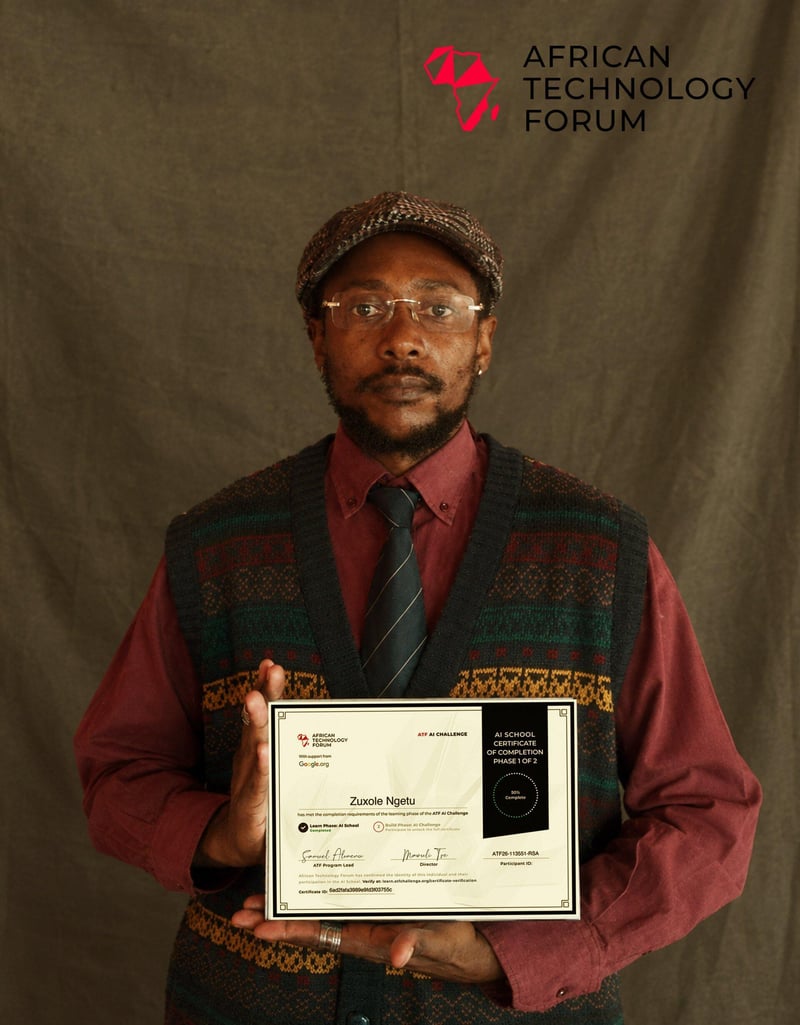
Zuxole Ngetu, popularly known as Lolo Vandal, has successfully completed the learning phase of the Building with Large Language Models certification programme offered through the African Technology Forum (ATF) Artificial Intelligence School, with support from Google.org. This achievement marks an important milestone in his journey towards understanding artificial intelligence, developing practical technology skills, and contributing to the growing digital innovation landscape. The announcement was communicated through a message from the African Technology Forum Artificial Intelligence School, which read: “Dear Zuxole Ngetu. You have a new message at ATF AI SCHOOL. You won the Building with LLMs certification.” This recognition confirms his completion of the learning phase and signals the beginning of the next stage of his journey, where he will join other participants in exploring how to build practical solutions using large language models.
For Zuxole, also known as Lolo Vandal, this accomplishment represents more than receiving a certificate. It reflects a commitment to learning, personal development, and exploring the opportunities presented by emerging technologies. In a world where artificial intelligence is increasingly influencing education, business, communication, research, and creative industries, acquiring relevant knowledge has become an important step towards participating in the digital economy. Completing the learning phase provides him with a foundation for further exploration of artificial intelligence and prepares him to move from learning concepts to discovering how they can be applied to practical challenges. His achievement also demonstrates the importance of taking advantage of educational opportunities that help individuals develop skills relevant to the changing technological environment.
The Building with Large Language Models programme focuses on an area of artificial intelligence that has attracted considerable global attention. Large language models are artificial intelligence systems trained on extensive amounts of data to understand and generate human language. They can support tasks such as writing, summarising information, answering questions, assisting with software development, analysing documents, and powering conversational applications. These capabilities create opportunities for individuals and organisations to develop new tools, improve certain workflows, and explore innovative ways of solving problems. Understanding how these systems work, how to use them effectively, and how to recognise their limitations is an important part of becoming an informed participant in the artificial intelligence ecosystem. Through the learning phase, participants gain a foundation for exploring these possibilities before progressing towards the practical application of their knowledge.
The African Technology Forum, commonly known as ATF, is an organisation focused on advancing science, technology and innovation in Africa. Established in 1988, the organisation has worked to promote technological capacity and encourage collaboration among stakeholders interested in Africa's scientific and technological development. Its broader mission is relevant at a time when digital transformation is creating new opportunities for economic growth, entrepreneurship, education, and employment across the continent. Through initiatives that connect learning with practical innovation, the organisation contributes to conversations about how African communities can develop the skills and capabilities needed to participate meaningfully in the global technology economy. Its involvement in artificial intelligence education is particularly important because it encourages learners to move beyond simply using existing technologies and begin exploring how to develop solutions that respond to the needs of their own communities.
Through its Artificial Intelligence School and related learning initiatives, ATF provides opportunities for participants to engage with emerging technologies and build foundational knowledge. Such programmes are important because the rapid development of artificial intelligence can create a gap between the availability of powerful tools and people's ability to understand, evaluate, and apply them effectively. Structured learning opportunities can help narrow that gap by introducing participants to relevant concepts, encouraging experimentation, and preparing them for more practical work. In the African context, developing artificial intelligence skills can also help create opportunities for locally informed innovation, allowing emerging technology practitioners to explore solutions that reflect regional languages, community priorities, economic conditions, and industry-specific challenges. This approach supports the broader ambition of ensuring that Africa is not only a consumer of global technology but also an active contributor to its development.
The programme's support from Google.org adds another important dimension to this initiative. Google.org is the philanthropic arm of Google and supports projects that use technology, funding, and other resources to address social and economic challenges. Support for digital education and artificial intelligence skills development is significant because access to relevant knowledge can help individuals prepare for new opportunities in an increasingly technology-driven world. As artificial intelligence becomes more widely integrated into professional and everyday activities, people need opportunities to understand these systems and learn how they can be used responsibly. Initiatives supported by philanthropic organisations can help expand access to learning, strengthen digital capabilities, and encourage more people to explore technology as a pathway towards innovation and economic participation. The partnership involving ATF and Google.org therefore reflects the importance of investing in people and their ability to engage with emerging technologies.
For African young people, the development of artificial intelligence skills presents opportunities across several sectors. In education, artificial intelligence-powered tools could help learners access explanations, learning materials and personalised study support. In business, they could assist entrepreneurs with research, communication, customer support and the development of new services. In agriculture, healthcare, financial services and other industries, carefully designed artificial intelligence applications could help professionals process information, improve access to knowledge, and explore more efficient ways of addressing particular challenges. These possibilities require thoughtful implementation, appropriate human oversight and an understanding of the limitations of artificial intelligence systems. Nevertheless, they demonstrate why learning to work with large language models can be valuable for people who want to participate in the next generation of digital innovation.
Having completed the first of the programme's two phases, Zuxole is now preparing to join other participants in the building phase. This transition represents an important movement from acquiring knowledge to exploring practical applications. The building phase offers an opportunity for participants to investigate ideas, experiment with artificial intelligence tools, develop projects and learn how large language models can be incorporated into solutions designed to address real-world needs. It also highlights the importance of collaboration, since developing useful technology often involves sharing ideas, learning from different perspectives, testing assumptions, and improving solutions through feedback. Working alongside other participants can expose learners to new approaches and encourage them to think more critically about the opportunities and challenges associated with artificial intelligence.
The move towards building is particularly significant because understanding a technology and applying it to solve a problem are two different achievements. While the learning phase establishes a foundation, practical development requires creativity, persistence, critical thinking, and a willingness to learn through experimentation. Participants must consider not only whether a technology can perform a particular task but also whether the resulting solution is useful, reliable, accessible, and appropriate for its intended users. They must also remain aware of issues such as inaccurate outputs, data privacy, security and potential bias. Developing this combination of technical understanding and responsible problem-solving is essential to creating artificial intelligence applications that can deliver meaningful value. For Zuxole, the next phase represents an opportunity to continue learning while beginning to explore what can be achieved through the practical application of his knowledge.
His accomplishment also carries a broader message for aspiring innovators across South Africa and the African continent. The future of technology will depend not only on the tools that become available but also on the people who develop the skills to use, adapt and improve them. Educational programmes that introduce emerging technologies can help individuals discover new interests, strengthen their capabilities, and identify opportunities for entrepreneurship, employment and independent innovation. By participating in such initiatives, learners can begin positioning themselves to contribute to a digital economy that increasingly values adaptability, technological understanding, and creative problem-solving. Zuxole's completion of the learning phase is one example of how individuals can take steps towards developing these capabilities.
As he prepares to join fellow participants in the next stage, the focus now shifts towards turning knowledge into practical experience. The building phase may provide opportunities to explore new ideas, collaborate with others, and investigate how artificial intelligence can be applied to challenges in education, business, community development and other areas. Although the completion of the learning phase is an achievement in its own right, it is also the beginning of a continuing journey that will require curiosity, dedication and a willingness to develop new skills. The real value of the experience will continue to grow as the knowledge acquired during learning is applied, tested and refined through practical work.
Zuxole Ngetu, also known as Lolo Vandal, deserves congratulations for successfully completing the learning phase of the Building with Large Language Models certification programme through the African Technology Forum Artificial Intelligence School, supported by Google.org. His achievement marks the completion of the first of two phases and opens the door to the next chapter of learning, collaboration and building. It is also a reminder of the importance of initiatives that expand access to technology education and empower African learners to participate in emerging fields. As he joins other participants on the journey of building, the opportunity ahead is to transform knowledge into ideas, ideas into practical solutions and practical experience into continued growth. The learning phase is complete, the foundation has been established and the next chapter begins with the challenge and opportunity of building with artificial intelligence.
Release information
Issued on behalf of
African Elephant PR
Media contact
African Elephant Productions
Zuxole Ngetu