
From E-Waste to Enterprise - How South Africans Are Building Businesses From Returned Appliances
National eWaste Day | 14 October 2026
Last year, TCB diverted 176 tonnes of e-waste from landfill while Repair entrepreneurs generated an estimated R16.4 million in profit.
As South Africa marks National eWaste Day on 14 October, Taking Care of Business (TCB) is calling for greater commitment to repair and reuse practices as practical responses to both e-waste and unemployment. Through its Repair Programme, returned and slightly damaged appliances are transformed into stock, skills and income opportunities for unemployed South Africans building informal businesses.
Across South Africa each year thousands of electrical appliances are returned, damaged in transit or store, or simply never sold. While many of these items can still be repaired and reused, too often they are discarded, contributing to the country's growing e-waste challenge.
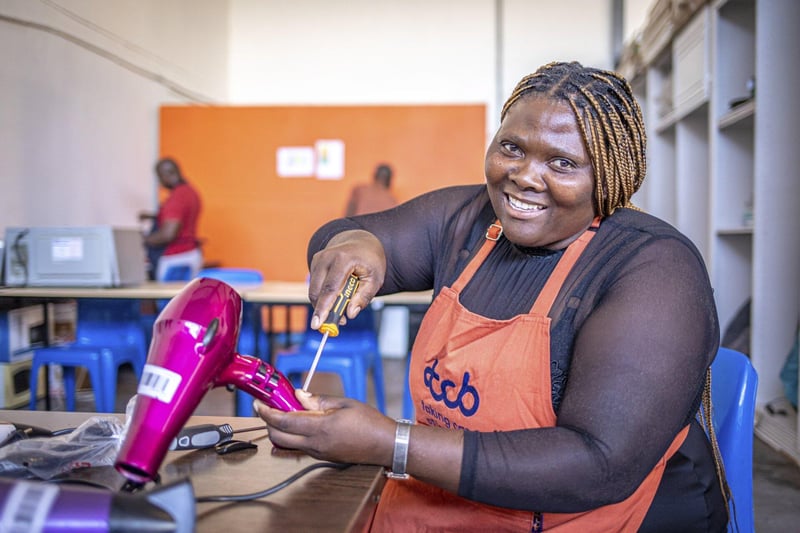
For 15 years, Taking Care of Business (TCB) has been demonstrating a different approach. Through its Repair enterprise development programme, returned and damaged appliances become the starting point for small businesses, helping unemployed South Africans earn an income while extending the life of products that might otherwise end up in landfill.
The nonprofit organisation works with major retail partners including the Shoprite Group, Clicks and TFG, which donate surplus, returned and damaged appliances. Participants (unemployed South Africans) learn to test, repair, refurbish and resell these items while building the business skills needed to run successful enterprises.
During the past year, 176 participants were actively trained across TCB's Cape Town, Johannesburg and Durban branches while a further 217 graduates continued to benefit from access to stock. The programme processed over 152,000 items and redirected 176 tons of e-waste from landfill. These items fueled informal businesses and, collectively, Repair entrepreneurs generated an estimated R16.4 million in profit from what would have been waste.
“ The programme is about far more than repairing appliances,” says Tracey Gilmore, Executive Director of Partnerships for TCB. “Participants embark on a two-year enterprise development journey that develops the Heart, Head and Hands: the confidence and resilience to build a business, the financial and business skills to run it successfully, and the technical skills required to repair appliances safely and effectively.”
TCB also collaborates with Producer Responsibility Organisations (PROs), industry bodies and green economy networks to strengthen responsible e-waste management and support Extended Producer Responsibility compliance. This includes collaboration with registered PROs such as eWASA and ERA, and participation in the wider circular economy ecosystem through GreenCape. These relationships support knowledge sharing, responsible end-of-life pathways, logistics and sector collaboration in an environment where organisations have traditionally competed for access to recoverable materials.
For Nomaseko Ntshongwana from Khayelitsha, Cape Town, the Repair Programme offered a way forward after divorce, a car accident and the loss of her job left her struggling to support her three daughters. She initially expected only to purchase appliances for resale. Instead, she found technical and business training, mentoring, counselling and a community that helped her rebuild her confidence.
“I learnt how to fix appliances, sell them and manage my business,” says Nomaseko. “Through the business I am running, I have my own money and I can give my children a warm home. I gained confidence that I did not have before.”
Today, Nomaseko sells appliances from a mall stand and online, and delivers products to her customers. Her story demonstrates how repair can restore value on several levels: extending the useful life of appliances, giving communities access to more affordable goods and enabling entrepreneurs to generate income close to home.
On National eWaste Day, TCB is inviting more retailers, manufacturers and producers to partner with the Repair Programme by redirecting suitable returned, excess and slightly damaged appliances into enterprise development.
“Circular systems cannot be built in isolation,” says Gilmore. “When retailers, PROs, recyclers and enterprise-development organisations collaborate, products can follow the highest-value responsible pathway. Items that can be repaired get another life, components can be used as spares, and material that cannot be recovered safely is channelled to responsible recycling. Together, we can turn a growing waste challenge into opportunity.”
Release information
Issued on behalf of
TCB: Taking Care of Business
Media contact
Branded Consulting
Helene Brand