
One leaking toilet can add up to R1,215 a month to a Cape Town water bill as restrictions loom
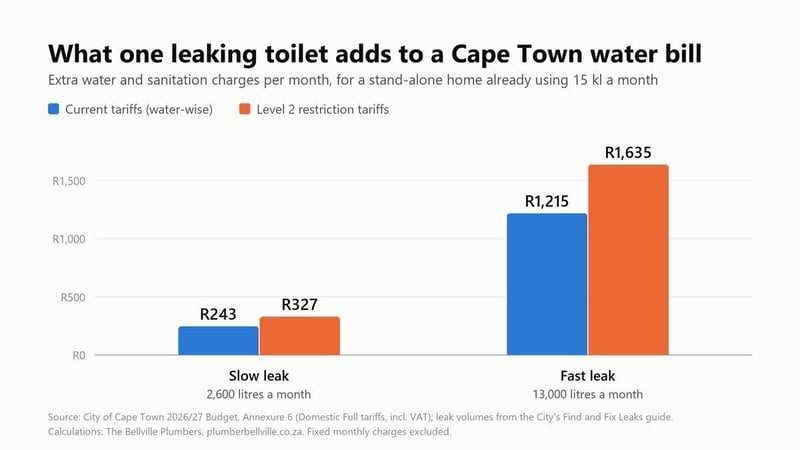
Cape Town, 6 October 2026: One leaking toilet can add between about R240 and R1,215 a month to a Cape Town household’s water and sanitation charges at the City’s current 2026/27 tariffs, and up to R1,635 a month if Level 2 restriction tariffs come into force, according to calculations published today by The Bellville Plumbers, a plumbing service based in Bellville in the city’s northern suburbs.
The figures come as the City of Cape Town reports dam levels of 75.7% going into the final month of the rainy season, which ends on 31 October. In its update on 2 October, the City said dam levels typically need to be 80% or more by the end of the rainy season to avoid water restrictions, that 895 million litres of water was used on 1 October against an 860 million litre daily limit, and that household consumption needs to drop by at least 10%. Restrictions on the Western Cape Water Supply System, which the National Department of Water and Sanitation has the authority to implement, are under consideration.
“By being more aware of our daily usage and reducing unnecessary consumption now, residents, businesses and City teams can help keep our dams fuller for longer and reduce the severity of restrictions should they become necessary,” said Alderman Zahid Badroodien, the City’s Mayoral Committee Member for Water and Sanitation, in the City’s statement.
How a small leak becomes a large bill
The City’s own Find and Fix Leaks guide estimates that one leaking toilet wastes between about 2,600 and 13,000 litres a month, and a leaking tap between about 400 and 2,600 litres a month.
Because Cape Town bills water in rising steps, leaked water is not charged at an average rate. It is added on top of everything the household has already used, so it is billed at the highest step the account reaches that month. Sanitation rises with it: for stand-alone homes, the City calculates the sanitation charge on 70% of metered water, so every kilolitre lost to a leak also adds to the sanitation line.
For a stand-alone home already using 15 kilolitres a month, the extra monthly cost works out as follows:
| Leak (City estimate) | Water lost per month | Extra cost at current tariffs | Extra cost at Level 2 restriction tariffs |
|---|---|---|---|
| Leaking tap | 400 to 2,600 litres | R37 to R243 | R50 to R327 |
| Leaking toilet | 2,600 to 13,000 litres | R243 to R1,215 | R327 to R1,635 |
Over a year, a fast-running toilet at today’s tariffs comes to more than R14,500. Homes that already use more water pay more for the same leak. A home using 30 kilolitres a month whose toilet leaks 13,000 litres is pushed past 35 kilolitres, where water costs R147.77 a kilolitre, and the leak adds about R2,139 a month. Under Level 2 restriction tariffs, the same leak in the same home would add about R3,290 a month.
The 15-minute check the City recommends
The City recommends a simple meter test that any household can do:
- Close all taps on the property and do not flush toilets.
- Record the water meter reading.
- Wait 15 minutes and read the meter again, making sure nobody has used water in between.
- If the reading has changed, there is a leak on the property that needs fixing.
For toilets, the City’s guide suggests three quick checks: listen for water trickling into the bowl, press a piece of toilet paper against the back of the bowl to see if it gets wet, or put 15 drops of food colouring in the cistern and see whether the water in the bowl changes colour within 15 minutes. Where a household cannot afford a plumber straight away, the City advises using the small stopcock, or angle valve, at the base of the toilet to keep it turned off between flushes.
Who fixes what
Leaks on private property, whether indoors, in the garden or under the house, are the owner’s responsibility. The City fixes burst pipes, leaks at the water meter or council stopcock, and leaks in roads, pavements and on other City property. Leaks in streets and public spaces can be reported to the City on WhatsApp at 060 018 1505, by calling 0860 103 089, or by SMS to 31373.
Registered indigent households may qualify for help. The City has allocated more than R3.8 million in 2026/27 to repair leaks at registered indigent properties, which are identified through the City’s billing system.
Homeowners in Bellville, Parow, Goodwood, Brackenfell and Kraaifontein who find a leak they cannot trace can find details of leak detection in Bellville on The Bellville Plumbers’ website.
How the figures were calculated
Calculations use the City of Cape Town’s 2026/27 water and sanitation tariffs for single residential (Domestic Full, non-indigent) properties, including VAT, as published in Annexure 6 of the City’s 2026/27 Budget. Current costs use the water-wise (no restriction) tariffs that apply from 1 July 2026, listed in the budget as Level 1: water costs R25.85, R36.76, R61.37 and R147.77 a kilolitre across its four steps. Restriction costs use the published Level 2 schedule. Sanitation is calculated on 70% of metered water, capped at 35 kilolitres, as the City does for stand-alone homes. Leak volumes are the City’s own estimates. Fixed monthly charges are excluded because a leak does not change them. Cluster and sectional title properties are billed differently and are not covered.
Sources
- City of Cape Town, dam levels update, 2 October 2026, as published by Politicsweb
- City of Cape Town, 2026/27 Budget, Annexure 6: Water tariffs, Level 1
- City of Cape Town, 2026/27 Budget, Annexure 6: Water tariffs, Level 2
- City of Cape Town, Find and Fix Leaks guide
- City of Cape Town, How the City manages leaks and burst pipes: guide and FAQs
About The Bellville Plumbers
The Bellville Plumbers is a plumbing service based at 132b Durban Rd, Bellville, 7530, serving Bellville and the northern suburbs, including Parow, Goodwood, Brackenfell and Kraaifontein. Its services include leak detection, geyser repairs and installations, drain unblocking and plumbing compliance certificates. More information is available at plumberbellville.co.za.
Release information
Issued on behalf of
The Bellville Plumbers
Media contact
The Bellville Plumbers
John Ranker