
Rational Defiance - How strategic dissent drives long term performance
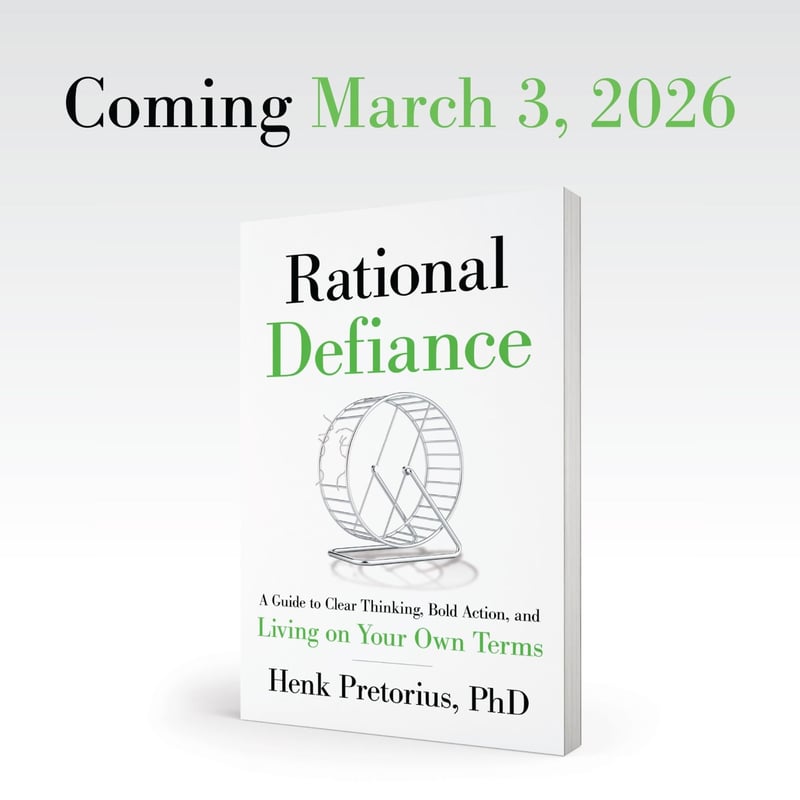
Our greatest limitations in business and life are not imposed by circumstance, but by our unconscious attachment to the status quo, argues Henk Pretorius in his newly published book, Rational Defiance.
He calls this state the Conformity Coma, an unconscious attachment to the status quo that shapes decisions, strategy, and culture without deliberate intent.
In a business environment defined by rapid technological change, shifting customer expectations, and relentless competition, drifting is not neutral. It is costly.
The central argument is clear. Competitive advantage no longer comes from executing established playbooks better than everyone else. It comes from knowing when to question the playbook itself.
The cost of the status quo
Status quo bias is not a theoretical concept. It is a measurable force in markets.
Customers stick with default options. Employees remain in disengaging roles.
Companies persist with legacy systems and outdated processes because replacing them feels risky or inconvenient. Leaders defend strategies that once worked but no longer do.
This is not irrational in every context. Defaults reduce complexity. Habits create efficiency. Institutional memory prevents chaos. The problem arises when familiarity becomes a proxy for effectiveness.
Markets do not reward comfort. They reward relevance. And relevance demands the ability to detect when what once worked has quietly stopped working.
Organisations trapped in the status quo rarely collapse overnight. They decline gradually through incremental underperformance, missed inflection points, and slow erosion of strategic clarity.
The three traps that undermine performance
Pretorius identifies three recurring conformity traps that are particularly dangerous in business environments.
-The consistency trap: loyalty to past success
Consistency is widely valued in leadership. It signals stability and discipline. But blind consistency can lock companies into outdated strategies.
Executives double down on products that once drove growth. Teams persist with processes that no longer scale. Leaders cling to identity narratives built in a different market era.
The sunk cost effect further entrenches this pattern. After investing time, capital, and reputation into a direction, walking away feels like failure. Yet in business, the refusal to pivot often proves more expensive than the pivot itself.
Strategic discipline requires the ability to separate commitment from attachment. Rational Defiance asks a difficult question: If we were starting today, would we make the same choice?
-The compliance trap: the pressure to align
Organisations are social systems. Alignment is necessary. But compliance can quietly replace critical thinking.
Groupthink emerges in executive teams. Industry norms go unchallenged. Benchmarking substitutes for original strategy. Leaders pursue initiatives because competitors are doing so, not because they are strategically sound.
Compliance is especially powerful in high performing cultures. When everyone appears confident in the direction, dissent feels disruptive. Yet some of the most consequential strategic failures in history were not caused by lack of intelligence. They were caused by lack of dissent.
Rational Defiance in business is not rebellion for its own sake. It is the structured encouragement of principled challenge. It requires creating environments where questioning assumptions is a responsibility, not a risk.
-The complacency trap: accepting business as usual
Complacency rarely announces itself. It shows up as incrementalism.
Margins erode slightly. Engagement dips gradually. Innovation pipelines thin out. Instead of questioning the model, teams optimise within its existing boundaries.
Over time, “how we do things here” becomes a constraint rather than a strength.
Markets, however, do not stand still. Technological disruption, particularly in AI driven transformation, is compressing strategic timelines. Business models that were stable for decades are now vulnerable within years.
Complacency is not passive. It is an active decision not to reexamine assumptions.
Defining Rational Defiance in business
Rational Defiance is the deliberate decision to challenge the status quo when doing so creates superior outcomes.
The emphasis on rational matters. This is not about contrarian branding or impulsive disruption. It is about disciplined, evidence based questioning of defaults.
In practice, Rational Defiance in business looks like:
- Reexamining long held assumptions about customer behaviour
- Redesigning default processes rather than layering fixes onto legacy systems
- Incentivising constructive disagreement at senior levels
- Testing unconventional ideas through structured experimentation
- Separating identity from strategy so the Organisation can evolveFrom drift to deliberate direction
It is a mindset that treats the current state not as sacred, but as provisional.
Every Organisation operates within a set of defaults: legacy systems, cultural norms, incentive structures, strategic narratives.
As Pretorius explores in Rational Defiance, the critical question for leaders is whether those defaults are consciously chosen or unconsciously inherited.
Drift is easy. It requires no courage. It preserves short term comfort. But it compounds strategic risk.
Rational Defiance is harder. It demands clarity, data, and the willingness to unsettle established patterns. Yet it is also the foundation of renewal, innovation, and sustained competitive advantage.
In a market defined by acceleration, the greatest risk is not moving too boldly. It is floating in a direction you never deliberately chose.
The organisations that thrive in the next decade will not be the most compliant. They will be the most consciously defiant.
Release information
Issued on behalf of
Henk Pretorius
Media contact
Reklame
Rosa-Mari Le Roux