
SARB holds repo rate at 7% — prime stays 10.50%, easing repayments but not restoring affordability
Written by: BizCommunity Editor Save to Instapaper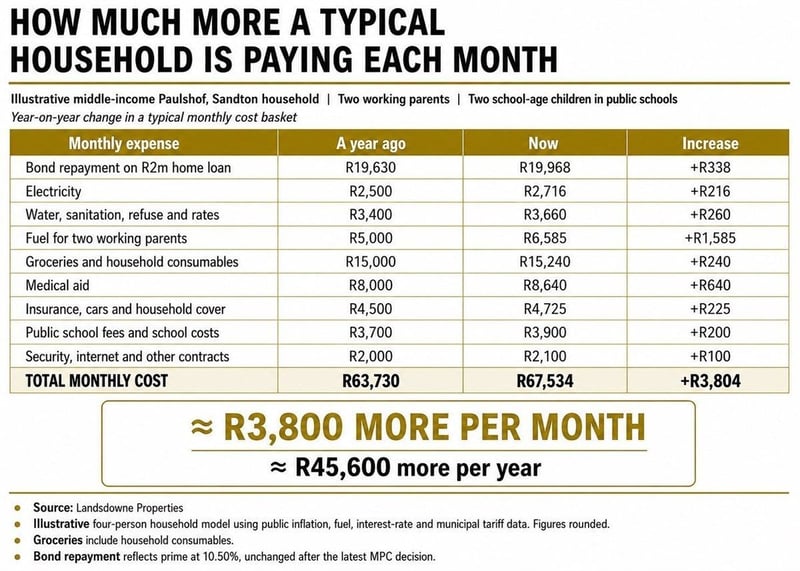
The South African Reserve Bank's decision to leave the repo rate unchanged at 7% means the prime lending rate remains at 10.50%.
For homeowners with variable-rate bonds, that avoids a new repayment increase this month, giving households a measure of breathing room after a difficult period for household finances.
But a rate hold, although against market expectations, keeps the pressure where it is.
Homeowners are still a long way from cheap money
Prime at 10.50% is below the 11.75% peak reached during the post-Covid hiking cycle, but it is still well above the 7.00% prime rate households saw at the Covid-era low.
On a R2m bond over 20 years, the monthly repayment remains at roughly R19,968. That is about R1,700 less than at the recent peak, but still about R4,460 more than at the Covid-era prime-rate low.
The bond table only tells part of the story
The absence of a further hike matters, but households do not pay the bond in isolation. Consumer inflation rose to 5.0% in June. Transport inflation accelerated to 12.7%, while fuel prices were 34.3% higher than a year earlier. Petrol was up 31.7% and diesel up 50.8%. From 1 July, households in major metros also absorbed higher municipal bills, with increases across key services such as water, electricity, sanitation and refuse.
This is where the hold still leaves homeowners exposed. The bond may not rise this month, but the rest of the monthly cost basket has not stood still.
The rate is national, but the pressure is local
Every borrower faces the same prime lending rate. But households do not experience affordability in the same way.
A family in Johannesburg, Durban, Cape Town or a smaller municipality may have the same bond repayment on paper, but very different municipal bills, service reliability, insurance costs, fuel exposure, body corporate charges and backup-power needs.
For homeowners, this means the real test is not only the interest rate. It is whether the home remains affordable in the specific municipality, suburb, estate or building in which they live.
Homeowners should use the pause
For existing homeowners, the hold should be used as an opportunity to stabilise cash flow rather than as permission to relax.
Households under pressure should review monthly commitments, avoid using short-term debt to fund recurring expenses, and speak to their bank early if arrears are becoming a risk. Waiting until the pressure is visible to everyone else usually leaves fewer options.
A rate hold gives homeowners time. It does not remove the need for discipline.
Buyers can breathe, but should not stretch
For buyers, the unchanged repo rate avoids a fresh deterioration in bond affordability. Some affordability calculations may therefore remain intact for now.
That does not mean buyers should stretch. Prime at 10.50% is still a high borrowing cost compared with the Covid-era low, and buyers still need to test whether the property works after the bond, municipal account, insurance, utilities, transport and other household costs have been paid.
Prequalification remains important, but it should not be treated as the full affordability test.
Sellers are negotiating with cautious buyers
For sellers, the decision should support some confidence because buyers have not faced another immediate rate shock. But buyers remain numbers-driven.
Homes that are realistically priced, well presented and clear on monthly costs can still move. Homes priced on last year's confidence may sit longer or face harder negotiation.
A rate hold does not remove demand. It keeps the market functioning, but the buyer across the table is still watching the monthly budget closely.
Landlords should not read the hold as a blank cheque
The rental market may remain supported as some households delay buying and stay in rental accommodation for longer.
But tenants are under the same cash-flow pressure as homeowners. Landlords should therefore be careful not to read rental demand as unlimited pricing power. Rental increases that move too far beyond affordability can create vacancy, arrears or higher tenant turnover.
In this environment, protecting occupancy and collection quality matters as much as pushing rental growth.
First-time buyers need lower-cost ownership, not only lower prices
First-time buyers should not abandon the market. The rate hold gives some stability, but it does not restore cheap finance.
Lower purchase prices matter, but lower monthly ownership costs matter too. Qualifying green-rated apartments deserve attention where they offer bank concessions or lower utility exposure. Buyers still need to test price, location, levies, resale demand and management quality.
The test remains tight
The decision to hold rates reduces the immediate risk of another repayment shock. It does not restore affordability.
That is the issue for the housing market. Homeowners, buyers, tenants and landlords are still operating in a high-cost environment where the monthly budget matters as much as the purchase price.
The next phase will not only be about what people can buy. It will be about what they can carry every month after the rest of life has been paid for.
Get new press articles by email
The Pulse Latest Articles
- Women Shaping Ai Global Creative Work From South Africa (August 25, 2026)
- Women’s Month Ends In August. Accountability Shouldn’t. (August 25, 2026)
- Ai In Job Profiling: When Efficiency Becomes A Risk (August 24, 2026)
- Women Are Performing While Physiologically Depleted (August 24, 2026)
- Kwv Marks 100 Years Of Brandy-making With Top Two Scores At Iwsc South Africa Judging (August 20, 2026)