
UN report warns world has moved from water crisis to 'water bankruptcy'; African utilities' losses expose risk
Written by: APO Group - Africa Newsroom Save to Instapaper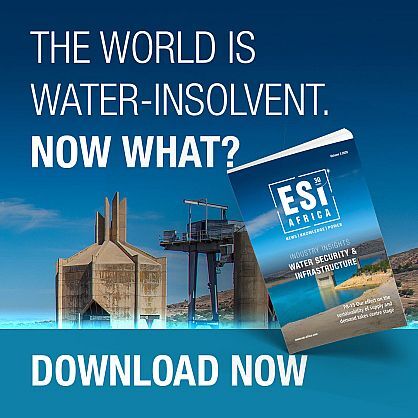
A new United Nations report says the world has moved past a water crisis into water bankruptcy, and Africa's utility numbers already show what that looks like.
This is the focus of Water Security & Infrastructure Volume 2026 (https://apo-opa.co/3TrgwgU), launched by ESI Africa, part of VUKA Group, mapping the shift from water crisis to water bankruptcy and holding it against African utility data.
For years, "water crisis" has been the term used whenever a dam ran low or a city faced Day Zero. The Global Water Bankruptcy Report (2026), published by the United Nations University Institute for Water, Environment and Health (UNU-INWEH), argues that the word "crisis" no longer fits.
A crisis is a shock a system recovers from. Bankruptcy is what happens when it can't. The report defines it as a "persistent post-crisis condition... in which long-term water use has exceeded renewable inflows and safe depletion limits, causing irreversible or effectively irreversible degradation."
Nearly 75% of the world's population now lives in a country classified as water insecure. The world has lost 410 million hectares of wetlands since 1970, an area the size of the European Union, at an economic cost the report puts at $5.1 trillion. Glacier mass is down more than 30% over the same period, and 70% of major aquifers are in long-term decline.
Where Africa's utilities stand
ESI Africa's new Water Security & Infrastructure Volume 2026 examines that global diagnosis and holds it against African utility data. The pattern repeats at a smaller scale, and it's already visible in the numbers that regulators publish annually.
Non-revenue water, water that is produced but never billed, lost to leaks, theft or faulty metering, sits above 35% across South Africa, Tanzania and Mozambique. In Zimbabwe and among Kenya's largest utilities, it exceeds 50%.
"Where in South Africa are we addressing non-revenue water?" asks South African Water Chamber CEO Benoît Le Roy. His own answer is that it's nowhere close to enough. South Africa's non-revenue water rate sits at roughly 47.8%.
The World Bank reached a similar conclusion in 2017, studying around 120 utilities across 14 African countries. Close to half couldn't cover their own operating and maintenance costs from revenue. Government transfers filled the gap, but at a cost, because this support removed any pressure on utilities to fix their own finances.
Eight years on, the region's own regulators confirmed the trend hasn't reversed. ESAWAS's 2023/24 benchmarking of 10 major utilities found average cost coverage fell from 99% to 91% in a single year. Collection efficiency dropped from 107% to 87%. In Zambia, two utilities have had tariffs frozen by government decision for more than four years.
Why doesn't the money move?
Bothwell Manikai, DBSA Principal for Infrastructure Financing, put it directly: "I must admit that the fact that we are where we are in terms of those losses means we can all do more."
Zakhele Mayisa, AfDB Senior Consultant for Private Sector Engagement, traced the blockage further upstream, to land tenure disputes and thin baseline data that disqualify water projects before financing talks start.
Without ring-fenced revenue, Le Roy argued, no financier can underwrite the risk. Cost-reflective tariffs matter, but they can't fix a network that loses water before that cost is ever billed.
The next big consumer
The volume also names the sectors that will need to shrink, adapt or pay more: mining, thermal power, agriculture, and, increasingly, data centres. By 2030, AI-related water consumption could reach 9.3 trillion litres globally, enough to cover the annual domestic needs of roughly 1.3 billion people in Sub-Saharan Africa.
Africa's 360MW of existing data centre capacity already exposes the gap. "We don't bill the customer for it," said Nazeem Holmes, senior solutions architect at Open Access Data Centres, explaining why water efficiency lags energy efficiency on site. Power is metered and billed to the tenant. Water, shared across a facility, isn't.
What comes next
The focus isn't on building more dams and desalination plants; it's a warning that doing so can deepen the overshoot by encouraging further unsustainable growth. Instead, there is a call for nature-based capital investment, water-bankruptcy risk screening by lenders, and real-time global monitoring of what remains.
ESI Africa Editor-in-Chief Nicolette Pombo-van Zyl frames the shift in her opening letter to the volume: "I'd wager the utilities that thrive over the next decade won't be the ones that produce the most water. They'll be the ones that lose the least of it."
The full volume features 17 articles unpacking finance, metering and policy responses across the sector, published in partnership with Conlog and the STS Association.
Access the full volume: https://apo-opa.co/3TGzjVw
Get new press articles by email
The Pulse Latest Articles
- Knockout Chaos 2 Sets The Tone As Boxing Takes Centre Stage At Rpm Performance Gym (July 23, 2026)
- The Growth Of Trading Card Games (July 21, 2026)
- Why Supplier Verification Is No Longer Enough To Stop Fraud (July 20, 2026)
- Why Empathy, Not Algorithms, Is The Key To Unlocking South Africa’s Billion-rand Digital Economy (July 20, 2026)
- Thousands In Cape Town Gave Ladles Of Love A Hand (July 19, 2026)