
Puerto Rican Homeowner Sues Bad Bunny Over Use Of La Casita In Short Film And Stage Set
Written by: BizCommunity Editor Save to Instapaper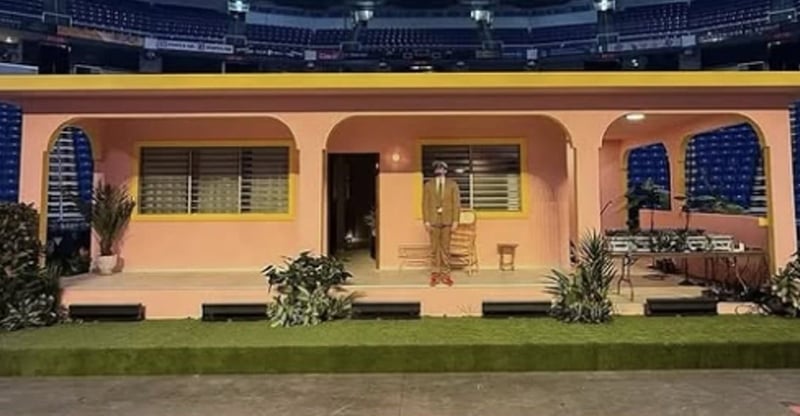
Bad Bunny’s “La Casita” stage set
Román Carrasco Delgado (Carrasco), the 84-year-old Puerto Rican homeowner, who says he designed and built his distinctive salmon-coloured home with his brother, filed a lawsuit in Puerto Rico’s Superior Court in September 2025 against several defendants, including Benito Antonio Martínez Ocasio, known as Bad Bunny.
Carrasco alleges that his home was used without proper consent in the 13-minute short film Debí Tirar Más Fotos, which accompanied Bad Bunny's album of the same name, and that it later inspired a full-scale replica used during the artist's concert series.
Supplied image: Bad Bunny’s “La Casita” stage setSupplied image: Román Carrasco Delgado’s home (Puerto Rico)Supplied image: Replica appearing in Bad Bunny’s "Debí Tirar Más Fotos” short film
Carrasco claims he has suffered a loss of privacy and emotional distress, alleging that his once-quiet home now attracts public attention, with fans arriving to take photographs and effectively turning his property into an uninvited tourist attraction.
The issues raised in the lawsuit extend beyond Puerto Rico and resonate in jurisdictions such as South Africa. At its core, the dispute raises questions about informed consent for using a private home in a film and replica, fair treatment of a potentially vulnerable party during contracting, and whether reproducing the home for commercial use could amount to copyright infringement.
Contractual validity, consent, and crossing creative lines
Carrasco alleges that a location scout requested to use his home for the short film but did not explain the project or provide a formal proposal. He contends that, although he consented to filming, he did so without knowing it would later be replicated for a long-term concert series.
Carrasco further alleges that production staff cleaned and prepared the home for filming and took extensive photographs and measurements of the interior and exterior.
Carrasco also alleges that, when the agreement was formalised, he was asked to sign a blank cellphone screen. He claims the electronic signature was then applied to two contracts he could not read and that were not explained to him.
He says he received payments of $2,400 and $2,800 for the short film, which he contends were far below the value of the later commercial use of his property, including the replica built for Bad Bunny’s long-term concert series.
Carrasco argues that the mere existence of a signature does not establish a binding agreement where a party is illiterate and vulnerable. He also contends that an electronic signature does not remove the requirement of informed consent, particularly where the other party benefits commercially from use of the property beyond what was agreed.
What SA law says
In South African law, the principle of sanctity of contract is the starting point. Our courts have repeatedly affirmed that parties are generally bound by their agreements.
A person who signs a document is presumed to assent to its contents, whether or not they have read it. In other words, a signatory is expected to take reasonable steps to understand what they are signing.
That duty is not absolute. A signatory may avoid being bound in certain circumstances, including where the other party made misrepresentations that induced the agreement. But a party’s failure to foresee or understand the downstream consequences of a contract does not, on its own, amount to misrepresentation.
South African law does not impose a general duty to “explain everything.” However, where one party lacks legal sophistication because of age, illiteracy, or other vulnerabilities, our courts will scrutinise the fairness of the contracting process. Exploitation of that vulnerability can undermine contractual validity.
Ownership, authorship, and copyright in buildings
The lawsuit further claims that Carrasco and his brother personally designed and built the house - a detail that carries legal significance beyond its sentimental value.
Under South African law, copyright protects original artistic works - and works of architecture are expressly included. On that basis, Carrasco’s house would qualify as an artistic work eligible for copyright protection.
Ordinarily, the author of such work is generally the first owner of copyright unless there is a contract or legal assignment to the contrary. As Carrasco and his brother designed the house, they are co-authors of the building, as an artistic work, and the first owners of the copyright that subsists in it.
Copyright ownership grants the right to reproduce, adapt, and publicly display a work, as well as to authorise others to do so. These rights enable owners to control commercial exploitation and to prevent unauthorised copying. Primary copyright infringement occurs when any of these exclusive rights are excised without permission.
Photographing a publicly visible building is generally lawful in South Africa. Reconstructing it elsewhere from photographs and measurements, however, may amount to copyright infringement.
Recreating Carrasco’s home in three dimensions could qualify as reproducing an artistic work. If the replica is objectively similar to the original, infringement may be inferred.
South African courts assess infringement qualitatively, focusing on what was taken rather than how much. Minor changes are therefore unlikely to avoid liability if the recognisable essence of the house remains.
While copyright infringement is not currently claimed in the lawsuit, it could become a significant issue if the underlying agreement is found to be invalid, potentially opening the door for Carrasco to obtain an interdict and damages or a royalty in lieu of damages, which would require an account of profits.
Conclusion: Consent and copyright as non-negotiable foundations
The lesson for South African filmmakers and creatives is clear: contractual consent must be informed, not assumed. Where consent is shaky, the entire structure may collapse.
A signature alone may not be enough if the person signing cannot meaningfully understand the agreement. Where a personally designed house is reproduced without permission, copyright infringement may also come into play.
Whether this matter proceeds to judgment or is settled, it serves as a reminder that creative projects require not only ambition, but also proper rights clearance and informed consent.
Get new press articles by email
We submit and automate press releases distribution for a range of clients. Our platform brings in automation to 5 social media platforms with engaging hashtags. Our new platform The Pulse, allows premium PR Agencies to have access to our newsletter subscribers.
Latest from
- AGES Impact Report Shows 20+ Deals and $25 Million Financing Outcomes From Summit Ecosystem
- Buyers Underestimate Post Bond Holding Costs As Levies Push Monthly Bills Higher
- Business Partners Limited Highlights Youth Led SMEs Driving Jobs Skills And Community Impact
- Nigeria Secures $3 Billion Investment as Reforms Boost Mining Sector Growth
- New Ugie MFB Press To Improve Availability Of BisonLam MelaWood MelaWood SupaTexture And Monteo+ Ahead Of Peak
- Thousands Of Bursaries Expected For 2027 Academic Year To Tackle Skills Shortages
- Chommies Launches Wish You Were Here Leather Travel Collection Inspired By Postcards
- Why Mass Applying Hurts Your Job Search and Risks ATS Rejection
- Gavin Coley Appointed Head Of Claims At Santam Syndicate 1918
- Access to Finance Live Debuts at The Business Show - - Africa to Connect SMEs with Funders
- Green Guarantee Backed Bond to Fund d.light Solar-Home Rollout Reaching 4.3 Million People
- Inospace Repositions Wadeville Asset into Flexible Multi‑Let Park for SMEs
- South African Passenger Vehicle Sales Rise Slightly To 114,517 Units In Q1 2026 As Market Turns More Selective
- Alex Goldberg Appointed Executive Creative Director at Halo Cape Town
- Foot and Mouth Disease Becomes Structural Threat to South Africa Red Meat Value Chain
The Pulse Latest Articles
- The Real Ai: How African Ingenuity Drives Growth And Distinguishes The Continent’s Logistics Sector (June 25, 2026)
- Sotru Launches To Stop Supplier Fraud At The Moment Of Payment (June 23, 2026)
- The Death Of The Dinner Party? Why South Africans Are Choosing Convenience Over Traditional Entertaining (June 23, 2026)
- Wildbeest Media Launches 2026 Tourism Marketing Campaign Service For South African Travel Brands (June 22, 2026)
- Opinion Piece: The Chair Is Not The Person: A Ceo’s Hardest Leadership Lesson (June 22, 2026)