
From dairy farm to boutique winery - Mellish Family Vineyards’ rise in Durbanville
Written by: Ingerese Schoeman Save to Instapaper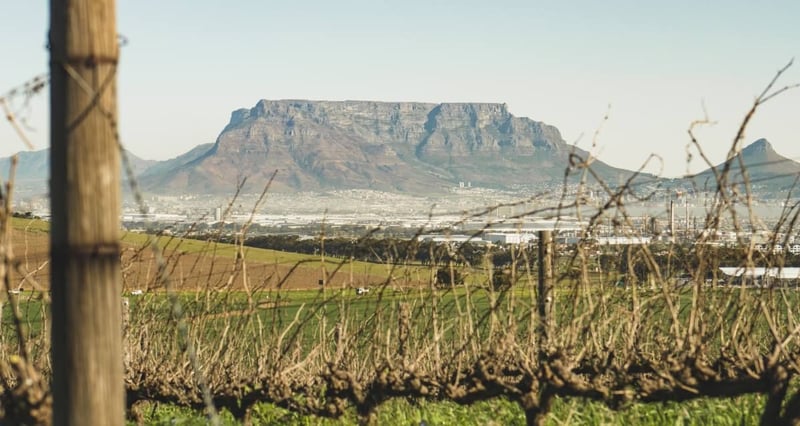
Mellish Family Vineyards didn’t start out with wine, but with cows and grain. Today, it’s a boutique winery built up by a family deeply connected to the land.
Welbeloond farm already had a long history with the Mellish family long before their name appeared on a wine bottle. Winemaker Andrew Mellish is the fourth generation at Welbeloond. His great-grandfather first leased the land in 1918, then bought it in 1934. Decades rolled by and most of the effort went into grain and dairy with periods of sheep and vegetable farming in between. Over time, Welbeloond evolved into a significant dairy operation led by Andrew’s dad, Andrew Gustave Mellish, who milked around 900 cows and co-founded the dairy brand Homestead. In 1997, Clover acquired Homestead, but the Mellishes continued to produce milk for a few more years.
Although Andrew grew up on a dairy farm, it never really interested him. In about 1999, while he was still at school, something changed in Durbanville. Vineyards started getting more attention, especially after the launch of Durbanville Hills. The Mellishes’ neighbours were also planting vines and even wanted to expand onto their land. As big international wine companies started noticing Durbanville’s potential, Andrew found himself drawn to vineyards and wine.
One evening, while out celebrating graduating with a degree in oenology and viticulture from Stellenbosch University, he tasted a Kaapzicht Merlot 2004 at Wijnhuis in Stellenbosch. That moment everything changed. “That was the first time I really understood what wine could be,” he says. From then on, wine wasn’t just something in the background, it became his focus.
The farm’s first vines – six hectares of Merlot – were planted in 2000. Over the next few years, the plantings grew to about 35 ha, with the addition of Shiraz, Cabernet Sauvignon, more Merlot and later Sauvignon Blanc. “All these decisions were guided by what suited the site best, with a strong focus on soil, slope and producing wines with a clear sense of place,” Andrew says. The main goal was to supply fruit to Durbanville Hills rather than make his own wines, but it set the stage for future developments.
In 2020, Andrew completed the WSET diploma. To delve into the business side of things, he registered for the Business of Wine course at UCT’s Graduate School of Business in 2021 and in 2022 he enrolled at the Michael Fridjhon Wine Judging Academy.
He also got his hands dirty during harvests in Hawkes Bay, New Zealand, and later in Carneros, California, where he picked up a variety of techniques both in the vineyard and cellar. He also completed several harvests locally at Asara Wine Estate, Durbanville Hills, D’Aria and De Grendel. On visits to Champagne, Burgundy and the Rhône Valley, he saw firsthand why winemakers worldwide regard these French regions as the gold standard.
In 2015, he at last felt ready to take the plunge and introduce organic methods to the farm. Those early years were nothing but trial and error, he says. As the vineyards matured, he dived into winemaking, experimenting as he went along. In 2018, Mellish Family Vineyards was officially launched.
Building the brandBuilding a wine brand was a whole new ball game compared with growing grapes. From the outset, Andrew said he wanted Mellish to be a boutique winery, producing only small batches of premium wine. He produces about 6 000 bottles a year, with plans to grow to 90 000 bottles – it’s all about being in control and getting everything right. “Being small isn’t a weakness,” he says. “It’s actually the key to what I’m trying to achieve – producing something truly special.”
Andrew decided to initially focus on Syrah and Sauvignon Blanc, as these two varieties had already demonstrated their success in the vineyard. Rather than casting the net wide, he chose to keep it minimalistic. When Mellish Family Vineyards launched its wine to the public in February 2020, things didn’t go quite as planned. With the introduction of Covid lockdowns, it was like hitting the brakes just as they were gaining speed. Andrew says it probably put them back about 18 months, which is a long time for a new brand to be stuck in neutral.
Even so, the direction has remained steady. Andrew admits that selling wine is not his strongest suit and at times it feels like he’s knocking on doors that don’t always open on the first try. But luckily with the right people on his side, the doors eventually do open.
Mellish Family Vineyards feature regularly in Winemag’s Top 10 list, with the 2020 and 2021 Syrah both grabbing 95 points and the 2020 and 2021 Blanc Fumé both 93 and 94 points respectively. The 2021 Blanc Fumé really stood out, too. It scored 94 points and was named their Sauvignon Blanc of the Year and showcased at the Winemag London tasting. The Blanc Fumé 2020 won a gold medal and 96 points at the Investec Trophy Wine Show this year. Michael Fridjhon also selected the 2021 Blanc Fumé for the Global Fine Wine Challenge in 2023 where it was the only South African Sauvignon Blanc to win gold. Mellish has also picked up 4.5 and five stars in the Platter’s wine guide.
The wines now also include a Pinotage and Chenin Blanc, are positioned in the premium segment, and are aimed at consumers who like high-end products and are happy to pay from R250 to R300 a bottle, as long as it’s of good quality. It’s a market that expects consistency and quickly notices when the quality drops off.
Distribution is purposefully selective and comprises a combination of direct-to-consumer sales, boutique stores and a few restaurants. Andrew’s goal is to eventually export about 50% of production to international markets, including Singapore, Japan and parts of Europe.
Future visionLooking ahead, the focus is on growth. Andrew is still finalising his cellar and production space, which will gradually expand the wine range. It will include a Chardonnay, Blanc de Blancs MCC and eventually a Cabernet-based blend. Even as the volume increases, it’s not at the expense of identity. Andrew is committed to keeping things small enough so each release has its own character.
Next up is a tasting room that’s set to open in September. “True to the brand, it will be simple and centred around the wine,” Andrew says. “No gimmicks – just a beautiful space where the wine is the main draw.”
For him, success isn’t about becoming huge. It’s about reliability and wanting the vineyards to thrive. “If people trust the wines and keep coming back, that’s all that matters,” he says.
Mellish Family Vineyards is still writing its story, but Andrew’s direction is clear: “Build slowly, build properly and let the wines do the talking.”
To read more articles in our August issue themed “Champions of Change,” buy a copy here.