
World Radio Day 2026 Highlights AI As A Tool Not A Voice In Broadcasting
Written by: MyPressportal Save to Instapaper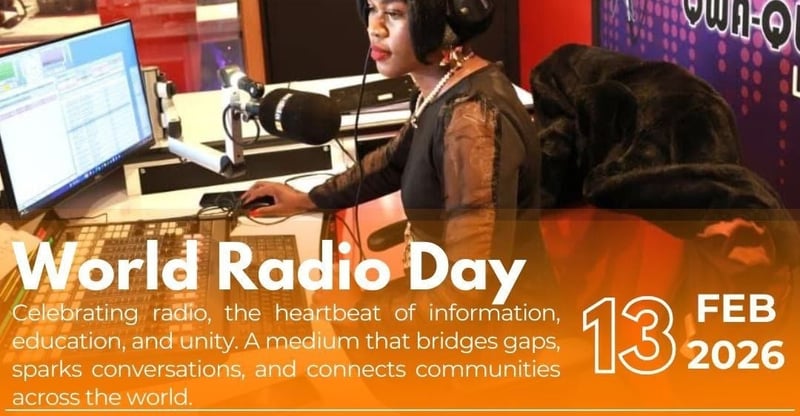
The theme for World Radio Day 2026 is AI is a tool, not a voice. Get involved: #WorldRadioDay, which speaks directly to one of the most pressing conversations confronting the broadcasting sector today. It captures both the promise and the anxiety that artificial intelligence has introduced into mainstream, public and community media ecosystems.
South Africa’s rapidly expanding access to affordable broadband has fundamentally changed how audiences consume content. Digital technologies are now central to how people seek information, entertainment, social connection and services. As a result, a handful of global digital platforms increasingly dominate the media landscape. This shift has raised legitimate concerns about the future relevance of live radio, particularly as audiences gravitate towards 'on demand' audio such as podcasts, streaming services and personalised playlists.
As Professor Franz Krüger notes in Beyond the Broadcasting Industry, the rise of on demand audio content consumed entirely at the listener’s convenience challenges traditional broadcasting models and fuels fears that live radio may gradually lose its centrality within the South African society.
These concerns were echoed in conversations held across South Africa in the lead-up to the G20 Summit, where journalists and media practitioners reflected deeply on the state of the media. One topic dominated those discussions: artificial intelligence. Its power. Its potential. And its risks.
Yet within the community radio sector, an important and more hopeful perspective is emerging. There is a growing recognition that, when used responsibly and ethically, AI does not replace human voices, it supports them. Much like an executive assistant, AI can manage back-end and repetitive tasks such as scheduling, voice-tracking, compiling weather or sports updates, and basic production support. This, in turn, allows station managers, producers and presenters to focus on the true heart of radio: informing, educating and entertaining communities in their own languages and lived realities.
This is where the MDDA’s role becomes critical
The Media Development and Diversity Agency is a statutory development agency established in terms of the MDDA Act No. 14 of 2002. It represents a partnership between the South African Government and major print and broadcasting companies, with a mandate to promote media development and diversity, particularly within community and small commercial media sectors. Since beginning its grant-funding work in January 2004, the MDDA has worked to create an enabling environment that reflects the needs, aspirations and voices of all South Africans.
As part of its mandate, the MDDA is also tasked with raising public awareness around media development and diversity issues, including the impact of emerging technologies such as AI.
From the Agency’s perspective, the future of community radio does not lie in resisting technological change, but in shaping it in ways that strengthen local voices rather than silence them.
World Radio Day is, above all, a moment to recognise broadcasters; mainstream, public and community alike, for the stories they tell, the voices they amplify and the public trust they uphold. For the MDDA, this celebration is also an opportunity to reflect on the extraordinary impact of community media in South Africa’s democratic journey.
Radio remains one of the most powerful platforms for public discourse and civic engagement in the country. It reaches deep into rural and remote areas, enabling participation in national conversations where few other platforms can. Community radio in particular has expanded the scope of public discourse in a country where access to media and freedom of expression were once severely restricted.
The concept of community radio emerged from the media policy debates of the 1990s and was formally recognised in the media policies of democratic South Africa. Today, as South African radio marks 102 years of existence, it is impossible to tell this history without acknowledging the central role community radio has played in fostering social cohesion, inclusion and nation-building.
If there are lingering fears within the sector about becoming obsolete in the age of AI, community radio needs only to look back at its own recent history. During the height of the Covid-19 pandemic, community radio stations proved indispensable in educating, informing and supporting communities with trusted, localised information when it mattered most. No algorithm could replace that human connection.
As we celebrate World Radio Day 2026, the message is clear: AI may be a powerful tool, but it can never replace the authentic, community-rooted voice of radio. With the right support, policy environment and ethical use of technology, community radio will not only survive this digital transition, but it will continue to thrive.
Referenceshttps://www.tandfonline.com/doi/pdf/10.1080/02500167.2024.2403404https://www.dailymaverick.co.za/opinionista/2025-12-04-ai-is-the-best-and-worst-thing-to-happen-to-journalism/