
Tiger Brands Reports Robust H1 26 Volume Growth and Improved Operating Income
Written by: BizCommunity Editor Save to Instapaper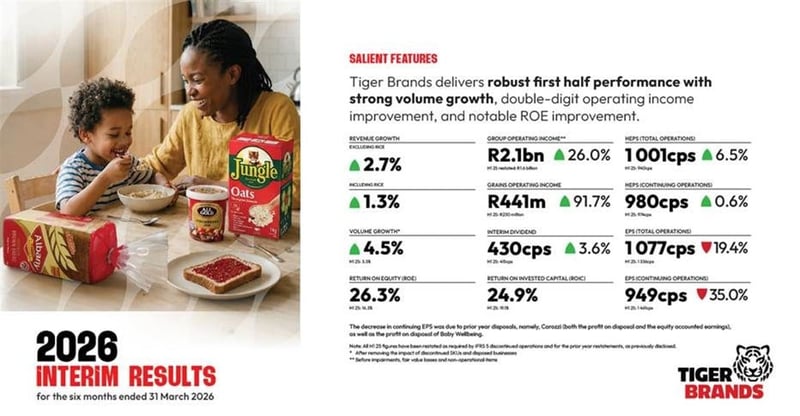
Salient features Disciplined operational execution and a sustained focus on affordability underpinned a robust performance by Tiger Brands for the six months ended 31 March 2026 in which the company delivered strong volume growth and a meaningful improvement in operating income. This performance was achieved despite ongoing macroeconomic volatility, continued pressure on consumer spending, and a competitive environment.
Overall revenue growth was 1.3% R17.9bn, primarily driven by volume growth of 2.6% and price deflation 1.3%. On a like-for-like basis, excluding the impact of discontinued SKUs (Stock Keeping Units) and disposed businesses, normalised volume growth was 4.5%, with price deflation at 1.7%. Gross margin increased to 32.1% in H1 26 from 29.8% in the prior year, driven by favourable raw material inputs in key categories and continuous improvement initiatives of factory efficiencies and value engineering savings.
“The South African consumer bears the heaviest burden during challenging economic times and as Tiger Brands we remain committed to driving affordability and relevance in everything we do. The growth achieved in the first half along with continued momentum in delivering the business turnaround is the result of diligent execution of our strategic and operational levers,” says Tjaart Kruger, CEO Tiger Brands.
All Business Units improved operating income, with Grains and Culinary delivering a standout 91.7% and 26,9% increase respectively.
Milling and baking
Revenue increased by 0.6% to R4.2bn, driven by volume growth of 0.3% and price inflation of 0.3%. Operating income increased 15.3% to R376m and margins increased to 8.9% versus 7.8% in the prior year. The Super Bakery project remains on track for commissioning by end of the calendar year (FY27), with equipment containers in transit.
Grains
Grains revenue of R3.5bn was driven by volume growth of 6.9%, offset by price deflation of 10.8% in soft commodities. Operating income increased by 91.7% to R441m, with margins nearly doubling to 12.7% from 6.4%. This growth was driven by effective pricing strategies, a stronger product mix, logistics optimisation, and improved profitability at King Foods.
Culinary
Culinary revenue increased by 8.7% to R5.7bn, driven by 6.0% volume growth and 2.7% price inflation. Culinary had compelling operating income at R562m, which was 26.9% higher than prior year, with operating margin at 9.9% versus 8.5% in the prior year. Improved operating income was driven by topline growth from the Condiments category as well as CI initiatives of recipe value engineering in Condiments, packaging value engineering, and logistics optimisation.
Snacks, treats and beverages (STB)
STB revenue of R3.3bn was 1.2% higher than prior year, with volume growth of 1.2% driven by count lines, candy and ready-to-drink dilutables. Operating income improved 16.1% to R505m, operating margin was at 15.5% (versus 13.5% in the prior year), driven by favourable input costs and CI initiatives. The development of the Snacks and Treats mega-site remains on track for completion by end of FY27.
Home and personal care (HPC)
HPC revenue declined 9.5% to R1.3bn, driven by volume declines of 10.4% in both Home Care (impacted by wet weather reducing peak pest season demand) and Personal Care (impacted by continued competitive intensity). Despite this, operating income was 1.7% higher than prior year at R297m, with operating margin at 22.9%, supported by factory efficiencies and logistics optimisation. Recovery of Personal Care is a priority for H2 26, with key innovations planned around functionality and reducing seasonal dependency of the body care range.
In addition, Tiger Brands continued to make progress in delivering on commitments to reduce environmental impact, address food security in vulnerable communities and with its digital transformation strategy implementation.
Tiger Brands recently signed a landmark electricity wheeling agreement with renewable energy supplier Apollo Africa to help reduce its scope 1 and 2 greenhouse gas (GHG) emissions, beginning with its manufacturing sites in Gauteng. Set to commence in 2028, the agreement marks a significant step in the company’s transition to cleaner energy sources. Tiger Brands’ sites to be supplied via Ekurhuleni Municipality will receive approximately 60% of their electrical supply from wheeling by 2028.
Tiger Brands’ strategy execution journey over the coming months will maintain a priority focus on enhancing affordability across its portfolio, while accelerating growth and creating value for the business. Key to this is the implementation of its structural investments, including our Super Bakery, Mega Distribution Centre and various site expansions and optimisations,” says Kruger.
“While we expect the macroeconomic environment to become more challenging in the second half, Tiger Brands remains confident in our ability to deliver in line with guidance. We are proactively managing geopolitical and trade‑related pressures through disciplined cost initiatives and targeted pricing actions, ensuring the resilience of our performance in H2 2026.”
The board of Tiger Brands has declared an interim ordinary dividend of 430 cents per share for the six months ended 31 March 2026, in line with the Company’s dividend policy of 1.25x cover based on HEPS. The net interim dividend, after withholding tax of 20%, is 344 cents per ordinary share. The payment date is 6 July 2026.
Get new press articles by email
We submit and automate press releases distribution for a range of clients. Our platform brings in automation to 5 social media platforms with engaging hashtags. Our new platform The Pulse, allows premium PR Agencies to have access to our newsletter subscribers.
Latest from
- New Ugie MFB Press To Improve Availability Of BisonLam MelaWood MelaWood SupaTexture And Monteo+ Ahead Of Peak
- Thousands Of Bursaries Expected For 2027 Academic Year To Tackle Skills Shortages
- Chommies Launches Wish You Were Here Leather Travel Collection Inspired By Postcards
- Why Mass Applying Hurts Your Job Search and Risks ATS Rejection
- Gavin Coley Appointed Head Of Claims At Santam Syndicate 1918
- Access to Finance Live Debuts at The Business Show - - Africa to Connect SMEs with Funders
- Green Guarantee Backed Bond to Fund d.light Solar-Home Rollout Reaching 4.3 Million People
- Inospace Repositions Wadeville Asset into Flexible Multi‑Let Park for SMEs
- South African Passenger Vehicle Sales Rise Slightly To 114,517 Units In Q1 2026 As Market Turns More Selective
- Alex Goldberg Appointed Executive Creative Director at Halo Cape Town
- Foot and Mouth Disease Becomes Structural Threat to South Africa Red Meat Value Chain
- Prof. Useh Elected to Chair HESCoP Academic Subcommittee to Lead Sustainability Dialogue
- React Native Evaluation Stalled by Old Assumptions Despite Enterprise Provenance
- Uganda To Spotlight Mining Investment Opportunities At African Mining Week 2026
- FunHouse Digital Selected for AWS and Deloitte Accelerator Among Nine African Organisations
The Pulse Latest Articles
- Sotru Launches To Stop Supplier Fraud At The Moment Of Payment (June 23, 2026)
- The Death Of The Dinner Party? Why South Africans Are Choosing Convenience Over Traditional Entertaining (June 23, 2026)
- Wildbeest Media Launches 2026 Tourism Marketing Campaign Service For South African Travel Brands (June 22, 2026)
- Opinion Piece: The Chair Is Not The Person: A Ceo’s Hardest Leadership Lesson (June 22, 2026)
- Pura And Soweto Cyclists Celebrate Youth Day 50 Years After The 1976 Uprising (15) (June 18, 2026)