
Waterford Estate’s Martin de Kock champions minimalist, place-driven menu to enhance wine estate experience
Written by: Wanda Augustyn Save to Instapaper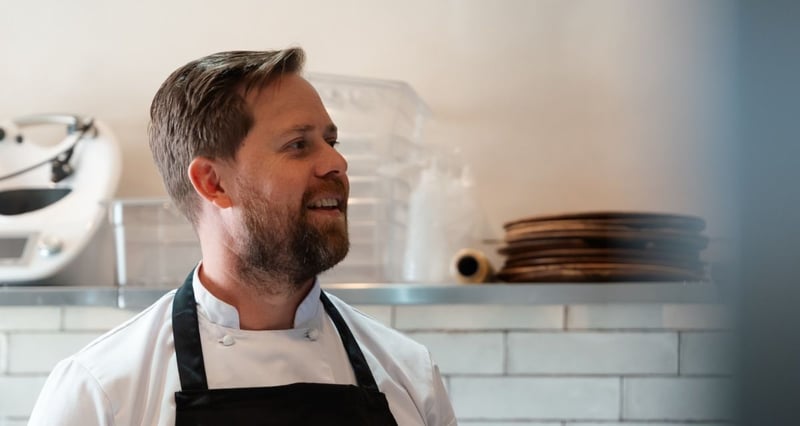
There is something revealing about a chef saying there should be nothing really to hide behind on a menu.
For chef Martin de Kock, that means fewer dishes, good produce and enough restraint to let each element do its job. At Waterford Estate, where food sits alongside wine, landscape, hospitality and the wider estate experience, his aim is not to make the menu compete for attention.
“I want to elegantly add to the whole without subtracting from what already makes the estate so special,” he says.
He keeps the menu deliberately small. The thinking behind it, however, goes much further, from Cabernet Sauvignon and coastal samphire to foraged mushrooms, seasonality, and the role food plays in influencing a complete wine estate experience.
It is a useful way of thinking about estate dining. Food can be an attraction in its own right, but in a wine environment, it also has another job: it can change how a guest experiences a wine, how long they remain at the estate and, ultimately, what they remember when they leave.
For Martin, the answer is not to make the food more elaborate. In fact, his instinct is moving in the opposite direction. Less on the menu, more to consider
He describes the Waterford menu as minimalist and focused, part of what he sees as a broader shift back towards more uncomplicated dining.
A smaller menu brings its own discipline. There are fewer places for an average ingredient or an unnecessary element to disappear. It also means each dish has to work within the wider tasting experience rather than simply succeeding on its own.
Yet wine is not necessarily where every dish begins.
“Ideas sometimes stem from drinking wine, foraging, engaging with people or just from dining out,” he says. “I always try to look at each experience, no matter what, as an opportunity to add to my offerings.”
That distinction is important. Rather than constructing every plate backwards from a particular cultivar or tasting note, Martin allows ideas to emerge first and then considers how they might sit within Waterford’s wine offering. The result is a relationship between kitchen and cellar that is deliberate without becoming formulaic.
When Cabernet meets bone marrowWaterford’s strong Cabernet focus inevitably finds its way onto the plate.
Martin says a rich red-meat dish is a natural fixture on the compact menu, supported by details such as potatoes cooked in in-house rendered tallow. One current example is a T-bone served with roasted bone marrow, Rooikrans smoked compound butter and a roasted garlic and onion salad with a bright, zesty character. It is paired with Waterford’s Antigo.
“The slight tobacco and oaky sweetness really just rounds out the mouthfeel on a bone marrow-ridden slice of beef,” he says.
Then, with the qualification of someone who knows personal preference remains part of any pairing, he adds, “Maybe I am biased. I love a beautiful piece of red meat with a complex Cab.”
Other combinations move in a very different direction. A Pelargonium-inspired dessert is paired with Heatherleigh, while the purity of the estate’s Chenin Blanc, influenced by its time in concrete, pairs well with line fish with mussel broth and coastal samphire.
The examples illustrate something more interesting than matching red wine with meat or white wine with fish. Texture, weight, acidity, savoury elements and aroma all influence the relationship. And, as Martin is quick to acknowledge, getting that relationship right is not an exact science.
Pairing without flattening the wineOne of the risks of wine pairing is that an apparently logical match can become too obvious.
“Sometimes mirroring flavours dulls the wine down,” Martin says.
The margin between complementing a wine and overwhelming it can also be surprisingly small. “These things can be so delicate. Add a little too much of something, and it’s overpowered.”
There is another complication: taste remains subjective. For a chef, this means there is no formula that removes the need to taste, reconsider and adjust. Martin describes the process simply as using his palate, followed by trial and error until the balance feels right.
For wine businesses developing food experiences, that subjectivity is worth remembering. A successful pairing is not necessarily the one that most neatly repeats the descriptors in a wine’s tasting note. Sometimes contrast, texture, or restraint does more to reveal the wine.
Letting the landscape onto the plateSeasonality provides another layer of direction. For Martin, it is a core part of how the Waterford kitchen works, made easier by a menu small enough to adapt as ingredients change.
Foraging has become part of that approach. Mushrooms can come from nearby Paradyskloof, while coastal plants are sourced around Melkbos.
“I love being able to use the environment near me to guide the menu,” he says.
That connection between place and plate has obvious storytelling appeal on a wine estate, where provenance already carries considerable weight. But Martin also points to a more practical consideration. When ingredients are used outside their natural season, the problem is not only price. Produce may need to be grown elsewhere and transported considerable distances, increasing its environmental footprint.
Seasonality, therefore, influences more than the flavour of the menu. It affects sourcing, cost, adaptability and the relationship between a hospitality offering and its surroundings.
Remembering the whole, not the partsAsk Martin what he hopes guests remember after eating at Waterford, and he does not choose a particular plate. In fact, remembering the food, wine and estate as separate elements would almost miss the point. He wants them remembered as a collection and an experience as a whole.
“The estate, the surrounds, the service, the story and then how the wine and food back that up.”
That may be the more useful insight behind Waterford’s dining approach. Wine estate hospitality increasingly asks producers to think beyond the tasting room as a place where wine is simply poured and explained. Food, setting, service and story all influence the context in which a visitor experiences the product. The challenge is ensuring those additions strengthen the wine experience rather than overwhelm it.
At Waterford, Martin’s answer is restraint: a small menu, strong ingredients, responsiveness to the seasons and enough confidence not to make every plate the centre of attention.
“Sometimes the most effective thing food can do for wine is not to compete with it at all.”
Get new press articles by email
The Pulse Latest Articles
- Meet The South Africans Making 'going Green' Part Of Everyday Life (August 13, 2026)
- From Silos To Shared Solutions: Rethinking Supply Chain Resilience In Africa (August 13, 2026)
- Cut The Waste Before You Count The Carbon (August 12, 2026)
- 125 Years Of Innovation: The Hansgrohe Journey Through Design, Comfort And Sustainability (August 12, 2026)
- The Grocery Strategy That Almost Halved One Cape Town Woman's Monthly Food Bill (August 12, 2026)