
WWF South Africa Marks 20 Years of Conservation Partnerships Protecting 23 585 Hectares
Written by: WineLand Media Editor Save to Instapaper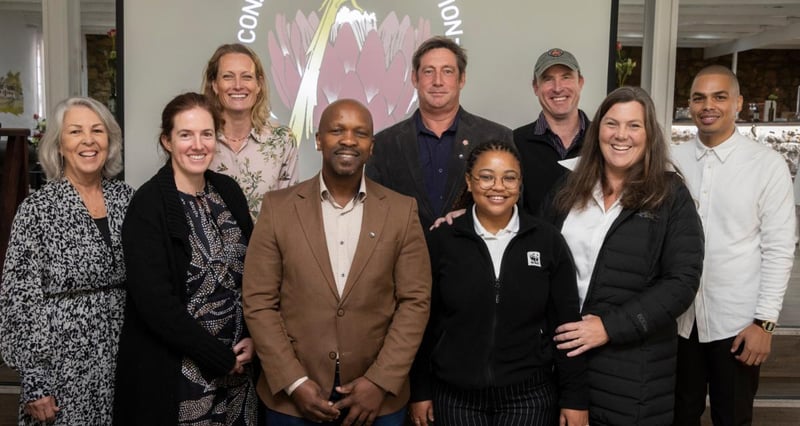
Conservation Champions gathered at Houw Hoek Hotel, Grabouw, to celebrate a powerful 20-year partnership that actively conserves 23 585 hectares of threatened Cape flora across the winelands.
The WWF South Africa’s Conservation Champion programme brought together wine farms, conservation partners and industry leaders, with Angel Campey of Smile FM as MC, bringing her energy, sharp humour and shared appreciation for nature and wine to the occasion, to celebrate:
– two decades of global conservation and wine leadership; – 60+ WWF Conservation Champion wine farms; – 23 585 hectares of natural habitat under active conservation – equivalent to almost 24 000 rugby fields.
They also gathered to look ahead to the exciting next chapter of conservation-led wine farming.
From BWI to Conservation Champions: How it all began
In the early 2000s, South Africa’s wine industry was growing rapidly, and the expanding vineyards were encroaching on the highly threatened habitats of the Cape Floral Kingdom. This pressing challenge spurred the creation of a pioneering partnership between the conservation and wine sectors.
In 2004, the Biodiversity and Wine Initiative (BWI) was established to support wine farms whose owners pledged to set aside parts of their natural land for conservation. The initiative gained remarkable momentum in its first decade: by 2015, over 90% of the South African wine industry was able to certify through the BWI and IPW (Integrated Production of Wine) partnership.
In 2016, WWF strengthened its commitment to continue advising and guiding the industry’s true environmental leaders, while also raising the environmental bar. The programme transitioned from BWI to WWF Conservation Champions – recognising and supporting leading wine farms that demonstrate outstanding conservation commitments, as well as ecotourism ambitions, and water and energy innovations.
Vergelegen Wine Estate was the first wine farm to sign up in 2005, when the programme was still known as BWI. Vergelegen remains a Conservation Champion today and has since been joined by another 59 farms, with Koopmanskloof and Zevenwacht the most recent to join.
20 years of milestones
The growth of the programme tells its own story of momentum and commitment. By December 2019 the programme had welcomed 40 Champions; by September 2021 that number had grown to 50; and today 60 wine farms proudly carry the Conservation Champion title.
Collectively, these 60 farms are conserving 23 585 hectares of natural vegetation in the Cape Floristic Region – an extraordinary achievement, with over 60% of that conserved land classified as endangered or critically endangered. Commonly called “the Cape Floral Kingdom”, this area is a global biodiversity hotspot and home to the world’s smallest plant kingdom, with over 9 000 plant species, many of which are found nowhere else on the planet.
One of the programme’s most impactful recent initiatives has been the Activation Fund, supported by incentive funding from the Table Mountain Fund, as well as contributions from Neville and the late Pamela Isdell. The Isdells have supported the Conservation Champion programme since 2019, and we are grateful for their continued commitment to supporting both the Conservation Champions and the Activation Fund.
This R50 000-per-farm funding has enabled 16 farms to undertake specific conservation-relevant projects they would otherwise not have had the resources to implement – from clearing water-thirsty invasive alien plants and carrying out ecological restoration of rivers and other important habitats, to education, ecotourism and better agricultural management. It is a tangible example of conservation and commerce working hand in hand.
What the programme means for the industry, for farms, for wine lovers
For the South African wine industry, the WWF Conservation Champion programme recognises environmental leaders and acknowledges their conservation efforts. It helps raise sustainability standards, protects unique biodiversity, and enhances the reputation and market value of South African wine on the global stage.
“There is no economy without ecology. There is no business without nature. There is no wine in your glass without nature,” said Pavitray (Pavs) Pillay, Executive Head of Business Development & Marketing WWF-SA.
For the Conservation Champion wine farms themselves, belonging to the programme provides both accountability and recognition. Eben Olderwagen, Environmental Manager at Vergelegen Wine Estate – the programme’s first member – said “For us at Vergelegen it’s all about balance. It’s not just about nature, it’s not just about people or making and selling wine, it’s how everything fits into one picture.”
The programme also positions South Africa as a global example of collaborative conservation. Mkhululi Silandela, Policy and Systems Change Lead at WWF-SA said “The Conservation Champions programme provides South Africa with a ready opportunity to be one of the frontrunners in demonstrating how conservation could be done differently.”
For wine lovers, the programme offers a simple and meaningful way to “purchase for the planet and your palate” – supporting South African wineries that actively contribute to conserving the precious Cape Floristic Region. Look for the sugarbird and protea label on the bottle. This symbol, unique to the Cape Floral Kingdom, indicates the synergy between two species, who require each other to survive. This is symbolic of the relationship between conservation and agriculture on the farms.
Looking ahead
The programme’s ambitions are expanding.
Key priorities include growing the number of WWF Conservation Champion farms in areas of high biodiversity value, creating greater ecological linkages between Conservation Champion farms and other protected areas in the landscape, and deepening the commitment to nature-positive production across all member farms.
Significantly, WWF is also exploring expansion into the fruit farming sector – a move that could extend the Conservation Champions model’s proven impact well beyond the wine industry and the Western Cape.
The programme’s vision remains clear: a future in which people and nature thrive together, and South Africa’s farmers are recognised as the custodians of some of the world’s most irreplaceable ecosystems.
“May we continue to build a nature-positive South Africa, where people and nature thrive, and may every single glass of wine from South Africa continue to not only tell a story of excellence, but of stewardship, resilience, collective action and hope,” concluded Pillay.
Get new press articles by email
We submit and automate press releases distribution for a range of clients. Our platform brings in automation to 5 social media platforms with engaging hashtags. Our new platform The Pulse, allows premium PR Agencies to have access to our newsletter subscribers.
Latest from
- Veridian Global Enables Compliant South African Hires for UK Businesses as Costs Rise
- Relate Bracelet Partnership With Tourvest Generates Income For Artisans And Flood Recovery
- Off Site Built Bridge Praised at Western Cape Economy Innovation Awards for Withstanding Annual Deluge
- Men’s Health Month Guide From Medshield Focuses on Preventative Performance
- Vincent Leygonie Retains Pro Men’s Title At South African BMX Freestyle Championship
- Phumeza Kate Scales Ilinge Lethu Bafazi Trading From Two To 12 Employees After Financial Excellence Programme
- Life Right Operator Must Respect Spousal Occupation Rights After Resident Marriage
- Authorities Warn Of Widespread Flooding And Infrastructure Damage After Severe Eastern Cape Weather
- Tsebo's Warren Miller Warns New Hires Pose Early Food Safety Risks in Catering Sector
- Stellenbosch Team Turns Academic Protein Research Into Commercial Venture With Fluorobiotech
- Petshop Science Partners With OUTsurance To Offer Free Accidental Pet Insurance Benefits
- Reliable Courier Networks Enable South African SMEs To Scale Nationally
- Saica Group Supports 546 MSMEs in 2025 With Targeted Development and Financial Expertise
- Republic of Congo To Host Second Congo Energy & Investment Forum At Kintélé In 2027
- Medical Community Warned That AI Diagnostic Insight Derives From Physicians
The Pulse Latest Articles
- The Hidden Cost Of Living Crisis Is No Longer Inflation - It Is Energy (June 4, 2026)
- Hisense Powers Up For Fifa World Cup 2026 With New Tv Launch (June 4, 2026)
- Finfind Partners With The Silulo Foundation To Expand Funding Access For Underserved Msmes (June 2, 2026)
- You Can’t Measure What You Can’t Define – Or Can You? (part 3 Of 5) (June 2, 2026)
- South African Women Are Missing This Essential Nutrient (May 20, 2026)