
Tradition Meets Technology At WMG’s Amphora Symposium Celebrating Craft And Curiosity
Written by: WineLand Media Editor Save to Instapaper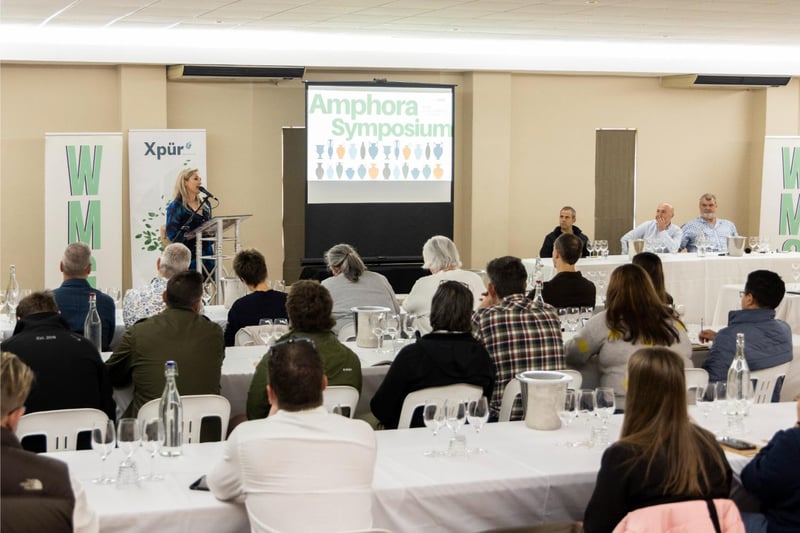
The Wine Machinery Group (WMG) recently presented its popular Amphora Symposium, which is dedicated to exploring the tradition and innovation of amphora winemaking.
In collaboration with Amorim Cork, WMG welcomed an international guest speaker for the first time – winemaker and amphora specialist Pedro Ribeiro, from Herdade do Rocim in Portugal. The symposium was also open to all amphora winemakers, not only those using Manetti amphoras for which WMG is the local supplier.
South African winemakers have been experimenting with amphora for two decades, learning as much from the failures as from successes.
The Holy Grail
Winemaker Alastair Rimmer started working at Kleine Zalze in 2014. South Africa had begun to gain a reputation for expressive wines, and he and fellow winemaker RJ Botha wanted to push the envelope. “We were on a journey of discovery, trying to build wines with intensity and texture without being overbearing and relying too much on new oak and ripeness to build volume,” he says.
Alastair describes their quest as trying to find the ‘holy grail’. “We were looking for the perfect balance of vibrance and energy, while maintaining texture and density of flavour,” he says. “Winemakers sometimes pick their grapes earlier in an effort to capture more freshness, but you end up losing intensity and flavour. You add vibrance, but lose complexity.”
Another technique to add freshness is using stainless steel tanks, but the team was concerned about diluting the intensity of wines like their barrel-fermented Chenin Blanc. And vessels like foudres or concrete tanks would require a different winemaking philosophy. “There’s a window of ripeness, and picking in the middle of that window gives you the best balance of flavours and intensity,” Alastair says. “For our Chenin, that meant quite full and rich wines.”
Their quest for freshness and intensity continued until a particular tasting where Alastair was struck by a particularly vibrant wine. The winemaker revealed it had been fermented in an amphora instead of their usual barrels. “I’d never seen such a dimension-changing impact on a wine before.”
The experience led him to order the winery’s first amphora. “It was risky, but the results spoke for themselves,” he says. “Amphoras just seem to amplify the energy of the wine.”
“Everywhere I work with amphora, I see this concentration of energy and vibrance, without the wines becoming flippant or losing intensity. There’s an undeniable vibrance to wines that have been fermented and/or matured in amphoras.”
The test of time
Amphoras are prized for their consistency and seem to maintain their properties over time, with no discernible difference between old and new vessels. They also maintain their temperatures for even maturation.
Clay seems to preserve the tension and intensity of the wine in ways that concrete and stainless steel can’t match. “In my experience, this is specifically true for white wines – whether Chenin, Chardonnay, skin-contact or no skin contact – there’s a salinity to them,” says Alastair. “It’s not an acidic freshness, like what you get from picking early. There’s a saline freshness that just isn’t there when you ferment them in other vessels.”
Ten years on, Kleine Zalze now has no fewer than 24 amphoras in the cellar. The vessels are the cornerstone of their experimental Project Z range, which was conceptualised to evaluate distinctive sites and innovative techniques for creative and commercial potential. “Don’t underestimate the value of using these vessels as tools to turn up the volume and energy of commercial releases,” Alastair says. “They also making a great blending components. Even a small percentage can turn up the volume significantly.”
Despite all these advantages, amphoras take up a lot of room and aren’t as easy to arrange efficiently as barrels. More porous examples often can’t accommodate valves and have to be emptied manually. “You have to accept you’re going to work a bit harder with amphoras, especially with larger volumes,” Alastair says. “But my experience is that it’s worth every bit of real estate we’ve had to sacrifice at the winery. That 10% gave us a lot
more value than if it had been barrels stacked in their place.”
Pedro Ribeiro, winemaker and CEO of Herdade do Rocim
Tradition with distinction
Being essentially a hand-made product means not all amphoras are created alike, and it’s important to keep quality of clay and craftmanship in mind when investing in new vessels. Some winemakers have sourced their pots and even the clay from South African potters such as Yogi de Beer, while imported amphoras enjoy the benefit of centuries of tradition and recognised provenance.
Although the traditional method of manufacturing Portugal’s large clay amphoras has been lost to the region, Pedro has been dusting off this heritage and putting their amphoras to use as a recognisable point of difference. Of the 1.5 million bottles Rocim produces each year, about 50 000 are made in amphoras. “It’s small in terms of quantity, but if you ask anyone about Rocim, they will know we make amphora wines,” he says. “Amphoras are a big part of our marketing and communication.”
The traditional method of amphora winemaking, known as Vinho de Talha, enjoys geographical protection and may only be produced in Alentejo. Its main requirement is that the wines have to be on the skins in the amphora until at least November 11, the feast day of St Martin, when the amphoras are ceremonially opened.
Pedro was instrumental in launching the country’s annual Amphora Wine Day in 2018, which invites amphora wine producers from all over the world. The event started small, with just 30 wine producers and 300 people, but has been growing steadily and in 2024 the festival drew 1700 visitors.
A long future
Thanks to renewed interest and the winemakers, modern amphora production is a booming industry. In Italy, Manetti family has been manufacturing terracotta products since the 1800s, and has become internationally renowned for its clay amphoras, which are fired at a low temperature to create a porosity comparable to a second-fill barrel.
The company recently released a new, ceramic-based amphora fired at a hotter temperature, with lower porosity for less micro-oxygenation, and able to hold fittings such as a valve or sparging tap.
For winemakers, these vessels offer something new and exciting. “I think we’re just scratching the surface of what this tool can do,” Alastair says.
Get new press articles by email
We submit and automate press releases distribution for a range of clients. Our platform brings in automation to 5 social media platforms with engaging hashtags. Our new platform The Pulse, allows premium PR Agencies to have access to our newsletter subscribers.
Latest from
- 7 Business Trends Your SME Can Leverage In 2026
- Sadilar Amplifies Visibility And Impact During Conference Season
- Future-ready Logistics- 5 Shifts TO Watch In 2026 (SUB-saharan Africa)
- Dunlop Urges Motorists To Prioritise Tyre Safety On The Busy Joburg To Cape Town Festive Route
- Poverty Trends Report Shows National Progress But Flags Growing Challenges In Gauteng
- SDG Challenge SA 2025 Highlights The Power Of Youth Innovation In Shaping A Sustainable Future
- Experienced Industry Leader Pauli Van Dyk Named Dean Of AFDA’s Upcoming Hatfield Campus
- South Africans Keep Tourism Alive As Homegrown Travel And Local Spending Rise
- Pretoria Student Wins Global Excel Esports Competition
- AfDB Steps Up Support For Somalia With $76m Investment In Roads And Regional Integration
- Corporate Law Experts Warn Directors Of Serious Consequences For Improper Transaction Approval
- New 3% Inflation Target Begins To Shift Expectations In South African Economy
- Retail As A Development Catalyst Drives New Africa Developments’ Inclusive Growth Strategy
- Collaborative SEF Model Shows How Civil Society And State Can Rebuild Economic Trust
- Shumani Accelerates Industrial Growth With Bheka Forklifts And New Equipment Plans For 2026
The Pulse Latest Articles
- Education Is The Frontline Of Inequality, Business Must Show Up (December 11, 2025)
- When The Purple Profile Pictures Fade, The Real Work Begins (December 11, 2025)
- Dear Santa, Please Skip The Socks This Year (December 10, 2025)
- Brandtech+ Has 100 Global Creative Roles For South African Talent (December 9, 2025)
- The Woman Behind Bertie: Michelle’s Journey To Cape Town’s Beloved Mobile Café (December 9, 2025)